


Institute AGM and Midland Branch Technical Meeting

Institute AGM and Midland Branch Technical Meeting

On Monday 22nd November 2021, the Institute of Corrosion held its Annual General Meeting.  This was an unusual year in that the AGM was on Monday instead of Thursday and this was the first “hybrid” AGM, with both in-person attendance and live streaming for those who could not physically attend. As ICorr Council had found with the 2020 AGM which was held virtually, this provided an opportunity for many more people to participate in the AGM. This year people joined the day’s events from as far away as Vietnam.

The in-person event took place in the Motorcycle Museum at the NEC in Birmingham, and the ability to look around the museum during the breaks was one of the attractions of the venue.  All of the motorbikes were presented in gleaming condition and not a trace of corrosion anywhere. For those of us who always seem to be working with the “before” stage with corrosion, it was good to see the “after” condition with all parts restored, holes filled in and intact paint work.

The programme for the day was organised by the Midland Branch and began with an introduction to the training and courses that are currently offered by ICorr and the courses which are given through the Institute’s training partners. There were also three excellent technical presentations which certainly raised the awareness of the current status in those areas.  Midland Branch would like to thank the ICorr speakers Chris Spence, Richard Edwards, John Fletcher and Kevin Harold for contributing to and delivering informative presentations on our current training and certification programmes, as well as our industrial speakers, Ian Southerton, Prafull Sharma and Jack Cornes for contributing to and delivering informative presentations.

The AGM itself was efficiently chaired by the President, Bill Hedges, who reminded us all that despite all the difficulties that the covid situation has caused, and in some areas is still causing, corrosion does not stop for pandemics, and that many ICorr members have continued to be extremely busy and this is reflected in the membership and the strong position of the Institute.

Tony Collins, our Honorary Treasurer presented the accounts and these reflected the healthy position of the Institute. Careful protection and investment of the funds was crucial in the current climate, and Tony was thanked for this prudent management.

The list of proposed Trustees and Council members for 2021 to 2022 was shown to the attendees, and all of the proposed were accepted unopposed. The President noted that Trevor Osborne had decided to stand down.  Trevor was thanked for his immense contribution to ICorr, for organising and supervising the refurbishment of Corrosion House, managing the investment of ICorr funds (which were growing ahead of inflation), and for being a steadfast member of committees and a wise voice on Council.

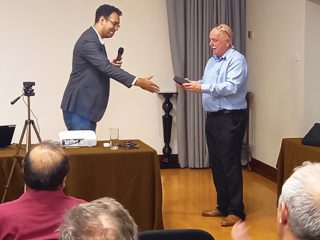
The final activity for the AGM was the presentation of the H.G. Cole award.  The award was given posthumously to Dr Bill Cox in recognition of his many years of service to the Institute.

Brian Wyatt gave a short speech about the award itself and explained why Bill Cox had been selected.  This award has only been made to 4 people since its first recipient, Charles Booker, in 1997. Later recipients included Fed Palmer and Roger Hudson. The requirements for the award are:

• A long-term and consistent history of exceptional commitment to ICorr

• A contribution to enhancing the reputation and standing of ICorr

• To have enhanced the ability of ICorr to improve corrosion prevention and control, on a national and/or international basis, by sponsorship of innovation and/or the support of ICorr training and certification

• To have directly improved the fiscal position of the Institute and/or its offices and/or accommodation

Bill fulfilled these in spades!  Within ICorr, Bill was President (1996 to 1998), a member of Council for 20 years, a member of the Training and Certification Governing Board for 20 years, a member of both the Membership Development and Awards Committees, and he organised successful (and profitable) conferences and seminars on corrosion monitoring and related subjects.

He was critical of those who found it easier to spend ICorr’s funds than to help raise them. He was strong, technically very competent, honest and direct.

This award is particularly appropriate as Bill know Henry Cole well; as Bill started his career Henry was one of his mentors and in later years they would occasionally lunch in London. He is a worthy recipient.

As the fifth recipient of the award,  Bill’s wife Anna and daughter Ella were present to receive the award from Brian Wyatt, and Anna Cox thanked the Institute for the award.

As there was no further business or questions from the attendees, the 2021 AGM was formally closed.

The day was considered a resounding success as a hybrid type attendance with in-person attendees and remote access to our members via Webinar.  Special thanks to all members who attended, and all of the members who made this event possible.


Latest News from London Branch

Latest News from London Branch

There was plenty of anticipation for the first in-person technical presentation of the branch since early 2020, a joint meeting with the London Materials Society (the London Branch of IoM3), which was held at the Lancaster Hall Hotel in London. The presentation was also streamed online for those who could not get to London- This was the first time such a hybrid technical talk has been held.

The presentation was delivered by Stephen Shapcott CEng FIMMM MICorr to mark his stepping down as Chair of the London Materials Society (LMS) and was titled, “Meeting Todays Materials Challenges to Enable Low Carbon Hydrogen Production at Scale”.

His presentation began by saying that many countries have made commitments to reduce environmental carbon emissions, and that the UK government has set in law the world’s most ambitious climate change target, cutting emissions by 78% by 2035 compared to 1990 levels. Stephen commented that for countries that are heavily reliant on the use of natural gas to meet the required reduction in carbon dioxide (CO2) emissions, they will need to choose and adopt low or zero carbon technical solutions.

Stephen explained that the UK government are investing in multiple hydrogen (H2) projects to replace much of the current uses of natural gas (methane, CH4), this is because when hydrogen is used as a fuel it does not emit CO2 at point of use, but also because of the versatility of hydrogen for heating, industry, transport, and energy storage. One such project is Hynet in the North West of England which plans to use advanced steam methane reforming combined with Carbon Capture, Utilisation and Storage (CCUS).

Steam-methane reforming takes methane and steam and converts them into hydrogen and carbon dioxide. The main differences between traditional steam-methane reforming technologies verses advanced reforming technologies, which use an Autothermal Reformer (ATR) or a combined Gas Heated Reformer (GHR) and ATR, were covered in the presentation. The traditional vs GHR + ATR routes were compared, showing the higher efficiencies and lower capital cost of GHR + ATR.

The remainder of the presentation focused on the material’s damage mechanisms in the core gas reforming section of both a traditional steam-methane reforming flowsheet and that of a typical GHR + ATR design. The damage mechanisms covered were High Temperature Hydrogen Attack (HTHA), Refectory Degradation, Steam Blanketing leading to Short Term Overheating and Stress Rupture, Creep, High Temperature Oxidation, and Metal Dusting (metal dusting is a destructive form of corrosion that occurs when susceptible materials are exposed to environments with high carbon atmospheres, and leads to the disintegration of the structural metal into dust composed of fine particles of the metal and carbon).

Stephen explained that most of the damage mechanisms in advanced reforming are widely understood and able to be designed for using established practices, however metal dusting is not one of them. Materials and corrosion engineering are central to managing the risks of metal dusting. Therefore, materials and corrosion engineers with deep experience and understanding of metal dusting are critical to GHR + ATR designs, as demonstrated experience not only ensures suitable equipment lifetimes, but also ensures reliability and operating efficiency. The UK was the location of the first GHR + ATR design as part of the ICI Leading Concept Ammonia (LCA) flowsheet at Severnside that was operational for over 20 years, making the UK a world leader in GHR + ATR technology.

There was an active Q&A from the audience both in attendance and online from around the globe. The presentation concluded with Stephen thanking ICorr and LMS for hosting the event and he presented the new Chair of LMS, Caroline Allanach, with the Chain of Office.

This first hybrid event was considered a success with 60 people attending, roughly half in person and half online, including from overseas, with some from UAE and Pakistan.

The November meeting featured an interesting presentation from Alex Garner, Corrosion Services Ltd, entitled “Lessons learned from 40 years in corrosion protection”.  As in the previous month, this talk was held in person and online.

Alex described the highs, with brief mentions of the lows, of his 40-year career in corrosion protection, including CP, material selection, coatings and insulation, for a wide variety of onshore and offshore facilities. His journey started in 1980 and he covered the technical and social challenges of office and site -based work in Europe, Middle East, Asia, Canada, South America, and Australia. as well as the corrosion protection peers encountered over the years, many of which are now his friends. This anecdotal presentation highlighted the pleasures and technical excellence that can be achieved in this industry and Alex hoped that it would encourage younger people tp take up a career in the corrosion protection industry, and not scare too many away from it. 

45 people, roughly 50/50 in person/online, attended this very interesting presentation from an experienced practitioner in the field of corrosion protection. 

The next meeting of the branch will be on 13thy January 2022 when Dimitrios Mamalopoulos from Cescor UK Ltd will present on. “Life extension of offshore platforms, through retrofit CP design assisted by modeling”. Again, it is intended to hold this in person at the usual venue, Lancaster Hall Hotel, Bayswater, London, and online vie Teams.  Final details will be posted on the diary page of the ICorr website.

Young Engineers Programme (YEP) 2022

Young Engineers Programme (YEP) 2022

Following the great success of its 2018 and 2020 Young Engineer Programme in London, the Institute of Corrosion will now be running a YEP from January to November 2022, in Aberdeen.  The ICorr Young Engineer Programme (YEP) is second to none and delivers a technical competency framework that’s consistent with the Institute of Corrosion’s aims and professional standards, to help prepare graduates for entry into the Corrosion Science and Engineering industries, with a broad range of knowledge. As well as providing an opportunity to network with like-minded professionals, the programme offers participants a solid foundation and a stepping-stone, as the first stage in achieving MICorr and CEng status.

This is a training programme aimed at young Engineers (graduates) from a range of disciplines who have a specific interest in Corrosion Management.

The programme consists of a series of mainly evening lectures spread out over a 12-month period with required attendance every month from January to November. In May 2022 the group will be split up into teams and appointed a mentor to assist them with a Case Study which will be a real corrosion problem that has required a solution. Each team will then present their case study to the Institute of Corrosion at the Aberdeen Branch meeting in November with invited guests from academia and industry. Each presentation will be judged, and the winning team will be awarded an expense paid trip to the AMPP 2023 Conference (formerly NACE) in USA.

Application for participating in this programme is now closed and the committee are in the process of selecting and enrolling around 20 participants.

Lecturers, mentors and organisations supporting the programme will all be professional volunteers however, we are still looking for sponsors to cover the following costs (fully or partially),

1. A second award for one engineer as selected by the judges due to their outstanding performance (one award is already sponsored by BP).

2. Sponsor for the venues / catering in Aberdeen for 9 lectures and competition event.

The YEP 2022 sponsors logo will appear on all the programme materials, including, posters, flyers, training material and application forms distributed to the companies in the ICorr mailing list.

Any interest in sponsorship, or queries, should in the first instance be addressed to: Hooman Takhtechian, Aberdeen Branch Chair,  HTakhtechian@oceaneering.com

Latest news from Aberdeen Branch

Latest news from Aberdeen Branch

The branch held a joint technical meeting with TWI Scottish Branch on 28th September where the speaker, Matthew Beatty from Sonomatic Ltd. discussed “In-service ultrasonic tank floor inspections”.

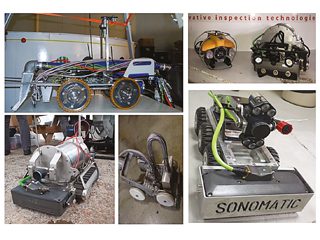
As described below, Sonomatic have developed an advanced system of robotic instrumentation and associated test procedures which can be used to inspect storage tanks while still in service. The instrumentation can easily navigate tank floors and using ultrasonic techniques (UT), measure the remaining through floor plate thickness, detecting both product side and soil side corrosion. From this, the remaining useful life of the tank can be determined by comparing this with the minimum containment thickness criteria for the vessel.

Desludging of tanks is performed during the measurement process as it is essential that the robot has a clean surface to make the measurement, and obtain good and reliable data. This is by done by either pumping sludge away within the tank, or pumping sludge out of tanks into containers for recycling or filtering and return. The inspection process can extend to survey tank shell walls and roof, annular plates and shell to floor welds using ultrasonics techniques.

Two main ultrasonics techniques are commonly used; (1) Short-range ultrasonics (SRUT) for features such as,

• Tank floor annular plate testing

• Testing concrete coated interfaces

• Testing under pipe supports

• Tank dyke piping interfaces

• Under vessel supports

and (2), Multiplexed phased array UT (PAUT) for the shell to annular plate weld inspection, and to  assess the condition of the internal and external weld (for cracking particularly).

Acoustic emission (AE) can be used to scan the floor for active corrosion prior putting the robot into the tank.

The robots deployed for the inspection are dependent on the tank media content and the accessibility. A hydraulic driven robot is used for heavy to light hydrocarbons and a mini ROV swimmer is used mainly in water tanks. Survey robots are fitted with hydraulic pumps and scrappers to remove sludge and sediment and clean the surface ready for ultrasonic work. All robots have safety systems and monitor critical items such as oxygen and nitrogen pressure through the umbilical and can automatically shut down power at alert safety levels.

For inspections, the robot is lowered through a deployment manway using a tripod and winch system to the tank bottom and connected back to the control room through a tailored sealed temporary manway cover. Finally, the tank is purged and pressurised.

The ultrasonic probes used have a range of diameters from 8mm up to 300mm total coverage and are typically arranged in an array of around 30 probes which speeds up the scanning process and makes data more reliable.

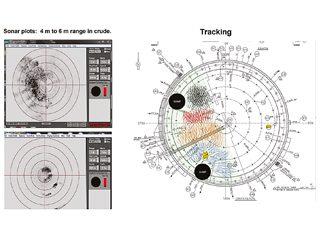
A case study was presented of a detailed in-service inspection of an 80 metre diameter tank with known corrosion. Acoustic emission was used first to check 100% of the tank for ongoing corrosion signs. With the robot deployed the sludge was displaced by suction pump and a rubber scraper to remove surface sludge.This inspection used a total of 521 scans, representing 5% coverage of tank base. The sampling methods and statistical analysis allow for limited coverage inspection so there is no need to inspect 100% of features. With the in-built ultrasonics, in this instance which used 8 transducers with amplitude variation across each transducer, the min thickness found was 4.8mm compared with the nominal thickness of 7mm, which gave an estimated remaining life of 2 years before an out of service inspection was required. After shutdown 3 years later, the floor thickness was confirmed to be 2.20 mm versus a predicted 2.53mm from in-service inspection, a <5% difference between the two methodologies which is considered an accurate and successful prediction compared with manually performed UT readings.

The accuracy of the predictive system using the in-service data illustrated that robotic inspection of the tank floor is a viable alternative to costly shutdown and out-of-service inspection.

The branch October meeting featured an interesting online talk from Professor Y. Frank Cheng. University of Calgary (UoC), entitled “Internal corrosion of pipelines: mechanisms, modelling and management”.

Internal corrosion of pipelines is a complex phenomenon, and the complexity arises from the fact that multiple chemical and electrochemical reactions occur simultaneously with numerous interrelated factors affecting the corrosion processes. A fundamental understanding of the phenomenon is essential to modelling, prediction and management of the corrosion processes, providing recommendations to industry for improved pipeline integrity management.

Currently, pipelines for oil and natural gas are the conduit for around 55% of energy transport and, despite the rise of renewables and net-zero targets, they will still be utilised for a similar amount of energy transportation when H2, CO2 and biogas gain in popularity. For oil and gas transport, the upstream ‘gathering’ pipelines which run from production to the upstream processing plants are the subject of interest here. Of course, the corrosion issues in different sectors of the pipeline system can be very different due to the product being carried and the internal environment. In upstream gathering lines within Alberta in 2019, 46% of the corrosion issues were deemed to be due to internal corrosion alone.

Multiple factors affect the corrosion process, including fluid chemistry, operating conditions and pipe geometry. To deal with the complex issues it is important that computer models take into consideration each of these factors, and study each of the key parameters, reaction chemistry, fluid hydrodynamics and configuration, so as to produce a workable model which will realistically predict the corrosion outcome.

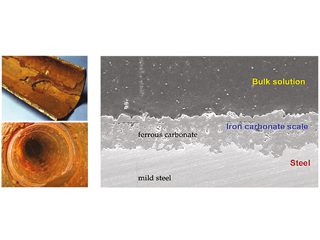
The UoC initially developed a thermodynamic model to determine the electrochemical anodic and cathodic reactions occurring during internal corrosion of pipelines under given conditions, and the chemical reactions (for instance CO2) occurring during electrochemical cathodic (evolution of gas) and anodic reactions (at the steel oxidation). The internal corrosion involves the formation of iron carbonate scale on the surface which changes the corrosion rate. When H2S is also introduced there are competing reactions with CO2, which further complicate the outcome.

For the chemical reactions they derived the reaction equilibrium constants and for the electrochemical reactions calculated the standard electrode potentials by Gibbs free energy and determined partial reaction potentials by the Nernst equation.

Fluid hydrodynamics plays a critical role in influencing corrosion, so studies were conducted by fitting electrodes flush with the inside pipe walls at straight and angled positions to measure corrosion rate with flow and with impingement angle to the pipe wall. Other effects that were incorporated in the flow model were the inhibitive effect of the hydrocarbon oil phase and the erosive effect of inorganic sand and solids.

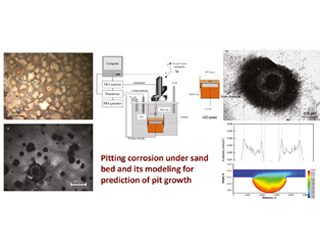
Another consideration for UoC modelling was the organic acid that is always part of the fluid in upstream hydrocarbon pipelines and which will attack the iron carbonate film which readily forms on the inner walls of the pipe. The scale builds faster with higher CO2 and temperature but, when the FeCO3 scale is broken locally at a defect, this leads to pitting corrosion under the scale and can lead to accelerated attack and leaks in pipeline walls. Pitting corrosion also occurs under sand layers which settle on the pipe floor from the high upstream sand concentration in the oil sand.

The final and possibly greatest issue in oil pipeline corrosion was determined as internal microbial corrosion which is believed to be responsible for ~ 40% of all internal corrosion events in pipelines. Microbial Corrosion occurs under any deposit mixture of petroleum sludge, sands, water microorganisms and corrosion. Internal operating environments encourage growth of the microbial population products. However, in the case of gas pipelines a thin layer of water condensate occurs on the chilled wall of the pipe which makes the formation of biofilms difficult and the deposit of corrosion films more favourable, so there is a competition between the two effects.

Several predictive corrosion models have been developed from the experimental studies of parameters and mathematical relationships, and these UoC models can assist in identifying critical corrosion locations, especially pitting and erosive corrosion on a long-distance pipeline, then predict the pitting corrosion rate and pitting growth rate, however corrosion mitigation and control by operators should not rely on inhibitors and biocides as they are not a totally satisfactory solution and periodic pigging is still required as main method of control in removing and reducing deposits and sludge.

This very comprehensive presentation generated much interest from the audience and many questions that were expertly responded to by the author.

Slides of technical papers for Aberdeen branch events, along with their respective Q&A’s can be found at, https://sites.google.com/site/icorrabz/ and also at Aberdeen Branch – Institute of Corrosion (icorr.org) under Local Technical Programme. A library of event recordings may also be found at:

https://www.youtube.com/results?search_query=ICorr+Aberdeen

New Sustaining Company Member

New Sustaining Company Member

OAG International UK LTD

OAG International UK LTD is a worldwide service provider offering solutions in Coating, Industrial and Custom Coating, Welding and NDT to customers and clients in the following sectors:

• Oil and Gas (Onshore, Offshore & Subsea)
• Renewables
• Utilities
• Refinery
• Nuclear
• Marine
• LNG

OAG started off as a project management and technical support service provider for the oil and gas industry in 1999, and which later evolved into providing pipeline coating services to EPC clients around the world. They then expanded their business further to provide a complete solution to the offshore and onshore pipeline coating, inspection, welding services, and most recently industrial and custom coatings markets.

OAG operates from regional locations in Asia Pacific, Middle East, and The Americas, for which they have now expanded to Europe and Africa.  To support this expansion, OAG have established a new state of the art regional location in Merseyside, United Kingdom, where they will continue to offer their conventional services and newly introduced services to cover their global portfolio of customers and clients.

OAG also offers Train the Painter courses as an affiliate member with the Corrodere Academy to cater for the ever-demanding needs for coating personnel in all market industry sectors.

ICorr Awards – Call For Nominations

ICorr Awards – Call For Nominations

Each year the Institute of Corrosion bestows a range of internationally renowned awards in recognition of excellence in corrosion science and engineering, and to reward outstanding service to the Institute and the wider corrosion community. Many of these awards are open to nomination by both members and non-members of the Institute. Below is a brief description of each award together with details of how to nominate potential candidates.

U.R. Evans Award
The U.R. Evans Award is the premier scientific award of the Institute of Corrosion and is presented annually for outstanding international achievements in pure or applied corrosion science.  The recipient is selected by a Corrosion Science Division panel and presented with an engraved sword at the annual Corrosion Science Symposium (CSS). 
The symposium is one which seeks to encourage the participation of the junior members of the corrosion community who would appreciate the visit of, and address by, a corrosion scientist of international repute.  The form of the award symbolises the fight in which we are all engaged.  The recipient is also granted Honorary Life Fellowship of the Institute.  Nominations may be submitted at any time via email to the CSD Chair, Julian Wharton (j.a.wharton@soton.ac.uk).

Paul McIntyre Award
The Paul McIntyre Award is presented to a senior corrosion engineer,
who, as well as being a leading practitioner in his field, has advanced European collaboration and international standards development. 
The award consists of an engraved trophy, which is presented at the
annual CED Working Day meeting. The recipient is requested to present
a brief overview of their activities and encouraged to prepare an article
for publication in Corrosion Management. Nominations should be submitted to the CED Chair, Nick Smart (nick.smart@jacobs.com), by 28th February 2022.

T.P. Hoar Award
The T.P. Hoar Award is presented to the author(s) of the best paper published in the scientific journal Corrosion Science during the previous calendar year. The winning paper is selected by a sub-committee of the Corrosion Science Division and the author(s) receive a certificate and a
cash sum of £400.

Galloway Award
The Galloway Award is presented to a student author for the best publication describing original research in corrosion science and engineering as judged by a sub-committee of the Corrosion Science Division.  The student should be the primary author of the work and preferably first author.  A summary of the winning paper is published in Corrosion Management and the prize consists of a certificate and a cash sum of £300.  The Institute does not retain copyright of the material, so this does not prevent separate publication of the work in a scientific journal. Submissions (in the form of a paper published within the past 12 months or a draft publication) may be
sent via email at any time to the CSD Chair, Julian Wharton
(j.a.wharton@soton.ac.uk). Supervisors may nominate students.

Lionel Shreir Award
The Lionel Shreir Award is given to the best student presenter at the annual Corrosion Science Symposium.  Selection of the recipient is carried out by a sub-committee of the Corrosion Science Division. The award consists of a certificate and a cash prize of £125.

For further details on the Institute awards, including lists of past recipients, please visit https://www.icorr.org/icorr-awards/