
The cart is empty!
London Branch Meeting 11 March 2021
Below is the recording from the London Branch meeting from the 11 March with The President, Dr. Bill Hedges.

Below is the recording from the London Branch meeting from the 11 March with The President, Dr. Bill Hedges.
ISO
The following documents have obtained substantial support during the past two months and have been submitted to the ISO member bodies for voting, or formal approval.
ISO/DIS 2080 Metallic and other inorganic coatings — Surface treatment, metallic and other inorganic coatings — Vocabulary (Revision of 2008 standard)
ISO/FDIS 22848 Corrosion of metals and alloys — Test method for measuring the stress corrosion crack growth rate of steels and alloys under static-load conditions in high-temperature water
ISO/DIS 23721 Corrosion of metals and alloys — Rating method by appearance of rust and stains of atmospheric corrosion for stainless steels
New international standards published during the past two months.
ISO 14571 Metallic coatings on non-metallic basis materials — Measurement of coating thickness — Micro-resistivity method
ISO 15156-1, 2, 3 Petroleum and natural gas industries — Materials for use in H2S-containing environments in oil and gas production — Part 1: General principles for selection of cracking-resistant materials, Part 2: Cracking-resistant carbon and low-alloy steels, and the use of cast irons, Part 3: Cracking-resistant CRAs (corrosion-resistant alloys) and other alloys
ISO 19902 Petroleum and natural gas industries — Fixed steel offshore structures
ISO 21716-1, 2, 3 Ships and marine technology — Bioassay methods for screening anti-fouling paints — Part 1: General requirements, Part 2: Barnacles, Part 3: Mussels
ISO 23221 Pipeline corrosion control engineering life cycle — General requirements
ISO 23226 Corrosion of metals and alloys — Guidelines for the corrosion testing of metals and alloys exposed in deep-sea water
CEN
Previous ISO standards now issued by CEN.
EN ISO 15156-1, 2, 3:2020 Petroleum and natural gas industries – Materials for use in H2S-containing environments in oil and gas production – Part 1: General principles for selection of cracking-resistant materials, Part 2: Cracking-resistant carbon and low-alloy steels, and the use of cast irons, Part 3: Cracking-resistant CRAs (corrosion-resistant alloys) and other alloys.
EN ISO 18086:2020 Corrosion of metals and alloys – Determination of AC corrosion – Protection criteria (ISO 18086:2019)
This document specifies protection criteria for determining the AC corrosion risk of cathodically protected pipelines. It is applicable to buried cathodically protected pipelines that are influenced by AC traction systems and/or AC power lines. The document does not cover the safety issues associated with AC voltages on pipelines. These are covered in national standards and regulations (see, e.g., EN 50443).
PCE-International is a leading quarterly publication focussing on the booming international protective and marine coatings markets. It creates a global dialogue between suppliers, engineers, contractors and the coatings end user. This includes bridges, ships, oil and gas facilities, offshore platforms, power facilities, transport and every type of industrial plant.
PCE-international provides insight, analysis and news of the latest on new technologies and innovations, regulations and good practice.
PCE-International regularly covers the issues critical for obtaining good coating application and practice, such as surface preparation (via both UHP & abrasives), testing, training and improved access.
The objective of this new work was to develop and evaluate experimental approaches using different analytical techniques to measure the permeability, diffusivity, and solubility of water in model coatings.
These properties are of primary relevance in studies of coatings for corrosion protection. For water permeation measurements, test rigs were designed and prepared to facilitate measurements by microcalorimetry, gravimetry, and thermogravimetric analysis. For sorption measurements, films were prepared in various thicknesses to allow a proper analysis with Fourier-transform infrared spectroscopy in transmission mode and gravimetry. All methods were successful in determining water uptake kinetics.
The work was published in Journal of Coatings Technology and Research, Volume 17, 2020.
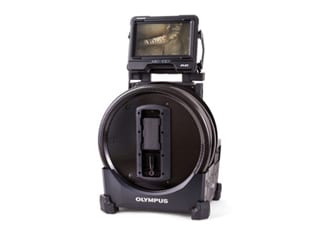
The interior of pipelines that carry hazardous material are commonly inspected for corrosion and other defects using videoscopes. Long, complex piping is especially difficult to navigate and inspect because of complex bends and potential obstructions. TheIPLEX™ GAir long scope from Olympus, combines maneuverability with high-quality, wide-view images to make complex pipe inspections fast and efficient, at distances up to 30 metres with outstanding image quality.
According to the company, the videoscope’s unique guide head enables it to slide easily through pipe joints while pneumatic articulation provides fine control, even when the 30 m insertion tube is fully extended. To enable easy inspection, a gravity sensor automatically rotates the onscreen image regardless of the scope’s orientation, while the insertion length indicator tracks how far the videoscope has been extended.
For dangerous or hazardous inspections, such as inside nuclear power plants, users can set up the videoscope and control it from a safer location up to 100 m away. The videoscope’s touch screen can be detached from the main unit and positioned up to 5 m, while wireless capabilities make it easy to share screen images with colleagues, concluded the company.
Intumescent coatings are a great alternative for passive protection of metal substrates against fire, with the binder polymer being one of the main components of the system. The objective of a recent work was to compare five different resin types (epoxy, acrylic, alkyd, silicone, and silicone–epoxy hybrid) in an intumescent formulation and to study the influence of resin concentration on the fire protection performance of the coating.
Results from TGA and MCC analysis of resins and coatings indicated that coatings containing silicone are thermally stable and release smaller amounts of heat. In the fire resistance test, samples containing epoxy and silicone resins had lower temperatures (130–160°C) compared to the other samples. It was also found that it is possible to decrease resin concentration in formulations containing epoxy and silicone resins by up to 25.6% and to maintain or even improve their fire protection capability.
The study was published in Journal of Coatings Technology and Research, Volume 17, 2020.