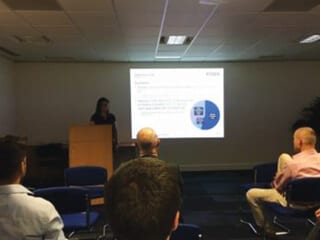
The first meeting of 2017 was held on Tuesday the 31st January, with 49 attendees from local Aberdeen based companies. The first guest speaker of the evening was Sarah Vasey, the new ICorr President.
Sarah enthusiastically explained the Institute’s plans for improvement of the bi-monthly journal – Corrosion Management (CM), which is being re-launched in a new format with greater technical content and extended papers, together with improvements to the ICorr website. Sarah made it clear that training would become a key focus for the Institute, with improved professional development for members towards Chartered Engineer status. At the end of the evening, Sarah met with all the members of the Aberdeen Committee, many of whom have more than 5 years’ service with the branch.
The technical presentation followed with, Dr Nadimul Faisal and Dr Ghazi Droubi, both lecturers at the School of Engineering, Robert Gordon University (RGU) in Aberdeen, who outlined the main goals of their current research programme into the potential for Acoustic Emission (AE) to detect both cracking and corrosion activity.
Acoustic emission is essentially a non-destructive technique where a test sample is subjected to a stress condition, under which, crack growth, local yielding and corrosion product fracture may occur, resulting in a sudden release of energy that can be detected by transducers.
The speakers described their recent findings from a range of RGU experiments, including those on thin aluminium and steel plates in different corrosive environments.
It is important to note that the AE from corrosion usually releases much less energy than emission from crack growth, and so is more difficult to detect in the field, however the results present a trend (as an exponential curve) between the concentration of the corrosive environment and the energy of the acoustic emission signal.
AE only occurs when corrosion scales fracture and corrosion needs to be active, although the presence of inactive / previous corrosion may be found by causing the scale to fracture by changing the strain sufficiently in the base material.
An extensive range of questions followed from the large audience during which the practical application of AE within the energy sector was further explored. Generally the role of AE was perceived as being in support of other NDT technologies and for specialised applications such as inspection of tank floors, and occasionally for critical components of high value, or high production impact.
The February meeting, held on Tuesday 28th, had over 50 attendees from local companies, and the guest speakers were, Dr Jake Davies of Permasense HQ, and his Aberdeen based Technical Support colleague Gary Wallace, who had recently joined from ConocoPhillips UK Production Well Integrity Division.
This most informative evening was entitled “Monitoring High Temperature Corrosion Attack: Correlation between Corrosiveness and results from Online Corrosion Monitoring”.
The speakers presented a wide range of successful Permasense wall thickness monitoring applications, from Upstream, Midstream and Downstream Energy Sector Operations, developed over a period of more than 10 years in partnership with BP and Imperial College London.
They emphasized the need to continuously gather quality real-time data to allow accurate determination of the rate of internal damage to key production components, operating under high temperature, high pressure and variable flow conditions.
It was pointed out that more traditional and less automated methods may provide over-cautious and sometimes unreliable information, owing to their reduced sampling frequency, manual nature and limitations on safe access. The availability of enhanced pipe wall data from all sources, can raise confidence levels, facilitate longer service intervals, and minimize production losses. A large number of case studies were used to illustrate these points and the potential gains from such systems.
It was emphasised however that all truly holistic inspection regimes utilize a full range of intrusive and non-intrusive devices for fluids and solids management to ensure continued safe operation of ageing assets. As with other complimentary monitoring devices, a recent key change in the application of such technologies has been the huge advances in wireless data transmission, greatly improved battery life and much improved integration with plant control systems, to provide ‘side by side’ data that is now much more meaningful to integrity specialists.
The closing question and answer session covered many diverse topics that truly demonstrated the value of evening, the level of interest and its excellent speakers. A wide range of Clamped and Magnetic wall thickness monitors were then made available for the audience to inspect.
For information about the Aberdeen branch activities please contact the branch secretary, Frances Chalmers, ICorrABZ@gmail.com, alternatively a calendar of local events of interest to corrosion professionals in the Aberdeen area, and the opportunity to sign-up to the branch mailing list, is available at https://sites.google.com/site/icorrabz/home.
North East Branch – The branch held its first event in 2017 on 21 February, which was hosted by ROSEN UK at its offices at Quorum Business Park, Newcastle upon Tyne. About 20 people attended the event and had an opportunity to learn about Flow Modelling and Flow Assurance through two presentations.
The first presentation, titled “Introduction to Flow modelling and Flow Assurance in Oil and Gas Industry” was delivered by a senior flow assurance engineer at ROSEN UK, Mr. Ashwin Pinto. His presentation discussed the basic concepts and methodology behind the
flow assurance, whilst also highlighting advantages of undertaking flow analyses to better understand performance of production systems, optimize oil and gas operations, and improve system designs.
The second presentation was given by Marguerite Forde, a senior engineer at ROSEN UK, entitled “Optimization and Validation of Internal Corrosion Direct Assessment – Prediction vs. Reality”.Ms Forde presented a case study focused on (i) demonstrating the accuracy of predicted corrosion rates vs. those rates experienced by pipeline assets in reality and (ii) utilization of available direct inspection results to fine-tune corrosion models to predict the condition of sections of the pipeline which cannot be inspected directly.
This year, the branch will hold a summer event on 6th July 2016 at Hatfield College, Durham University, when Professor Jon Glyuas, Durham University, will give a presentation on “Energy past, present and future”. The talk will examine the national picture for energy supply and demand, identify the risks, and then comment on what the UK can do to improve its energy security in the long term.
The evening starts at 17.00, with a tour of Durham Castle at 17.30, followed by the presentation, and a buffet and drinks from 19.30, together with time for networking.The costs are £5 for members and the first 10 students registered, and £10 for non-members. A Registration form will be available on the ICorr website, and as there are limited spaces, early booking is advised.
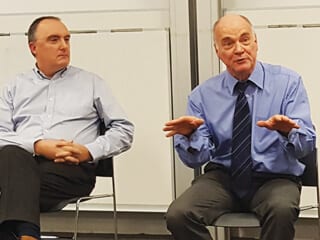
London Branch – The Branch began the New Year by welcoming the “Three Wise Men”, Alan Denny, AKD Materials Consulting, Bill Hedges, BP, Corrosion Engineering Technical Authority and Steve Paterson, Shell (Amsterdam), Principal Technical Expert Upstream Materials, who gave a presentation entitled ‘The Past, Present and Future of Corrosion’.
Alan Denney illustrated his past experience with numerous and far reaching projects and corrosion problems, including reinforcement corrosion in buildings, graphitic corrosion of cast iron, the use and misuseof Cor-Ten steel, the use of duplex stainless steels in architectural demanding buildings together with a number of issues in the oil and gas industry. Bill Hedges then looked at what the corrosion industry was doing well, such as technical development, networking and training, risk assessments, corrosion modelling, effective corrosion barriers and management systems. He then stated that opportunities for improvement existed in, attracting the next generation of engineers, project cost control, corrosion monitoring and inspection, sharing of knowledge across the industry, and the adoption of common standards. Steve Paterson detailed key future challenges including an ageing infrastructure, marginal field development, dealing with high pressures and temperatures, extreme environmental conditions, materials for sustainable energy together with the development of artificial intelligence, commercial acumen and a greater awareness of risk/probability.
Following the presentations, the 45+ attendees participated in a question and answer session which particularly discussed the way to attract young people into the industry who will be innovative and creative and use good judgement in the use of corrosion protection. On 9th February, the Branch met to enjoy a technical presentation entitled ‘Corrosion Inhibitor Testing – The Journey’ given by George Winning; corrosion specialist for Element Materials Technology.
George began his presentation with a quick review of the 70 year history and development of chemical products, the study of the inhibitor mechanisms, together with some of the key characteristics an inhibitor should have, to ensure that they will work for a particular oil and gas system. The presentation looked at the many tests that are needed to be carried out to identify the correct product for a system, and how a set of tests may vary between an application in low oil cut systems through to high water cut systems, and the different tests required for gas systems.George made particular reference to the problems associated with the effects of flow, the difficulty of achieving full inhibition where ‘under deposit corrosion’ (UDC) is occurring, the problem in combating ‘preferential weld corrosion’ (PWC) and the specific techniques required to combat ‘top of line corrosion’ (TOLC).
He then summarised ‘The Journey’ to be made for success, including review of the application, design of the test program, the selection of performance tests, field testing, re-evaluation and performance monitoring. After negotiating a question and answer session with the attendees, Committee Member, Polina Zabelina thanked George for his comprehensive review on all that needs to be considered, and invited all present to enjoy the traditional hospitality of the London Branch.
Details of forthcoming Branch technical meetings can be found on the ICorr website and in the Diary Date page of Corrosion Management, and are held at Imperial College Skempton Building, at 18.00 for an 18.30 start. Enquiries can also be sent to icorrlondon@gmail.com
It is with great pleasure that I am able to write to you in my new role as President of the Institute.I would like to express my thanks to John Fletcher and the whole steering committee for their hard work and time they have dedicated over the past two years, as they hand over the reins.
As an organisation, we are entering a period of change as we are faced with continued pressures and challenges in the world around us, but it is a challenge we are facing head-on. I hope to attend local branch meetings as much as possible, and look forward to more collaboration between the branches and headquarters.
Over the next two years I intend to continue the good work already started to deliver added value to our members, grow our network and membership numbers. Chris Bridge has beenelected as the Young ICorr representative, and will be the focus for the younger members.Other initiatives such as the joint working group with the Marine Corrosion Forum will begin to solidify, and I encourage participation by all members in any activity they can, to bring people into the world of corrosion.
We are a members-driven organisation, and we genuinely value your thoughts and ideas, and I ask that you contact me at any time to share these. A steering group has been set-up to look at the “road to Chartership”,and I will keep you up-dated with the progress on this, and other matters.You will start to see more visible changes in the website and this publication, which I hope you will see benefit in.
Thank you for your continued support of the Institute, and I look forward to working with you all.
Sarah Vasey,
President – The Institute of Corrosion
The Branch had a good start to the 2017-18 season, and whilst there were only had 40 people at the October meeting, the guests were from the major offshore operators, and about 30% were below the age of 40, which was the audience targeted.
Simon Bowcock of BP discussed the corrosion challenges and the considerations to be taken into account in the design and installation of 316 stainless steel clad subsea flowlines.
Material selection decisions are typically based on a compromise between cost, schedule, and meeting the specified engineering requirements. However, these decisions can often have wider, yet significant, impact on different stages of a project.Simon’s presentation looked to identify and explore some of these wider considerations in more detail, specifically with respect to the use of 316 stainless steel clad subsea flowlines in the oil and gas industry.He also did a fantastic job with a very interesting topic and went to the bother of explaining in detail the complexity of the installation of a clad subsea pipeline
Simon was presented with his ICorr pen and a vote of thanks from Ben Moorhouse.
The Branch also held a joint meeting with SCI (Society of Chemical Industry) at their premises on Belgrave Square, on 19th October. The evening was chaired by Dr Nicholas Bourne of SCI who introduced the two evening presentations.Coincidentally, the SCI was the home for the Institute of Corrosion from 1965 to 1980, when it moved to the IMF in Birmingham.
The first presentation was by Dr Fred Parrett, who has over 50 years’ experience in business, industry and academia. Fred’s presentation was a comprehensive look at the life and works of businessman, scientist, inventor and politician, Benjamin Franklin.Fred developed a timeline to show the developments in the study of electricity that were sweeping through Europe in 1740’s. Franklin wanted to find answers to a number of fundamental questions, what is electricity, how is it distributed in nature, are there two kinds of electricity, and why are materials conductors or non-conductors?
In 1751, he published his book ‘Experiments and Observations on Electricity”.The famous ‘Kite Experiment’ where Franklin showed that lightning did produce electricity, followed in 1752.In 1756 he was nominated for Fellow of The Royal Society of London, being described as ‘a gentleman, who has very eminently distinguished himself in various discoveries in natural philosophy and who first suggested the experiments to prove the analogy between lightening and electricity’. Following this award, Franklin moved to London as a diplomat and politician for Pennsylvania and became involved with the move to make America independent, predicting this would happen long before the war began. Eventually, around 1772 he returned to the colonies to help draft the Declaration of Independence and become one of the Founding Fathers of the United States.
The second presentation was by Dr David Eyre, an independent consultant, specialising in corrosion management and the integrity of buried pipelines, with over 35 years’ experience on UK and overseas projects.
David continued the theme of electricity but moved away from DC and introduced the problems created by modern high voltage AC transmission systems on oil and gas pipelines. David described the policy of routing AC transmission systems in the same corridor as pipelines. The magnetic field created around each AC phase wire running from tower to tower can induce AC voltages and currents in the wall of the buried steel pipelines, under both normal load and fault conditions on the transmission system. These effects can, on the one hand, create unsafe conditions for personnel working on the pipeline and secondly can induce significant AC currents which can cause corrosion on the external surface of the pipeline leading to full wall penetration in extreme conditions.
David indicated that the magnitude of the induced effects depended on many factors, including the transmission system voltage and current loading, the length of parallelism and separation distance of the pipeline from the transmission system, the pipeline characteristics and resistivity of the soil in which the pipeline is buried.
It is now generally recognised that pipelines can suffer AC corrosion despite satisfying the conventional cathodic protection (CP) criteria based on pipe to soil potentials. New CP criteria have been developed based on measured AC current density values, which can be used to minimise the risk, and these details are contained in the latest standard, BS ISO 18086 (see standards section below).It was emphasised that monitoring and data logging was essential to assess the ‘persistency’ of the problem and that the longer this monitoring is conducted the better the assessment of risk. Mitigation methods were described and David admitted that the mechanisms of AC corrosion on pipelines are still to be fully understood.
The Vote of Thanks was given by John O’Shea, a past President of ICorr. He started by thanking Dr Parrett, Chairman of the SCI London Group for initially floating the idea of the Joint Meeting and for all his support in organising this successful event.John also gave a brief eulogy for the late David Deacon, who had done so much for the Institute, worked at this Belgravia address and whose birthday was on the following Tuesday.
We use cookies to optimize our website and our service.
Functional
Always active
The technical storage or access is strictly necessary for the legitimate purpose of enabling the use of a specific service explicitly requested by the subscriber or user, or for the sole purpose of carrying out the transmission of a communication over an electronic communications network.
Preferences
The technical storage or access is necessary for the legitimate purpose of storing preferences that are not requested by the subscriber or user.
Statistics
The technical storage or access that is used exclusively for statistical purposes.The technical storage or access that is used exclusively for anonymous statistical purposes. Without a subpoena, voluntary compliance on the part of your Internet Service Provider, or additional records from a third party, information stored or retrieved for this purpose alone cannot usually be used to identify you.
Marketing
The technical storage or access is required to create user profiles to send advertising, or to track the user on a website or across several websites for similar marketing purposes.