On the 15th February the branch welcomed Paul Lambert, who gave a presentation on “1824 and all that – a celebration of the bicentenaries of Cathodic Protection and Portland Cement”, at the usual venue, the Lancaster Hall hotel, Bayswater, London.
Paul Lambert has over 40 years’ experience in the investigation of structural durability and degradation and in the development of novel remedial techniques for civil and building structures, most recently as Head of Materials & Corrosion at Mott MacDonald. In 2023, he became one of the first three inaugural Mott MacDonald Fellows. He is a past President of ICorr and is currently Chair of the Professional Assessment Committee (PAC). He is also a visiting professor at the Centre for Infrastructure Management at Sheffield Hallam University, where he carries out research into novel materials and repair technologies and is well qualified to talk on this subject.
Historical Background
On January 22, 1824, the Philosophical Transactions of the Royal Society in London accepted a paper for publication entitled ‘On the corrosion of copper sheeting by sea water, and on methods of preventing this effect; and on their application to ships of war and other ships’. The author was Sir Humphry Davy, and it described a study with his colleague Michael Faraday into what we now know as cathodic protection, which celebrates its 200-year anniversary in 2024. It was many years later before the true value of cathodic protection was recognised for the protection of buried and submerged steel structures. It was championed by the formation of the Texas-based Mid-Continent Cathodic Protection Association in 1938, which by 1943 had evolved into the National Association of Corrosion Engineers (NACE, now AMPP) in the USA.
But that is only half the tale. On October 21st, 1824, a bricklayer in Leeds patented a new formulation of hydraulic binder for mortar and concrete which he called Portland cement due to its similarity to the popular structural stone, especially when mixed with beach sand. Portland cement eventually dominated the manufacture of all concrete worldwide.
200 years on, the long-term durability limitations of Portland cement concrete are regularly made good by the application of cathodic protection, making 2024 a very important year for those involved in reinforced concrete and its remediation. So, a happy 200th birthday to Cathodic Protection and Portland Cement. This was a very educational and entertaining presentation, and after questions, Paul was thanked, and presented with an ICorr pen in appreciation.
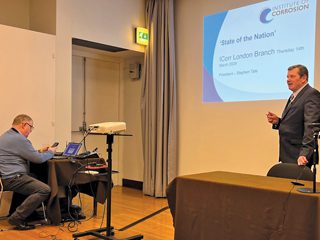
The branch held its AGM on 14th March, which was followed by the current ICorr President – Stephen Tate, with the bi-annual ‘State of the Nation’ speech.
The current chair of the branch, George Winning, highlighted the positive outcomes from the 22/23 season; hybrid meetings, introduction of webinars in the summer, which will be continued in ‘24, restarting the May event for branch members, which will also continue in ’24, and a very successful Christmas Luncheon. However, in-person and online, attendance were low, and this needs to be addressed.
The London branch treasurer, Jim Glynn, then showed and discussed the accounts for the 22/23 season. The branch receives an allocation from HQ to run all its activities, and after holding 6 evening technical meetings, May event, and the Christmas Luncheon, it returned a surplus of £10,500 to ICorr. Jim then proposed that these accounts be adopted, and this was proposed, and seconded by members attending, and approved.
George Winning as chair noted the 23/24 committee members, and thanked those who were standing down for their services. George stated he was also standing down due to other commitments, and that the new chair for 24/25 would be Paul Brooks, who will take over from the April meeting.
In his subsequent presentation, Stephen paid tribute to his predecessors for their major contributions to the Institute, and thanked the London Committee for its invitation to present this in-depth review of ongoing issues being addressed by the Trustees, and planned improvements to the Institute’s offering to members, both in the UK and overseas, with further opportunities for member engagement, following the successful roll-out of online webinars, that have proved very popular especially with those based outside the UK.
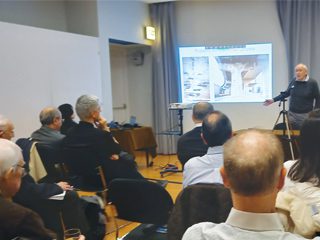
Paul Lambert Presenting on “1824 and All That” – a Celebration of the Bicentenaries of Cathodic Protection and Portland Cement.
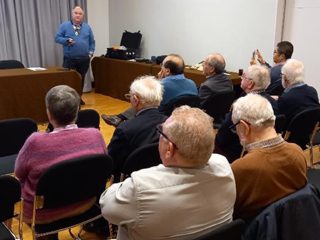
George Winning Retiring Chair of the London Branch at the AGM.
Stephen Tate ICorr President Presenting the Bi-annual ‘State of the Nation’
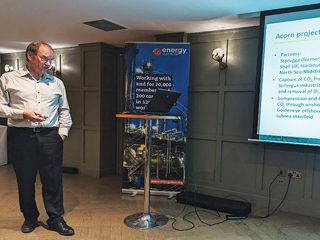
On Tuesday 30th January 2024 the Aberdeen Branch meeting welcomed Dr. Steve Paterson, Arbeadie Consultants Limited for a talk entitled, “Applying materials experience from oil and gas production to carbon capture and storage in North-East Scotland.”
Steve graduated from Imperial College London with a B.Sc. (Eng.) and Ph. D. in Metallurgy. He has over 40 years’ experience in the oil and gas industry, mostly with Shell. His final position at Shell was Principal Technical Expert for Upstream Materials where he was primarily involved in materials, corrosion, welding, inspection and integrity management. He has been involved in several CCS projects during his career and has co-authored papers on materials selection for CCS. Steve is currently an independent materials and corrosion adviser with Arbeadie Consultants based in Banchory near Aberdeen, UK; and is also, an external lecturer in Materials and Corrosion Management at Robert Gordon University in Aberdeen. He was awarded the Institute of Corrosion Paul McIntyre Award in 2019 and EFC Honorary Fellowship in 2023.
Applying Materials Experience from Oil and Gas Production to Carbon Capture and Storage in North-East ScotlandCarbon Capture and Storage (CCS) is a key technology to mitigate emissions from large-scale fossil fuel use. During transport and injection of the CO2 separate liquid phases may form depending on the phase envelope and CO2 composition. These phases comprise of water or reaction products including strong acids and elemental sulphur. The type of liquids formed and shifts in the phase envelope can significantly influence materials integrity including fracture, corrosion, and degradation of polymers. CCS involves the gathering of CO2 from industrial sources, and processing the gas so that it can be transported and injected into sub-surface reservoirs. After capture, the CO2 gas is compressed into ‘Dense Phase’ which is a super-critical fluid state, where its viscosity is similar to that of a gas but its density is actually closer to that of a liquid. It is important that these conditions are achieved for pipeline transport, as this means lower drag and operating costs.
Experience gained from the oil and gas sector can be used to facilitate materials selection and corrosion control that can address the specific integrity requirements of a CCS project. The presentation also placed in context the historical development of CCS opportunities offshore Aberdeen.
CCS in North-East Scotland has had a number of false starts, beginning with BP in 2005 with the proposed Peterhead CCS project to produce ‘carbon-free’ electricity from hydrogen and inject the CO2 into the declining Miller oil field 240 km offshore for enhanced oil recovery. This was scrapped in 2007 following the decision by the UK government to make funds available only to projects selected via a competition. This led to 3 short-listed bids by Shell, EON and RWE, including capture of CO2 at Scottish Power’s coal-fired Longannet Power Station, transporting it to St Fergus and injecting it in the depleted Goldeneye reservoir 100 km offshore. This project was cancelled in October 2011 due to its high-cost estimate. A new proposal to capture CO2 at SSE’s gas-fired Peterhead station and inject it in the Goldeneye reservoir was initiated in 2012 but cancelled in November 2015. In July 2018 UK government launched the CCUS Innovation programme to deploy CCS in a minimum of 2 industrial clusters by the mid-2020s, and 4 by 2030 at the latest. The aim was to capture and store 20-30 Mt CO2 per year by 2030. The first phase evaluation results in November 2021 confirmed HyNet and East Coast Clusters as Track-1 clusters for mid-2020s, with the Scottish Cluster (Acorn) as a reserve if backup was needed. The UK government confirmed Acorn and Viking CCS systems as Track-2 clusters in December 2023. The Track-2 Acorn project consists of 4 partners: Storegga (formerly Pale Blue Dot), Shell UK, Harbour Energy and North Sea Midstream Partners. In phase 1 the CO2 will be captured from existing St Fergus industrial emitters and transported through the existing 20” Goldeneye pipeline where it will be injected into the Acorn South (Goldeneye) reservoir. In phase 2 the options include CO2 capture and transport from industrial centres around Grangemouth to St Fergus via the National Gas Grid Feeder 10 pipeline, injection in the Acorn Central reservoir via the existing Atlantic pipeline, and a possible international interconnection utilising the Miller Gas System pipeline.
The question remains whether Acorn will actually happen. This will depend on a number of factors, including the high cost of providing the CCS infrastructure, and commitment and funding from the UK government. Only time will tell.
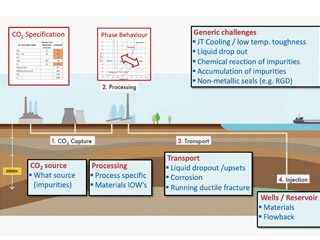
Materials Selection and Corrosion Control For capture, processing transport and reservoir storage appropriate materials selection and corrosion control is critical. Control can be affected by either avoiding threats that can lead to rapid failure by selecting resistant materials, or by managing threats using a suitable mitigation strategy. Specific threats that can lead to rapid failure include, brittle fracture due to Joule-Thompson cooling, running ductile fracture, hydrogen related cracking mechanisms and stress corrosion cracking. Threats that can be controlled using suitable barriers, including CO2 corrosion and acidic corrosion from impurities. These failure mechanisms were discussed in detail in the presentation by Steve.
For CO2 corrosion there is a wealth of data and many CO2 corrosion prediction models from the oil and gas sector including some based on the traditional De Waard-Milliams relationship. When water is dissolved in dense phase CO2 there is no corrosion, but if water drops out the CO2 dissolves in the water to form carbonic acid and CO2 corrosion becomes a threat. It has been found that at higher pressures the dense phase CO2 corrosion rate is lower than that predicted by the traditional De Waard-Milliams relationship. A revised correlation has been proposed that gives a better fit between field/lab data and model calculations.
CO2 for storage can originate from different sources with a range of impurities such as water, O2, SO2, NO2 and H2S. Impurities may trigger a water phase below normal dewpoint and initiate a shift in tendency of water to condense and create conditions for CO2 corrosion. Impurities can form highly corrosive liquid phases with sulphuric acid, nitric acid and elemental sulphur. Control options for the strong acids are either preventing formation or avoiding drop-out. H2SO4 (and also elemental sulphur) has low solubility in dense phase CO2, so the preferred control option is preventing formation. HNO3 has a relatively high solubility in dense phase CO2 so the preferred option is to avoid drop out by defining strict CO2 specification limits.
The presence of water in CCS systems can lead to breakdown of passivity of low grade CRA such as 13Cr often used for well tubing. High CO2 pressure in CCS can lower pH of condensing water to create conditions where de-passivation can occur. It is well known from oil and gas experience that de-passivation can cause pitting and possible SCC. Parameters that trigger de-passivation include pH, chloride content, temperature and presence of oxygen. For tubulars at the bottom of injection wells in a reservoir with high salinity, the selection of high grade CRAs may be required. CRA materials should be selected for conditions where de-passivation does not occur under any operating scenario. Special attention is required for CRA materials in wells especially if O2 is present in the CO2.
Polymer materials that will be exposed to CO2 should be assessed for rapid gas decompression resistance and the potential impact of impurities. Steve concluded by highlighting that much data and expertise are already available from the oil and gas sector to benefit design and operation of CCS projects, although additional testing may be necessary to confirm suitability for the specific conditions of CCS.
An extensive Q&A session and discussion followed a very detailed and informative presentation.
Predictable Pipeline Performance with Polymer Liners On Tuesday 27th February 2024 the Aberdeen Branch meeting welcomed Mark Smithson, Subsea 7 Limited with a talk entitled “Predictable Pipeline Performance with Polymer Liners.”
Mark is currently a senior development engineer with the Internal Corrosion Management team for Subsea7 pipeline products. An experienced engineer, he holds a Bachelor of Engineering in Mechanical engineering with industrial management from Liverpool University. Mark has been part of Subsea7’s polymer lined pipe developments and execution for more than 5 years working on a range of projects aimed at increasing the applications applicable to polymer lining. Within this role, he has been responsible for increasing the qualification limits for the new ‘Linerbridge’ connector and currently holds two patents relating to polymer liner developments with a further application pending. Prior to joining the polymer lined pipeline team at Subsea7; Mark worked for Artis, an independent polymer consultancy where he worked on projects ranging from polymer compound development, polymer characterization and product development to testing and process development or optimisation.
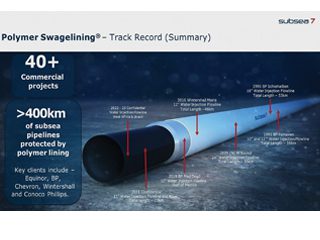
Polymer liners have provided a global, cost-effective solution for internal corrosion mitigation of rigid water injection flowlines for more than 25 years. The first polymer lined subsea pipeline was installed in 1994, since then more than 400 km of high-density polyethylene (HDPE) liners have been installed for subsea water injection service by Subsea7 companies. This track record includes design conditions and qualification programmes demonstrating pressures up to 1293 bar at depths greater than 1,500 m and temperatures up to 80 °C, with the potential to expand all these boundaries.
Reduced pipeline performance due to internal corrosion often leads to a reduction in field output, and an increase in maintenance activities and non-productive time. This results in reduced production and lost revenue. Furthermore, corrosion ultimately leads to pressure downrating or complete failure. The lifetime expectancy of a typical unlined carbon steel (C/S) water injection pipeline is ~ 7 years only and the global cross-industry cost of corrosion is presently estimated at $2.5 trillion annually. Appropriate corrosion mitigation could save industry ~ 35%. Subsea7 have developed innovative swage-lining products which are essentially polymer lined (C/S) subsea pipelines. These products have many advantages, and they can have greater and more predictable service life assurance. The pipeline weight can be reduced, there is increased uptime and the potential to reduce total expenditure costs. The swage-lining products can also offer reduced carbon footprint when compared to competing technologies.
In order to line a steel pipeline with a polymer the swage-lining process is used. This is a proprietary process in which a polymer liner pipe is selected which is of a slightly greater size than the pipe ID. The polymer pipe is pulled through a reduction die at entry and through the length of the pipe under tension, using a pull line threaded through the pipe. The pipe is reduced in diameter by the die and the strain enough to fit through the ID of the outer pipe and is pulled right through. Once in position the tension is released and the liner contracts in length and expands in diameter to form a snug fit inside the pipe.
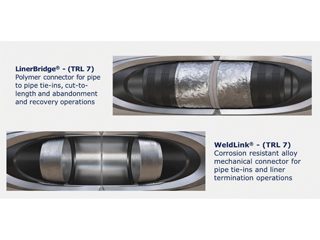
For connecting the sections of pipe together, there are a few different solutions. There is a Liner bridge and a Weld link product with ridges inside the polymer liner ends into which a compression ring can be forced to seal the polymer against the ID of the pipe.
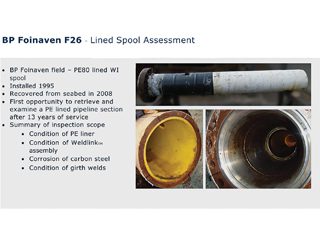
BP Foinhaven – Lined Spool AssessmentEvidence of the efficacy of polymer lining as a corrosion protection technology was demonstrated on the recovery of a spool from a live field at BP Foinhaven F26 after 13 years in service, which demonstrated no deterioration of either polymer material or carbon steel host pipe. Autopsy on the pipe involved sectioning the pipe and machining the interfaces to study the liner condition and the performance of the weld link products.
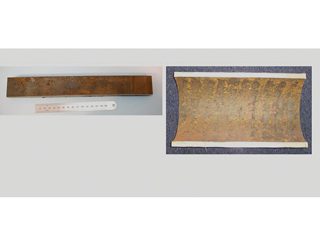
The PE liner condition was assessed by conducting tensile tests on recovered samples against the specification of 18 MPa and these were found to still be within spec on the 4 samples that were taken from different sites. The liner is also proven to have retained residual stress, indicating a tight fit. Tests were also made for environmental stress cracking and chemical stability. The material had improved stress cracking due to adsorbed service fluid. There was no change in chemical stability. The weld link and compression ring assembly remained fully intact after reeling installation, 13 years’ operating service and recovery. A pull-out test on the PE liner from the weld link joint also demonstrated that the force required to pull the liner out of the assembly exceeds the yield strength of the PE liner even after 13 years. The carbon steel pipe was sectioned, and the liner was removed from the inside of the pipe to examine for corrosion. The pipe had superficial corrosion only and was largely covered in cracked mill scale and rust blooming. The worst corrosion was examined in section and was found to be a maximum depth of 280 micron (0.28 mm) or approximately 1.6 % of wall thickness. Sections were also taken to assess the girth welds and the inner diameter of the carbon steel pipe. Girth welds within the polymer lined section were deemed acceptable, with the liner protecting the weld. Outside the lined section the weld was found compromised due to a fissure in the protective Inconel clad section near the clad flange.
These lining Products now have a significant track record and over 400 km of subsea pipelines have been installed for a number of operators worldwide.
More recently, this well-established flowline product has been supplemented by the qualification of polymer lined pipe for dynamic riser service (steel catenary riser, SCR, and Steel Lazy Wave Riser, SLWR). The qualification programmes included fatigue testing on both full-scale polymer-lined pipe sections and small-scale material coupons. Combined with an investigation of liner behaviour in the vertical orientation. The riser product obtained qualification to technology readiness level (TRL) 5 from the industry-recognised body, DNV. A deep-water riser has since been fabricated and installed off the back of this programme and is ready to enter service.
Current developments in polymer lining technology have the potential to offer these and other benefits in alternative service environments, such as Water Alternating Gas (WAG), production lines, and new energy transition applications like Carbon Capture, Utilization and Storage (CCUS) and Hydrogen transportation. Mark’s talk was most interesting and very well received. The Aberdeen Branch provides a very full technical programme of both in-person and online events. Abstracts of potential papers for the Aberdeen Technical Programme are always welcome for consideration, and anyone wishing to present should correspond soonest with the 2024/2025 Chair and Technical Programme Co-ordinator: meilingcheah@gmail.com
Further Information about the Aberdeen Branch, and past presentations, may be found on their website page: Aberdeen Branch – Institute of Corrosion (icorr.org) and to join the Aberdeen Branch mailing list, please contact: icorrabz@gmail.com
Dr. Steve Paterson, Arbeadie Consultants Limited.
Materials and Corrosion Challenges
Mark Smithson, Subsea 7 Limited.
Swagelining® Connectors.
Internal Section of Carbon Steel Pipe After PE Liner Removal Including Girth Weld Region.
Superficial Corrosion of Carbon Steel After Liner Removal.
World Corrosion Awareness Day’ a University of Manchester / ICorr NW Joint Event
To celebrate World Corrosion Awareness Day, the Institute of Corrosion Northwest Branch held a joint event with the University of Manchester (UoM) on 24th April 2024.
The event comprised an afternoon of exciting and varied presentations from University of Manchester and industry speakers:
The Role of Organophosphates in Corrosion Inhibition, K Brook (University of Manchester)
With a background in the coatings industry, Kathy presented post-graduate research on this innovative area of corrosion prevention.
Cathodic Protection of Wind Turbine Monopiles – Internal and External Issues, David Buxton (Intertek CAPCIS)
David Buxton is a Corrosion Consultant who has spent over 30 years working in cathodic protection and stray current corrosion control. David completed a PhD at the Corrosion Centre (UMIST/University of Manchester) and has been at Intertek CAPCIS for 20+ years undertaking both onshore and offshore cathodic protection related investigations, testing and assessments. He outlined key issues associated with cathodic protection in the emerging area of renewable energy.
Quff: An Innovation in Quantum Computer Programming, Christopher Wright (University of Manchester)
Christopher presented on this new programming language, developed for the fast-moving field of quantum software engineering. Quff is a high-level, dynamically typed programming language focused on simple yet effective hybrid programme development.
My Corrosion Journey: Dr Jane Lomas (ICorr / Amtec Consultants Limited)
The talk covered many aspects of the working life of a corrosion engineer and the role that ICorr has played in Jane’s corrosion journey. Whilst obtaining a BSc in Biochemistry, an interest in the problems with corrosion of metal hip joint replacements made an MSc in Corrosion seem a logical next step. This led on to the establishment of an independent corrosion consultancy and jobs ranging from beer cans to aeroplanes; bulk carriers to battleships; building and factory corrosion issues to corrosion of classic cars, church windows and on the leisure front even Blackpool Tower.
Safety Risks Cannot Be Overstated: The structural integrity
of buildings, bridges, and transportation can be severely compromised by corrosion and have led to many catastrophic failures. https://www.bbc.co.uk/news/uk-england-34335931 and http://news.bbc.co.uk/1/hi/scotland/glasgow_and_west/8495807.stm
The “World Corrosion Organisation (WCO) has previously designated 24th April as “World Corrosion Awareness Day”. This day aims to encourage the adoption of corrosion prevention strategies to reduce the economic and social costs associated with corrosion. The World Corrosion Awareness Day reminds the world that ‘rust never sleeps’ and recognises the impact corrosion prevention and control professionals make. It promotes sustainable management practices for critical industrial assets like energy infrastructure, transportation infrastructure, water/wastewater and waterways, the shipping industry, defence assets, and more.
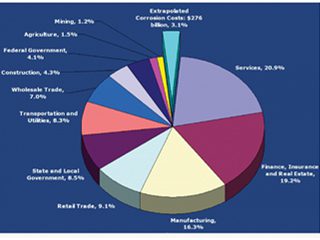
The estimated annual cost of corrosion, amounts to US$2.5 trillion globally and accounts for 3 to 4% of the GDP of developed nations, according to earlier research by AMPP, a global non-profit organisation that represents more than 32,000 members in the materials, corrosion control, and coatings industries. and brought to light on World Corrosion Awareness Day. This figure may be attributed, in part, to the lack of understanding among government and industry decision-makers regarding the seriousness of corrosion and the need for control.
Every year on World Corrosion Awareness Day, seminars, conferences, webinars, competitions, and student events are organised by corrosion associations worldwide to raise public awareness of corrosion and corrosion control among decision-makers in government, business, and academia.
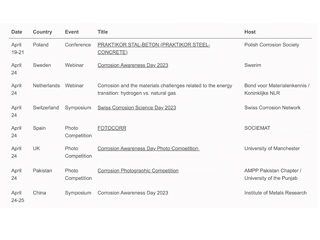
Some of the events conducted on corrosion awareness day 2023 are listed below. An elaborated list of events conducted on corrosion awareness day for previous years is available on the World Corrosion Organisation (WCO) Website (https://corrosion.org)
It is estimated that the use of corrosion control techniques will reduce the annual cost of corrosion worldwide by 15 to 35 percent, or $375 to $875 billion. The other intangible advantages to public safety and the environment that come with long-term, consistent asset integrity also add up to these substantial cost savings. Corrosion control specialists are in charge of averting catastrophic failures that can endanger public safety, cause lost output, deteriorate the environment, or result in fatalities.
You may like to read our Corrosion Awareness Day article published on the ICorr website:
Note: On 1st July 2024, an ICorr Sponsored – Parliamentary and Scientific Committee Event will take place with several Institute speakers including: Professor Gareth Hinds, Dr. Christian Stone and Izabela Gajewska.
Full details will be announced during April 2024. Some recent everyday examples of corrosion impacts to Infrastructure may be found at:
Coast Road barrier corrosion speed limit to remain – BBC News
‘Severe corrosion’ found during Cleveland Bridge repairs – BBC News https://www.bbc.co.uk/news/uk-england-58494275
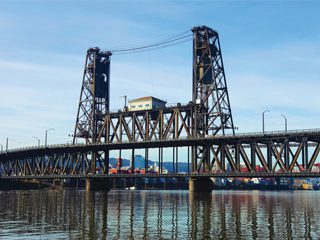
Above: An Example of Complex Infrastructure Requiring Special Anti-Corrosion Measures.
Mastering Passive Fire Protection with Specialised Training
Passive Fire Protection (PFP) is a discipline that goes far beyond the requirement for compliance with international standards. It’s a critical element in the oil, gas, and energy sector, and crucial in the safeguarding of both assets and, most importantly, personnel.
Advanced training in PFP equips those aspiring to pursue rewarding careers as PFP Inspectors with a detailed understanding of fire dynamics, materials and products used, approvals and qualifications of products to meet project safety requirements, and best practices that are essential to ensure structures and personnel are protected.
The ultimate benefit? When you qualify through the advanced PFP training routes offered by ICorr’s PFP courses, doors open to a career marked by demand, respect, and the potential to make a real difference in safety and protection of assets.
Read on to discover why the ICorr Fire Protection Coatings Inspector Training Course stands out, and the depth and breadth of content the course includes.
Why Do ICorr PFP Inspector Training Courses Stand Out?
The landscape of PFP is constantly evolving, and the need for specialised and advanced training is undeniable. The ICorr PFP Inspector Training Courses distinguish themselves with several key elements that set them apart from other PFP courses.
The first key differentiator is how the courses were developed in partnership with PFPNet, an independent industry group specialising in passive fire protection within the oil, gas, and energy sectors. This collaboration has ensured the course curriculum is grounded in the latest industry standards.
In addition, the course content has benefitted from PFPNet’s access to a membership with an unequalled depth of theoretical and practical knowledge, understanding, and experience. Such a foundation provides those who take the course with an unmatched resource of insights regarding PFP installation.
“The course allowed me to understand the differences between paint and PFP, and why recognising these differences is critical.” – Course participant.
These courses delve into the many material types used in PFP, emphasising the critical nature of product qualification to ensure that systems meet the stringent requirements for fire protection.
“A detailed and comprehensive course in all the key elements for installation of PFP materials.” – Course participant.
The Level 3 training goes beyond merely presenting the correct methods of material installation. It also addresses potential complications that can arise during the installation phase. This comprehensive approach means that those who qualify can identify and rectify issues to ensure the integrity of the installation.
If you want to excel and stand out in the field of PFP inspection, it is elements like these – as well as a focus on troubleshooting and problem-solving – that raise ICorr Level 3 PFP Inspector Training above the norm.
“The course provided good detail of what can go wrong in addition to what are the processes of installation.” – Course participant.
Level 3 PFP Course Content: A Deep Dive into the World of PFP
You’ll find that the Level 3 course delivers a comprehensive curriculum that will arm you with a deep understanding of PFP and its role in the oil, gas, and energy sector. It’s structured as a progressive narrative, blending theoretical knowledge with practical insights to ensure a well-rounded learning experience.
Here is an overview of the key components of the course content:
· Role and Duties of the PFP Inspector
This initial segment lays the groundwork, outlining the fundamental responsibilities and expectations placed upon PFP inspectors.
· Introduction to PFP
You’ll be introduced to the core purpose of PFP, helping you to understand its significance in safeguarding lives and infrastructure.
· PFP Types
The course continues with a broad introduction to the diverse types of PFP before delving into a more detailed overview, providing a clear understanding of the spectrum of PFP solutions available.
· PFP of Structures, Divisions, Processes, and Storage Vessels
A focused look at how PFP is applied to different structures and components within the industry.
· Classification Society Type Approval, Other Types of Approval (e.g. UL)
An exploration of the approval processes for PFP systems, including the significance of certifications and weight, is important for an Inspector to understand approvals and certifications.
· Qualification of PFP Systems
This section underscores the importance of supporting documentation in qualifying PFP systems, highlighting the need for rigorous validation.
· Development, Testing, and Approval of PFP Materials and Systems
You’ll learn about the journey from development to approval of PFP materials and systems, understanding testing protocols and criteria for approval.
· Epoxy PFP Degradation Mechanisms
An examination of the factors that contribute to the degradation of epoxy PFP, and how that is prevented to ensure that products meet the expected fire performance in the event of a fire.
· Application Defects and Fire Performance Implications
Insights into common application defects and how they can compromise the fire performance of PFP systems.
· The Specification Process
A deep dive into the specification process, covering aspects such as relevance, potential errors or omissions, and the importance of adhering to the epoxy PFP manufacturer’s application manual.
· Pre-job Meeting, ITP, and Quality Control
Emphasis on the significance of pre-job meetings, Inspection Test Plans (ITP), and maintaining quality control at all stages of application.
· The Critical Importance of Good Surface Preparation
Highlighting surface preparation as a foundational element for effective PFP application.
· Epoxy PFP Application Equipment
Overview of the types of application equipment and the checks Inspectors can perform to ensure proper application.
· Final Inspection: Role and Duties of Epoxy PFP Inspector
A focus on final inspection criteria, including build of thickness to achieve specification, topcoat application, and revisiting the role and duties of the epoxy PFP inspector.
· Safety Overview
A crucial component of the course, providing a comprehensive safety overview to ensure all practices adhere to the highest safety standards.
· Qualification Process
The course includes a practice test followed by a final examination consisting of 150 multiple-choice questions. On successful completion of the test, candidates for Level 3 will be invited to attend a peer review with an industry specialist to assess their understanding from the course and discuss how they would operate as an Inspector on a project.
Should You Attend this Course?
If you’re a specialist inspector or technician seeking to demonstrate your distinctive competence to properly understand and inspect PFP installations in new construction or retrofit situations, the Level 3 course is for you.
As correct surface preparation, priming, and top coating are crucial requirements in PFP installation, you should have a minimum of ICorr or NACE Level 1 to demonstrate your fundamental understanding of corrosion and protective coatings.
What’s Your Next Step?
In the critical field of Passive Fire Protection (PFP), ICorr’s PFP courses stand out by offering comprehensive and advanced training to meet the needs of today’s oil, gas, and energy industry. Developed with the expertise of PFPNet and focusing on real-world application, these courses prepare you for a rewarding career in PFP, protecting both infrastructure and personnel.
We are thrilled to announce that ICorr & Business Systems Manager at Argyll Ruane, Dale O’Reilly, has been appointed the Chair of the Institute of Corrosion (ICorr) Yorkshire Branch.
Recognising the need for revival after a period of inactivity, Dale is determined to breathe new life into the branch, leveraging the rich heritage of the City of Steel and the extensive work taking place throughout the Yorkshire region.
His vision is clear: to create a vibrant community of industry professionals coming together to exchange valuable knowledge, share best practice and enhance awareness of corrosion issues, ensuring they are considered in relevant discussions.
Already making strides, Dale has laid the foundation for the branch by utilising contacts from its past to raise awareness and help build a diverse branch membership spanning, inclusive of individuals of all technical capabilities.
Given the expansive geography of Yorkshire, a hybrid approach will be adopted for meetings, ensuring accessibility for everyone to attend in person or remotely.
Get involved!
If you’d like to get involved in the branch and find our when upcoming meetings will take place, please contact: yorkshirechair@icorr.org
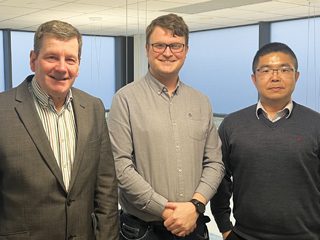
Left to Right: Stephen Tate, President of ICorr, Dale O’Reilly, Argyll Ruane ICorr and Business Systems Manager, and Dr Yunnan Gao, Vice President of ICorr.
“Yorkshire is an untapped reservoir of knowledge within the ICorr industry. The goal is to channel this wealth of expertise and involve more individuals in advancing the industry and preventing corrosion in the future.”
We use cookies to optimize our website and our service.
Functional
Always active
The technical storage or access is strictly necessary for the legitimate purpose of enabling the use of a specific service explicitly requested by the subscriber or user, or for the sole purpose of carrying out the transmission of a communication over an electronic communications network.
Preferences
The technical storage or access is necessary for the legitimate purpose of storing preferences that are not requested by the subscriber or user.
Statistics
The technical storage or access that is used exclusively for statistical purposes.The technical storage or access that is used exclusively for anonymous statistical purposes. Without a subpoena, voluntary compliance on the part of your Internet Service Provider, or additional records from a third party, information stored or retrieved for this purpose alone cannot usually be used to identify you.
Marketing
The technical storage or access is required to create user profiles to send advertising, or to track the user on a website or across several websites for similar marketing purposes.