Hydrotesting of vessels, valves and pipelines, is carried out to ensure that no leaks are present and that the vessel will hold up under expected operating pressures, however it also raises the risk of corrosion by introducing moisture to the system. The same water that proves the vessel is not compromised can be the very cause of corrosion that deteriorates the metal and leads to leakage over time.
According to Cortec®, its VpCI®-649 inhibitor, a unique concentrated liquid formulation combining contact and Vapor phase Corrosion Inhibitors, can protect surfaces during hydrotesting. These inhibitors form a molecular protective layer on metal surfaces below and above the water level, and protect both ferrous and non-ferrous metals, including copper, steel, galvanized steel, aluminum, and cast iron. The inhibitor does not contain nitrites, phosphates, or chromates, which helps minimise disposal concerns, concluded the company.
The Association for Materials Protection and Performance (AMPP) has announced that its CEO, Bob Chalker, plans to retire in July 2023. The AMPP board of directors has started a formal search for a successor, considering internal and external candidates for the position.
According to the AMPP, Chalker has served in his role for more than 12 years, first as CEO of NACE International and then with AMPP through the merger of NACE and SSPC in 2021.
“It has been a privilege to serve as CEO of this great organisation, and I want to extend my thanks to AMPP’s employees and members who have enabled the association to achieve so much,” said Chalker.
Gecko Robotics, a leader in using advanced robotics and enterprise software to help ensure the availability, reliability, and sustainability of critical infrastructure, has announced a three-year collaboration with Siemens Energy’s European Field Service organisation to market and perform advanced ultrasonic robotic inspection services across Europe.
According to the company, these advanced robotic inspections are poised to strengthen critical infrastructure and transform how installed equipment is inspected and maintained. Together, the two companies will develop new technologies and services to better serve customers across several industries, including pulp & paper, power generation (conventional and renewable), and oil & gas. Siemens Energy’s European Field Service organisation and Gecko Robotics have already completed inspections in Europe, in Poland (pulp/paper), Belgium (waste to energy), the Netherlands (food processing), and the UK (power generation). In support of the collaboration, Siemens Energy has established a new Product Competence Centre in the Netherlands, with expansion plans underway.
Gecko Robotics’ robots are remote controlled and equipped with ultrasonic transducers, localisation sensors, lasers, and HD cameras. They climb vertically and horizontally, adhering magnetically to an extensive range of equipment types to scan for changes in thickness, cracks, corrosion, blistering, and other forms of degradation. The robots also include localisation technology to pinpoint exact locations on an asset, allowing for truly accurate inspections that enable inspectors to examine corrosion trends over time, predict when failures will occur, and estimate when repairs will be necessary. Data captured by Gecko’s robots and its software platform can then produce a validated report within 24 hours, allowing inspectors to quickly assess and make informed decisions about ongoing maintenance or repairs. This process and quick turnaround also enable inspectors to reduce asset downtime and lost production while ensuring critical repairs are conducted with high confidence, concluded the company.
Each year the Institute of Corrosion bestows a range of internationally renowned awards in recognition of excellence in corrosion science and engineering, and to reward outstanding service to the Institute and the wider corrosion community. Many of these awards are open to nomination by both members and non-members of the Institute. Below is a brief description of each award together with details of how to nominate potential candidates.
U.R. Evans Award
The U.R. Evans Award is the premier scientific award of the Institute of Corrosion and is presented annually for outstanding international achievements in pure or applied corrosion science. The recipient is selected by a Corrosion Science Division panel and presented with an engraved sword at the annual Corrosion Science Symposium (CSS). The symposium is one which seeks to encourage the participation of the junior members of the corrosion community who would appreciate the visit of, and address by, a corrosion scientist of international repute. The form of the award symbolises the fight in which we are all engaged. The recipient is also granted Honorary Life Fellowship of the Institute. Nominations may be submitted at any time via email to the CSD Chair, Julian Wharton (j.a.wharton@soton.ac.uk).
Paul McIntyre Award
The Paul McIntyre Award is presented to a senior corrosion engineer, who, as well as being a leading practitioner in his field, has advanced European collaboration and international standards development. The award consists of an engraved trophy, which is presented at the annual CED Working Day meeting. The recipient is requested to present a brief overview of their activities and encouraged to prepare an article for publication in Corrosion Management. Nominations should be
submitted to the CED Chair, Danny Burkle (D.Burkle@lbbcbaskerville.co.uk) by 28th February 2023.
T.P. Hoar Award
The T.P. Hoar Award is presented to the authors of the best paper published in the scientific journal Corrosion Science during the previous calendar year. The winning paper is selected by a sub-committee of the Corrosion Science Division and the authors receive a certificate and a cash sum of £400.
Galloway Award
The Galloway Award is presented to a student author for the best publication describing original research in corrosion science and engineering as judged by a sub-committee of the Corrosion Science Division. The student should be the primary author of the work and preferably first author. A summary of the winning paper is published in Corrosion Management and the prize consists of a certificate and a cash sum of £300. The Institute does not retain copyright of the material, so this does not prevent separate publication of the work in a scientific journal. Submissions (in the form of a paper published within the past 12 months or a draft publication) may be sent via email at any time to the CSD Chair, Julian Wharton (j.a.wharton@soton.ac.uk). Supervisors may nominate students.
Lionel Shreir Award
The Lionel Shreir Award is given to the best student presenter at the annual Corrosion Science Symposium. Selection of the recipient is carried out by a sub-committee of the Corrosion Science Division. The award consists of a certificate and a cash prize of £125.
For further details on the Institute awards, including lists of past recipients, please visit https://www.icorr.org/icorr-awards/
This series of articles is intended to highlight industry wide engineering experiences, practical opinions, guidance, and focused advice to practising technologists. The series is written by experts who have made significant contributions to the field of corrosion management. The article in this issue features a contribution from Alan Denney, who discusses weld corrosion problems.
Preferential corrosion of welds – an introduction
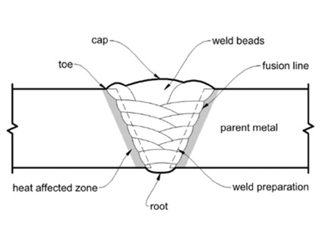
Welding of a metal results in a range of different metallurgical structures in the heat affected zone (HAZ); that part of the parent material adjacent to the weld which has not been melted and fused into the weld itself. Where a filler metal is used in welding (in the form of a welding rod or wire), such as in manual metal arc welding (MMAW), metal inert gas/metal active gas welding (MIG/MAG welding), flux cored arc welding (FCAW) or submerged arc welding (SAW) the weld metal will have an inherently different chemical analysis to the parent metal. This is because the parent metal has a wrought structure, with properties coming from mechanical working and heat treatment whereas the weld metal has a cast structure which achieves its strength mainly due to its additions of alloying elements.
When a weldment is exposed to an electrolyte (a conductive corrosive medium) one part of the weldment may corrode preferentially over another part, resulting in the weld being preferentially attacked. In real life situations the preferential attack may be in another discrete area such as the heat affected zone or even some distinct part of the heat affected zone which has a particular metallurgical structure. Where preferential attack occurs it can be rapid, difficult to detect by conventional monitoring methods, and potentially dangerous.
Galvanic corrosion
The corrosion may be caused or enhanced by galvanic action, galvanic corrosion being the electrochemical process where there is a different natural electrical potential between two metals or two different metallurgical structures, resulting in one part of the weldment being the cathode and another the anode of a corrosion cell. It is the anodic area which corrodes, but the cathodic reaction drives the corrosion process. The potential difference may be relatively small but if the parent metal is the cathode and the weld is the anode then there is a large cathodic area to drive the corrosion reactions and rapid weld metal dissolution can result.
Galvanic corrosion is a clear risk where a weld is made between significantly different metals, such as in welds between carbon-manganese steels and duplex stainless steel when exposed to a corrosive environment, but problems can also occur where there is less obvious difference in materials.
Preferential corrosion of welds in seawater lines
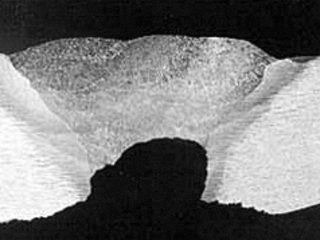
One well-known example of preferential corrosion is internal corrosion of pipelines transporting seawater. These are commonly used for water injection into oil wells. The corrosion occurs within the welds at the pipe joints made of carbon-manganese steel welded using welding consumables which would be considered as ‘matching’ in properties (albeit there are the wrought/cast structural differences mentioned above). One means of avoiding the corrosion is to reduce the oxygen level of the seawater to low levels of parts per million (which is extremely challenging) and/or to control the as-deposited composition of the weld metal to increase its cathodic potential thus minimising galvanic potential differences. This involves careful selection of the welding consumables, based on consideration of composition, but also the results of sophisticated corrosion testing of trial welds. A further solution is to install the line with a continuous internal plastic liner in the pipe, thus preventing seawater contact with the pipe or welds surfaces.
Preferential attack in welds in stainless steel
Stainless steels are cathodic when in combination with other metals such as carbon steels or aluminium alloys and hence unaffected by corrosion when in combination in a corrosive environment, but they are not immune to preferential corrosion effects. One example is when austenitic stainless steels are welded (to themselves), and exposed in a corrosive environment. They may then suffer from what is commonly termed ‘weld decay’. If this occurs in current times it is a consequence of an error in not selecting a modern resistant grade of stainless steel.
Stainless steels owe their corrosion resistance to a layer of chromium oxide a few microns thick which forms a passive protection layer. If breached and in a corrosive environment this layer does not repair itself and localised corrosion will occur. In their original form the austenitic stainless steels (the familiar 300 series of stainless steels) contained carbon up at levels of up to 0.08%. This carbon content and its distribution in the matrix becomes significant in welding the steel when ‘sensitisation’ can occur.
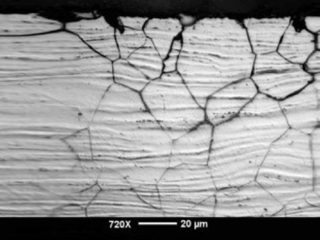
Sensitisation is due to the carbon preferentially combining with the all-important chromium to form chromium carbide which forms along the grain boundaries. This depletes the areas adjacent to the grain boundary of the chromium and this is no longer available to form the passive protection layer. In a corrosive environment, local corrosion cells will form, corrosion occurs around the grains and they can detach from the surface (Figure 3). This situation occurs within a range of temperatures experienced in the heat affected zone of the weldment.
This problem is readily avoided by selecting the low carbon stainless steels denoted by the L designation (e.g. 304L or 316L) which use modern steelmaking techniques to achieve carbon contents of less than 0.03%. There is a further material selection option which is to use the so-called stabilised grades of stainless steel, such as type 347, in which the carbon is ‘stabilised’ (i.e. chemically combined) by the addition of niobium.
In a component already fabricated from the higher carbon (unstabilised) grades it can be prevented by suitable post weld heat treatment.
In conclusion, there are numerous other examples of preferential corrosion of welds and this topic is well covered in web articles and technical papers which the reader can discover by performing online searches.
Welcome to the world of the welding engineer who has to select the welding and heat treatment parameters based on the materials and their application.
Alan Denney, Consultant.
References
1. Corrosion of welded components in marine environments (April 2003). Stuart Bond, TWI Ltd. Prevention and Management of Marine Corrosion, London, 2-3 April 2003. Lloyds List Events. (available on the TWI website https://www.twi-global.com/technical-knowledge/published-papers/)
2. Good welding practices for stainless steel. Presentation by Glenn Allen, TWI Ltd. Available to members on the TWI website.
Figure 1: An example fusion weld showing the heat affected zone.
Figure 2: Preferential weld metal corrosion in carbon steel (copyright TWI Ltd reproduced with permission). Source: Reference 1.
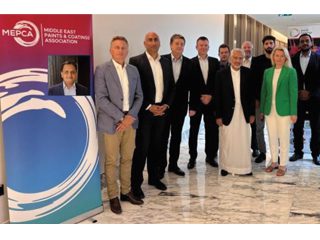
Ten leading paint manufacturers in the Middle East, Akzo Nobel, Altakamol, Asian Paints, Axalta, Caparol Paints, Hempel, Jotun, National Paints, PPG and RAR Holding, have agreed to launch the Middle East Paints & Coatings Association (MEPCA), with the backing and support from the World Coatings Council and
Vincentz Network.
Abukaker Sheibani, Group CEO, Sheibini Group/ Altakamol International commented “At long last, we have a joint platform for our industry in the region. We will collaborate for the benefit of all members and the coatings sector in general. Over time, we strive to grow our membership to include all relevant paints and coatings manufacturers in the Middle East”, and who was elected Chairman at the launch meeting held in Dubai on September 13th . He will be supported by Vice Chairman Martin Rosocha, Managing Director ME & Africa, Caparol Paints, and Treasurer Jasbir Gill, Regional Director Middle East and Africa, Akzo Nobel.
According to the report, the formation of MEPCA, made up of the most senior leaders in each company, was prepared and driven by the World Coatings Council (WCC) and Vincentz Network. President, Tom Bowtell, and global business director coatings, Jürgen Nowak, had held exploratory meetings in February, which were followed by a formal joint meeting with the group of companies in May and the launch meeting in September. Both
Vincentz Network as a company and Tom Bowtell as WCC President have been made Honorary Members of MEPCA.
The founding members of the new Middle East Paint and Coatings Association, after signing the launch document in Dubai on September 13. From left to right, Joseph Eapen (inset) (Asian Paints), Franck Derouen (Axalta), Jasbir Gill (Akzo Nobel), Martin Rosocha (Caparol Paints), Laurence Brown (Hempel), Tom Bowtell (World Coatings Council), Abubaker Sheibani (Al Takamol International), Jürgen Nowak (Vincentz Network), Anthony Reaidy (RAR Holding), Olga Kolevatova (PPG), Samer Sayegh (National Paints) and Esben Hersve (Jotun).
We use cookies to optimize our website and our service.
Functional
Always active
The technical storage or access is strictly necessary for the legitimate purpose of enabling the use of a specific service explicitly requested by the subscriber or user, or for the sole purpose of carrying out the transmission of a communication over an electronic communications network.
Preferences
The technical storage or access is necessary for the legitimate purpose of storing preferences that are not requested by the subscriber or user.
Statistics
The technical storage or access that is used exclusively for statistical purposes.The technical storage or access that is used exclusively for anonymous statistical purposes. Without a subpoena, voluntary compliance on the part of your Internet Service Provider, or additional records from a third party, information stored or retrieved for this purpose alone cannot usually be used to identify you.
Marketing
The technical storage or access is required to create user profiles to send advertising, or to track the user on a website or across several websites for similar marketing purposes.