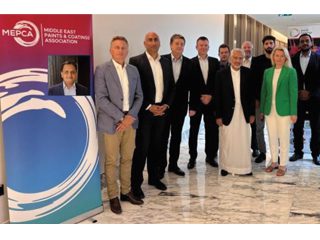
Ten leading paint manufacturers in the Middle East, Akzo Nobel, Altakamol, Asian Paints, Axalta, Caparol Paints, Hempel, Jotun, National Paints, PPG and RAR Holding, have agreed to launch the Middle East Paints & Coatings Association (MEPCA), with the backing and support from the World Coatings Council and
Vincentz Network.
Abukaker Sheibani, Group CEO, Sheibini Group/ Altakamol International commented “At long last, we have a joint platform for our industry in the region. We will collaborate for the benefit of all members and the coatings sector in general. Over time, we strive to grow our membership to include all relevant paints and coatings manufacturers in the Middle East”, and who was elected Chairman at the launch meeting held in Dubai on September 13th . He will be supported by Vice Chairman Martin Rosocha, Managing Director ME & Africa, Caparol Paints, and Treasurer Jasbir Gill, Regional Director Middle East and Africa, Akzo Nobel.
According to the report, the formation of MEPCA, made up of the most senior leaders in each company, was prepared and driven by the World Coatings Council (WCC) and Vincentz Network. President, Tom Bowtell, and global business director coatings, Jürgen Nowak, had held exploratory meetings in February, which were followed by a formal joint meeting with the group of companies in May and the launch meeting in September. Both
Vincentz Network as a company and Tom Bowtell as WCC President have been made Honorary Members of MEPCA.
The founding members of the new Middle East Paint and Coatings Association, after signing the launch document in Dubai on September 13. From left to right, Joseph Eapen (inset) (Asian Paints), Franck Derouen (Axalta), Jasbir Gill (Akzo Nobel), Martin Rosocha (Caparol Paints), Laurence Brown (Hempel), Tom Bowtell (World Coatings Council), Abubaker Sheibani (Al Takamol International), Jürgen Nowak (Vincentz Network), Anthony Reaidy (RAR Holding), Olga Kolevatova (PPG), Samer Sayegh (National Paints) and Esben Hersve (Jotun).
According to a new independent report from classification company, DNV, Jotun’s, Baltoflake glass flake polyester (GFP) coatings could offer 30 years’ maintenance-free corrosion protection at the splash zone for offshore assets.
The study showed that Baltoflake could provide decades of protection for offshore wind substructures and reduced lifecycle costs by up to 50%. DNV inspected a section of jacket from a North Sea oil platform which was installed in 1972 and decommissioned in 2020. Jotun’s Baltoflake coating was applied to the platform in the late 1980s and, despite over 30 years’ exposure to the North Sea’s harsh environment, analysis revealed that the coating at the splash zone was intact, still smooth and showing no signs of delamination.
Ismail Tan, Global Category Manager, new construction primers, Jotun said: “Although glass flake coatings have been used in the energy industry for over 40 years, there has traditionally been very little research into the material’s long-term benefits. However, by partnering with DNV on this report, we now have the relevant in-field data required to demonstrate Baltoflake’s full asset lifecycle protection performance.”
Baltoflake can remove the requirement for offshore wind developers to undertake expensive repairs or replacement due to corrosion, concluded Jotun.
The following documents have obtained substantial support during the past two months and have been submitted to the ISO member bodies for formal approval.
ISO/FDIS 3079 Two-electrode method using acetic acid to measure pitting potential of aluminium and aluminium alloys in chloride solutions
ISO/FDIS 9227 Corrosion tests in artificial atmospheres — Salt spray tests 2022-10-11 (Revision of 2017 standard)
ISO/FDIS 4628-5 Paints and varnishes — Evaluation of quantity and size of defects, and of intensity of uniform changes in appearance — Part 5: Assessment of degree of flaking 2022-10-12 (Revision of 2016 standard)
ISO/PRF 7784-3 Paints and varnishes — Determination of resistance to abrasion — Part 3: Method with abrasive paper covered wheel and linearly reciprocating test specimen (Revision of 2016 standard)
ISO/FDIS 10062 Corrosion tests in artificial atmosphere at very low concentrations of polluting gas(es) 2022-10-12 (Revision of 2006 standard)
ISO/PRF 11127-6 Preparation of steel substrates before application of paints and related products — Test methods for non-metallic blast-cleaning abrasives — Part 6: Determination of water-soluble contaminants by conductivity measurement (Revision 2011 standard)
ISO/FDIS 11127-7 Preparation of steel substrates before application of paints and related products — Test methods for non-metallic blast-cleaning abrasives — Part 7: Determination of water-soluble chlorides 2022-10-26 (Revision of 2011 standard)
ISO/DIS 22974 Petroleum and natural gas industry — Pipeline transportation systems — Pipeline integrity assessment specification
ISO/FDIS 23669 Corrosion of metals and alloys — Requirements for localised corrosion and environmentally assisted cracking testing of additively manufactured metals and alloys
New International standards published in the past two months
ISO 8504-4:2022 e Preparation of steel substrates before application of paints and related products — Surface preparation methods — Part 4: Acid pickling
ISO 1461:2022 Hot dip galvanized coatings on fabricated iron and steel articles — Specifications and test methods
ISO 11997-3:2022 Paints and varnishes — Determination of resistance to cyclic corrosion conditions — Part 3: Testing of coating systems on materials and components in automotive construction
The PDA Europe Conference & Exhibition will take place on 17-18 November 2022 in Porto, Portugal.
After almost two years of online events as a consequence of the Covid-19 pandemic, the organising committee are looking forward to welcoming you in-person for an exceptional two-day gathering in the beautiful region of Porto.
Registration for this is now open. For further information, including exhibit space and hotel accommodation,
see: www.pda-europe.org
Geothermal energy could be the “invisible key” to unlock new energy sources and help meet net zero greenhouse gas emissions by 2050, according to Queen’s University Belfast researchers.
Professor Mark Palmer and Joseph Ireland from Queen’s University Belfast have been working on a new landmark report for the Department for the Economy and the Northern Ireland Geothermal Advisory Committee.
The report, “Net Zero Pathways: Building the Geothermal Energy Sector in Northern Ireland”, highlights that
building the geothermal energy sector can help transition Northern Ireland towards a low-carbon future and create an emerging market.
Future geothermal energy use is considered key in decarbonising Northern Ireland’s heat sector as it is a clean and naturally occurring source of energy. It uses the natural subsurface as a source of heat and has the potential to provide cooling and seasonal storage of energy.
Launched as part of Northern Ireland Geothermal
Energy Week, the Queen’s University report offers
detailed recommendations for the way forward and f
ocuses on the confidence-building actions needed to
unlock the opportunities for energy from geothermal
heating and cooling.
The following documents have obtained substantial support during
the past two months and have been submitted to the ISO member bodies for formal approval.
ISO/PRF 1461 Hot dip galvanized coatings on fabricated iron and steel articles — Specifications and test methods (Revision of 2009 standard)
ISO/FDIS 4215 Corrosion of metals and alloys —Test method for high-temperature corrosion testing of metallic materials by thermogravimetry under isothermal or cyclic conditions
ISO/DIS 4905 Corrosion of metals and alloys— Electrochemical test methods— Guideline for electrochemical measurements in high temperature molten salts
ISO/DIS 18115-1 Surface chemical analysis — Vocabulary — Part 1: General terms and terms used in spectroscopy (Revision of 2013 standard)
ISO/FDIS 24139-1 Petroleum and natural gas industries — Corrosion resistant alloy clad bends and fittings for pipeline transportation system —Part 1: Clad bends
New International standards published in the past two months
ISO/TR 4340:2022 Water aggressiveness evaluation and optimized lining choice
ISO 12696:2022 Cathodic protection of steel in concrete
ISO 18768-1:2022 Organic coatings on aluminium and its alloys — Methods for specifying decorative and protective organic coatings on aluminium — Part 1: Powder coatings
ISO 18768-2:2022 Organic coatings on aluminium and its alloys — Methods for specifying decorative and protective organic coatings on aluminium — Part 2: Liquid coatings
ISO 24656:2022 Cathodic protection of offshore wind Structures
We use cookies to optimize our website and our service.
Functional
Always active
The technical storage or access is strictly necessary for the legitimate purpose of enabling the use of a specific service explicitly requested by the subscriber or user, or for the sole purpose of carrying out the transmission of a communication over an electronic communications network.
Preferences
The technical storage or access is necessary for the legitimate purpose of storing preferences that are not requested by the subscriber or user.
Statistics
The technical storage or access that is used exclusively for statistical purposes.The technical storage or access that is used exclusively for anonymous statistical purposes. Without a subpoena, voluntary compliance on the part of your Internet Service Provider, or additional records from a third party, information stored or retrieved for this purpose alone cannot usually be used to identify you.
Marketing
The technical storage or access is required to create user profiles to send advertising, or to track the user on a website or across several websites for similar marketing purposes.