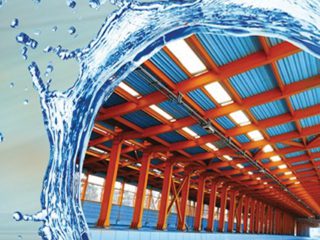
A new study focused on the possibility of using siloxane resins with epoxy modification to delay corrosion of metal substrates for hydraulic applications.
Formulations aimed at metal protection were designed, without including anticorrosive additives, and deposited on 11SMnPb37 steel. Thin monolayer films were obtained by dip coating in different process conditions, avoiding primers. The developed procedure was simple and able to provide solid and well-anchored coatings. They were characterised in terms of morphology, scratch and wear endurance, and resistance to a corrosive environment. The optimum formulation and deposition parameters were determined and the selected coating showed remarkable adhesion to the substrate, good mechanical properties, and resistance in a saline environment, proving to be suitable as a protective barrier against corrosion. The protective effect was ensured not by additives but through the excellent adhesion of the coating and its endurance to scratch and wear.
Global liquid and powder coatings supplier Axalta, has recently launched what it calls the first premium universal thermosetting powder primer available in the world. Alesta ZeroZinc UniPrime has been released in the EMEA region and is available from local Axalta offices.
According to the company, like other products in the Alesta ZeroZinc range, UniPrime has been formulated in accordance with High Density Ccrosslinking technology to prevent corrosion and extend a painted structure’s working life. The epoxy resin-formulated primer is reportedly easy to apply and meets stringent anti-corrosion requirements.
ZeroZinc UniPrime can be applied to all types of substrates, including steel, hot dig galvanized steel, metallised steel, aluminum, etc. It can also cover hard-to-reach places and demanding shapes, such as expanded metal, perforated sheet steel and sharp edges, concluded the company.
In a leaked confidential report, it’s been suggested that Paris’ Eiffel Tower is in poor condition given the amount of rust plaguing the structure.
According to the French magazine Marianne, who received the leaked report, the monument requires a full repair which experts have noted would involve stripping the structure to bare metal, various repairs and repainting.
Completed in 1889, the Eiffel Tower in Paris was constructed as part of the world’s fair. Designed and built by civil engineer Gustave Eiffel, the historic landmark stands 324 meters (nearly 1,063 feet) tall and is made of 7,300 tons of puddle iron—giving the structure its nickname, “The Iron Lady.”
Puddle iron was invented in Britain during the Industrial Revolution through a process that produced high-grade and purer wrought iron by removing carbon from pig iron in the melting process. These metal pieces were then placed together with what is estimated to be 2.5 million rivets.
Before officially opening to the public, the Eiffel Tower
received four coats of red lead paint. Although banned today, at the time lead paint was believed to be the best anti-corrosive agent. Despite its ability to prevent corrosion, Eiffel suggested that the structure would need to be repainted every seven years.
According to the report, despite regular maintenance coatings work, the tower requires more than the current 60 million euros ($61.2 million) painting “facelift” its undergoing. This recoating work on the structure is still underway as Paris prepares for the 2024 Olympics.
The European Corrosion Congress – EUROCORR, the EFC’s annual conference, is the flagship event of the international corrosion calendar. Attracting upwards of a thousand delegates, it is held every year in September in a different European country. EUROCORR is famous for its high technical standard and its popular social programme.
For more information, and to view the programme, go to www.eurocorr.org
This book is a personal history of Raouf Kattan and his involvement in marine coatings. It focusses on his life, the influences, factors, adventures he had, which resulted in his establishment of Safinah Ltd, as a consultancy to the marine industry. He describes working with the main players in the industry internationally, and the enjoyment, and tribulations, he felt during his career.
Raouf has written many technical articles about the marine coatings industry and its problems throughout his career, including several in this magazine.
This is an interesting history of the marine coatings industry over 30 years from one professional’s experience, and hopefully could encourage newcomers to the industry that there is great career to be had in marine coatings.
The book is available as a free downloadable ebook at, https://www.safinah-group.com/beyond-the-pail/
Located around 89 kilometres off the east coast of England, Hornsea 2 is due to be up and running by mid-2022. It has the capacity to produce more than 1.3 gigawatts of energy – enough to power over 1.3 million homes.
The foundations of all the turbines (which tower 204 meters above sea level) have been coated with Interzone 954 from the company’s International brand. Originally designed for the demanding protection of offshore oil and gas structures, the product has now also become the go-to solution for offshore
wind farms.
Protecting turbines right-first-time enables them to continuously operate in the most challenging locations. Offshore wind farms are particularly susceptible to atmospheric corrosion, due to the high humidity and chloride content in the air. The splash zone of each wind turbine – which is intermittently wet and dry due to tides and waves – is the most prone to corrosion.
According to the company, Interzone 954 has a unique blend of properties, including excellent barrier protection, exceptional abrasion resistance and high film build. It’s also resistant to a wide range of chemicals.
We use cookies to optimize our website and our service.
Functional
Always active
The technical storage or access is strictly necessary for the legitimate purpose of enabling the use of a specific service explicitly requested by the subscriber or user, or for the sole purpose of carrying out the transmission of a communication over an electronic communications network.
Preferences
The technical storage or access is necessary for the legitimate purpose of storing preferences that are not requested by the subscriber or user.
Statistics
The technical storage or access that is used exclusively for statistical purposes.The technical storage or access that is used exclusively for anonymous statistical purposes. Without a subpoena, voluntary compliance on the part of your Internet Service Provider, or additional records from a third party, information stored or retrieved for this purpose alone cannot usually be used to identify you.
Marketing
The technical storage or access is required to create user profiles to send advertising, or to track the user on a website or across several websites for similar marketing purposes.