Winn & Coales (Denso) Ltd.’s SeaShield 2000FD™ System was recently specified for the protection of 31 jetty piles at the Royal National Lifeboat Institution’s (RNLI) station in Padstow, Cornwall.
The existing epoxy coating on the piles had begun to fail due to its length of time in service, and abrasion caused by exposure to the local marine environment. The complete coverage of each pile required the installation team from PSJ Marine Services to work at height, from the beach, and subsea to fully protect the 16 piles of 762 mm diameter and 15 piles of 813 mm diameter.
The SeaShield 2000FD System, consisting of Denso Paste S105™, Denso™ Marine Piling Tape and a tough outer HDPE jacket, offers heavy-duty protection from corrosion and is suitable for application both above and below the water line, making it the ideal choice for this project and making Padstow the latest RNLI site to be protected with a SeaShield system., concluded the company.
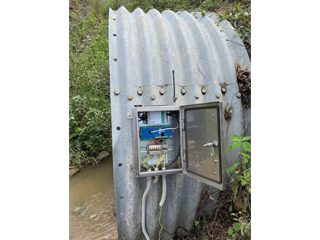
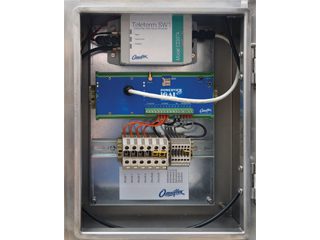
Remote monitoring specialist Omniflex has released the latest in its industry-leading Teleterm range of remote monitoring instruments — the Teleterm SW1 module — an IoT-focused satellite-based remote monitoring module for the global cathodic protection (CP) market. Suited for use in a variety of applications, such galvanic CP installations on highways, bridges and pipelines in remote locations, the SW1 enables satellite-based remote monitoring and control where there is limited mobile connectivity and power supply.
The new SW1 remote monitoring module is solar powered using a tiny built in solar panel, so it requires no additional connections to power, and has no specialist set up requirements, other than requiring a clear view of the sky. It uses the low-cost Swarm satellite constellation, which provides 100 per cent global coverage, meaning users can now benefit from remote monitoring in environments where it was not previously possible due to the lack of mobile phone coverage, such as remote highways, pipelines and offshore installations, concluded the company.
Aquatec has won OTC’s 2022 Spotlight on New Technology Award and ASME’s 2022 Albert Woelfel Best Mechanical Engineering Achievement Award.
The company received the Small Business Spotlight on New Technology Award for its KINEKtron® Retrofit Subsea Strain Measurement System, an innovative technology developed to measure and communicate strain levels on structural tubular members, pipelines, and other load-bearing infrastructure. The OTC-exclusive award recognises broad interest technologies that are innovative, marketplace-ready, and positively impact the industry.
Also, for its KINEKtron® system, the company received ASME’s (American Society of Mechanical Engineers) prestigious Woelfel Best Mechanical Engineering Achievement Award. The Woelfel BMEA Award recognises a company for a product, device, or system displayed at the OTC Conference that best reflects innovation and practical use of mechanical engineering in solving problems, improving design, or maximising performance.
Left: 2022 Spotlight on New Technology Award 2022
Right: 2022 Woelfel Best Mechanical Engineering Achievement Award
The questions in this issue feature, the possible corrosion impact of oxygen, and use of different zinc-based coatings.
Question:
In an oil and gas development I am working on in the Far East, a concern has been raised about possible corrosion impact due to excess oxygen. The current plan for gas lifting wells is to use N2 with 96% purity, with the remaining 4% oxygen. With operating pressures of 2300 – 2800 psig (at 1 mmscfd), this means that there will be a high level of O2 seen in the produced fluids. The production casing is carbon steel (CS) and the tubing material, 13 Cr steel is used in two wells, and carbon steel used in one well. The N2 gas will be delivered to well head platform via 850 m of flexible flowline (plastic material designed for high pressure) and then injected down the annulus. The production from the wells flows to a FPSO for further processing.
We are looking to reduce oxygen in gas phase and currently thinking of using an oxygen scavenger. Appreciate your expertise to advise on how these issues can be overcome. CM
Answer:
With this application there are two different issues to discuss.
• 13CR corrosion in the tubing
With 4% oxygen in the injected gas at these high pressures it would be expected that the dissolved oxygen in the production stream would be very high, and that the aqueous phase to be fully saturated with oxygen. In theory, some oxygen is helpful for CRAs (Corrosion Resistant Alloys) as they can form a protective film with oxygen. This complex film formed contains the structure, -Cr-O-Cr – O-Cr-, with chromium surrounded also by water ligands, and this makes the excellent protective film on the metal surface. However, it has been known (especially in the presence of high chlorides with 13Cr) that high oxygen may lead to deep pitting. This is because chloride gets inserted in this chromium oxide complex and weakens it, which can lead to the rupture of the protective film. The corrosive fluids with oxygen can now contact the metal surface and lead to serious pitting corrosion. As noted, a small amount of oxygen is a good thing for CRAs, but higher levels may lead to failures.
• Carbon steel corrosion
Carbon steel tubing in the annulus and one of the wells may undergo heavy corrosion in the presence of oxygen. Oxygen generally is more corrosive than CO2 or H2S. The by-products (magnetite or hematite) from oxygen corrosion are not protective, so will not protect the steel under any circumstances. This is a situation (very high oxygen) where oxygen scavengers are not cost effective and are also very difficult to apply to a gas stream. Although not an easy option, inhibition can be used in some instances for oxygen corrosion, but It is important that the product be selected in the correct manner as not all inhibitors are effective against oxygen corrosion.
In this situation, the best overall solution would be to reconsider the gas used for the gas lift system and use a source that does not contain oxygen. This would solve the issue in both annulus and tubing, although if other corrosive species are present CO2 /H2S this would need to be assessed as well. Even with dry gas if there is fluid in the annulus of the well, the gas will get re-saturated with water during injection, so would not be a solution. If this is not an option, inhibition could be considered, although it is very important to use a good oxygen corrosion inhibitor and inject so it that it will inhibit both the annulus and production fluids. The product (s) need to selected correctly to account for the oxygen present, and the application needs to ensure that distribution in the gas and water phase in the product fluids occurs.
George Winning, Clariant Oil Services UK Ltd Question:
“Zinc-based coatings can provide long term corrosion protection for steel substrates. What is the difference in zinc thickness needed between galvanising, thermal metal spray, and zinc-rich coatings, to give maximum life to first maintenance in different exposure conditions, and what are the cost implications?” K McKee
Answer:
A good question but the answer is probably more complex than you might expect!
Firstly, the corrosion protection system selected needs to be able to achieve the required corrosion protection in the given service environment. On this basis, zinc rich paints alone would not be widely used for primary corrosion protection, and where they are used, it is probably limited to category C1 (low corrosivity environments) as described in ISO 9223. There is no specific guidance on the coating thickness for a zinc rich paint, although they are typically used for touch-up and repair of small areas of damage to a galvanized coating where a coating thickness of 100 microns is required. The cost of application may be less than alternative systems but then the level of protection provided is limited with more frequent maintenance schedules being required!
Batch hot dip galvanizing (e.g. galvanizing after fabrication) is the most commonly used means of applying a zinc coating for corrosion protection. The process is conducted to BS EN ISO 1461 with the coating thickness requirement varying from 45-85 microns dependent upon steel section thickness, although thicker coatings up to 140 microns may be specified if steelwork is grit blasted before hot dip galvanizing. For most atmospheric applications an 85 micron galvanized coating will typically achieve a coating life of 60 years in many atmospheric environments, although thicker coatings may be specified for more corrosive environments. The cost for hot dip galvanizing is charged on a pounds per tonne basis using the as-galvanized weight of the article. Costs may vary according to the size and weight of an article and the volume of work to be processed.
Thermal spraying tends to be conducted on large solid structures which are literally too big to hot dip galvanize and while a zinc coating can be applied, often a zinc-aluminium or aluminium coating is preferred. The process is covered by BS EN ISO 2063 and typically a minimum coating thickness of 100 microns or more would be specified, although this may be increased significantly for corrosive environments. A final point to note is that due to a thermal sprayed coating not being fully dense, an organic sealant often has to be applied. The cost of thermal spraying is typically greater than that for hot dip galvanizing, in part due to the need for steelwork to be grit blasted, the application of an organic sealant, and
the limited number of coating applicators.
Dr Desmond Makepeace, Technical Executive, Galvanizers Association
The following documents have obtained substantial support during the past two months and have been submitted to the ISO member bodies for formal approval.
IISO/DIS 16961 Petroleum, petrochemical and natural gas industries — Internal coating and lining of steel storage tanks 2022-06-07 (Revision of 2015 standard)
ISO/FDIS 18768-1 Organic coatings on aluminium and its alloys — Methods for specifying decorative and protective organic coatings on aluminium — Part 1: Powder coatings
ISO/FDIS 18768-2 Organic coatings on aluminium and its alloys — Methods for specifying decorative and protective organic coatings on aluminium — Part 2: Liquid coatings
New international standards published during the past two months
ISO 2080 Metallic and other inorganic coatings — Surface treatment, metallic and other inorganic coatings — Vocabulary
ISO 23721 Corrosion of metals and alloys — Rating method by appearance of rust and stains of atmospheric corrosion for stainless steel
Belgian anti-corrosion coating company Acotec, has recently announced the launch of its one-layer protection coating for the wind farm industry, Humidur WF22. According to the company, this product is based on their all-weather offshore coating technology, reportedly delivering protection against aggressive humidity and seawater exposure.
The new product reportedly offers over 35 years of protection in highly corrosive environments. The one-coat system is cost-effective in that it reduces application time, labour costs and level of waste.
The coating has been proven to cure under water, including at freezing temperatures, allowing the structure to be submerged right after application. The coating is also 100% solids, containing no solvents, heavy metals, isocyanates, or VOCs, concluded the company.
We use cookies to optimize our website and our service.
Functional
Always active
The technical storage or access is strictly necessary for the legitimate purpose of enabling the use of a specific service explicitly requested by the subscriber or user, or for the sole purpose of carrying out the transmission of a communication over an electronic communications network.
Preferences
The technical storage or access is necessary for the legitimate purpose of storing preferences that are not requested by the subscriber or user.
Statistics
The technical storage or access that is used exclusively for statistical purposes.The technical storage or access that is used exclusively for anonymous statistical purposes. Without a subpoena, voluntary compliance on the part of your Internet Service Provider, or additional records from a third party, information stored or retrieved for this purpose alone cannot usually be used to identify you.
Marketing
The technical storage or access is required to create user profiles to send advertising, or to track the user on a website or across several websites for similar marketing purposes.