


The cart is empty!
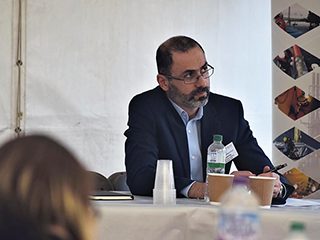
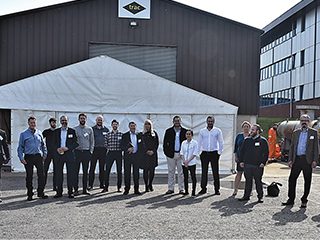
The branch was extremely pleased to be able to hold their first post-covid ‘Face to Face’ event on 24th August 2021 at the premises of hosts TRAC Oil & Gas Ltd, which included a range of technology demonstrations, kindly compiled by Mike Dixon (NDT Technical Manager) and Ian Somers (TRAC Compliance Manager – Executive Director of IRATA International), with the proceedings chaired by 2021-2022 branch chair Hooman Takhtechian. This Annual Corrosion Forum also comprised eight presentations by speakers from various companies, all very active in the integrity management field.
The event attracted over 30 delegates who enjoyed an interesting programme themed on ‘External Corrosion Management’ which remains a major issue in North Sea Oil and Gas operations.
For most, this was their first public meeting in nearly 18 months of home-working, and the relaxed atmosphere and relief was clearly evident after 3 covid waves, numerous covid tests, and long queues for vaccinations.
Dr Mehdi Monir, Senior Corrosion Engineer (Oceaneering), commenced the proceedings with a very comprehensive introduction to the principles of external corrosion, and the key deterioration mechanisms found within the Oil and Gas industries, together with common mitigation strategies. The environmental factors that drive corrosion pitting and cracking were clearly explained, along with how these influence corrosion rates in various regions of the world, with the UK marine environment being particularly aggressive.
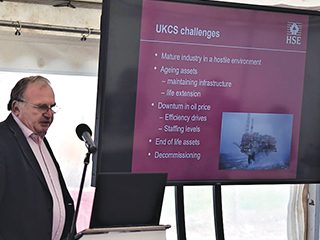
Walt Doxford, Specialist Inspector for the Offshore Division of HSE, followed on with an explanation of the HSE regulatory requirements and recent experiences from their viewpoint for a mature industry operating in a hostile environment, key issues being:
- Atmospheric external corrosion
- Bolting corrosion
- Corrosion of / at pipe supports, (in particular trunnion supports).
- CUI, (corrosion under insulation)
- Deck penetrations
- FM (fabric maintenance) in later life assets
This was in the context of many ageing assets approaching COP (cessation of production) and the drives by operators to reduce staffing levels and vendor visits to site.
Mike Adams, Director of Eden Asset Integrity Ltd, then considered this all from the Inspector / NDT Technician’s point of view (at the front line and often forgotten), and emphasised the need for corrosion engineers to correctly direct the industry workforce, so that NDT inspections are
relevant to the likely corrosion and erosion mechanisms occurring, and which may be due to:
- Changes in process corrosivity.
- Local increases in fluid velocity or changes in direction.
- Wherever a microbe just happens to settle down.
- Where surface wetting occurs.
- Where mineral or corrosion scale builds up or breaks down.
The NDT technician needs to know the expected form of damage, so that they can select the right technique, and because most NDT is just a sample of the total surface area, where to look, as without such information serious damage may be missed with consequential in-service failures.
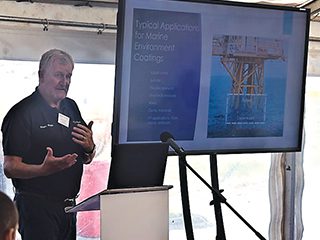
Colin Fowlis (Operations Manager) and Stuart Rennie (Commercial Manager) – Presserv (UK) Ltd, gave a great introduction to external mitigation by coatings covering all aspects of surface preparation technologies and available coating types on the theme ‘Coatings – The 1st line of defence against corrosion’ and highlighted that 50% of external corrosion costs are preventable (through regular fabric maintenance programmes).
The critical considerations for coating material selection were discussed including:
- Climatic conditions.
- Ease of application.
- HSE considerations.
- Mechanical characteristics.
- Overall lifetime cost (including future maintenance).
- Suitability to environment.
- Supply logistics.
- Tolerance to surface.
Frances Chalmers, Technical Consultant of Plant Integrity Management Ltd, continued the proceedings with a ‘Whistle-stop tour of CUI Management” including CUPS (corrosion under pipe supports), and reviewed the key regulator recommendations of the HSE-led CUI forum held on 31st May, which were:
Regulator Viewpoint, point 1
- Establish an effective CUI management scheme.
- Meeting good practice alone may not be sufficient to comply with the law (avoidance of prosecution in the event of an incident and/or issue of HSE improvement notice). i.e. The installation must remain safe in all respects.
Regulator Viewpoint, point 2
- Do what you say you’re going to do.
- Be clear about progress and CUI priorities.
Regulator Viewpoint, point 3
- Conduct suitable inspection at a frequency to permit detection and remediation of deterioration in good time.
Frances went on to describe CUI management strategies in great detail for asset early life, mid-life, and late-life situations, and RBI approaches, in consideration of all key factors and noting that CUI corrosion rate data can vary significantly for individual plants and locations (operating environments). A traffic light system was proposed for insulation anomalies and for assessing the degree of damage and risk. The manner in which a CUI defect finally fails being most usually related to its operating pressure, i.e. sudden burst (at high pressure) or weep/seep (at low pressure).
Frode Wiggen, Snr. Principal Engineer DNV, closed the morning session with a “virtual’ presentation and outlined the new DNV CUI Manager software, for managing the significant threats posed by CUI, developed under a joint industry project, resulting in DNVGL-RP-G109 methodology that facilitates structured continuous assessment and documentation of present and future CUI risk. This new project was first outlined at the SPE Corrosion Conference in June 2021, and may be found at https://www.spe-aberdeen.org/wp-content/uploads/2020/11/Thurs_DNVGL-RP-G109-presentation-rev-1.pdf
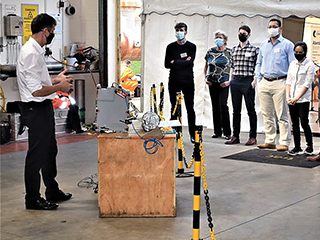
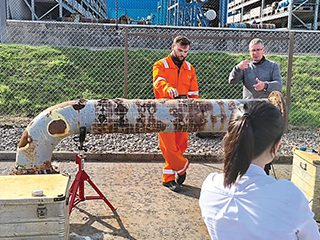
In the afternoon and after catering courtesy of our hosts, delegates were treated to an excellent series of NDT demonstrations highlighting the very latest technologies deployed in the energy and other sectors by TRAC, who are long-time supporters of the branch and its technical programme.
The event went off successfully and the branch are extremely grateful to TRAC for their hard work in making it possible for everyone.
The successful Corrosion Forum approach of blended learning, (virtual, plus face-to-face teaching), will surely continue in the years ahead, as we all seek to avoid unnecessary travel, in the desire by all to meet ever stricter environmental targets and avoid further pandemics.
All the technical papers for the event can be found at, https://sites.google.com/site/icorrabz/ and also at Aberdeen Branch – Institute of Corrosion (icorr.org) under “Local Technical Programme, August 2021”.
A reminder that the branch is inviting applications for the 2022 ICorr Young Engineer Programme (YEP), which it is pleased to support, following in the footsteps of the highly successful and extremely popular London Branch programmes. For its Aberdeen rotation, the YEP course will reflect the extensive locally based Oil and Gas related Industries, and of course also the rapidly growing Renewables Energy Sector. Please contact Hooman Takhtechian, HTakhtechian@oceaneering.com, if you are interested in participating in this.