Digital Strategy Update

Digital Strategy Update

As we continue developing The Institute of Corrosion’s online presence both via the website and our increasingly popular social media channels our attention has turned to the user experience people enjoy (or don’t enjoy) when they interact with our organisation online.

With traffic increasing across all platforms, it is now important that when people do visit the website, they can find what they want quickly and easily. It is also important that our members’ experience is an enhanced one and that there are benefits in terms of resources and functionality. Our overall aim is to create a ‘best in class’ website for both the public and our members with an array of new features aimed at creating a better user experience.

The starting point for this part of the project is to find out what those new features need to be, and you will have hopefully taken part in the recent members survey to air your views on what you feel is important and what would be beneficial. This feedback will be vital in steering our thinking in future developments, so thank you to everyone who took part. We will be assessing the responses over the coming weeks to develop an overall development plan. If you missed the opportunity to take part in the members survey but would like to voice an opinion, please email admin@icorr.org and we will ensure your comments are taken on board.

The overall digital strategy continues to deliver some encouraging results, monthly visitor numbers to the website continue to be strong with over 2000 visitors a month using the website.

The Institute’s social media channels continue to go from strength to strength with over 6400 followers on Linkedin. Our social media posts have been enhanced by a series of video snippets promoting video presentations at branch events and the CED Day, which are now available on the website. Video content is an area which we plan to develop, so if you have and conferences or events which you think may be suitable, let us know and we can discuss setting up a campaign.

As members you can help by liking, sharing and engaging with the content that we put onto social media. We are always interested in potential new content so If there is anything that you would like to see more of, please let us know via the usual channels or a direct message on social media.

Welcome new Sustaining Member – SEM

Welcome new Sustaining Member – SEM

SEM believes that technology, industry, and conservation can – and should – work together to sustain people and our planet. Each of their chemical solutions embodies that ethos, they also harness innovative ideas and create new technologies with tried and tested methodologies. The end result – a safe, clean and productive equipment and infrastructure is maintained, while protecting personnel and preserving the environment, and conserving health and wealth.

Young ICorr Events 2021

Young ICorr Events 2021

Young ICorr have been exploring options for future events in 2021, including a series of online events over a 12-month period called, “Meet your Mentors”. These events will allow young engineers to network and engage with experienced industry and academic professionals across a number of disciplines. In addition to this, depending on local restrictions, an event will be held in London, UK, in person towards the end of 2021.

You can follow Young ICorr on LinkedIn to find out more information about previous events, and to ensure you do not miss out on future events.

The President Writes …

The President Writes …

Welcome to the summer edition of your magazine – at last it feels like some good weather has arrived and for me it’s felt a long time coming
this year.

Although things tend to slow down a bit over the summer months ICorr continues to move forward and there is a lot happening in the area of training, so I’ll focus on that for
this issue.

We have identified some gaps in our broader corrosion engineering training offering and have progressed with two new courses, 

  1. Microbially Influenced Corrosion (MIC):  We recently signed a contract with Tony Rizk to develop a training course for MIC. Tony is a leading practitioner on MIC and, more importantly, how to control it, and we are delighted to have partnered with him on this project. The course content should be finished this year and be available in 2022.
  2. Production Chemistry:  At the end of 2020 BP generously donated their training materials related to production chemistry to ICorr.  George Winning and myself are now working to turn this into a more generalised training programme which will provide corrosion practitioners with the relevant knowledge of production chemistry problems, and how they relate to corrosion and corrosion control activities. The initial focus will be on oil and gas production.

David Mobbs and Sarah Vasey recently ran a pilot programme for our new Fire Protection Coatings Inspector (level 3) training course with key industry practitioners. This was very successful, and provided useful feedback which will be incorporated into the programme.

We are also excited to have recently signed non-disclosure agreements with the Brazilian corrosion society (ABRACO) which will allow us to work together to develop training programmes for Brazil. Many thanks to Lucia Fullalove and Kevin Harold for making this possible.

The development and updating of our training programmes is covered by our training strategy, and this is now in need of a refresh which will be undertaken in the autumn with around ten ICorr members who are actively involved in developing our training materials.  Related to this is a discussion around the best format(s) of our training materials, e.g. classroom, virtual classroom, on-demand.

If you have any thoughts or suggestions on which format(s) we should use, or training, I’d love to hear from you using the email address below.

I hope you are able to take a break over the  summer and get some well-deserved rest.

Until next time,

Bill Hedges, Institute of Corrosion President
Email: president@icorr.org

Passive magnetometry based corrosion monitoring and mechanistic simulation – Aberdeen Technical Talk

The branch held its last technical meeting of the 2020/2021 session on 25th May with guest speakers Sieger Terpstra (Shell Global) and Chetan Laddha (Sinclair Energy Partners). This most interesting 2-part talk was entitled: ‘Passive magnetometry based corrosion monitoring and mechanistic simulation.’

In corrosion monitoring there are a number of NDT techniques both automated and non-automated which can be used to detect and monitor integrity anomalies, but these techniques have limitations for remote areas like ‘normally unmanned Oil and Gas platforms (NUI’s) and for locations requiring rope access teams (RAT’s). Additionally, they all require power to be provided for active probes / magnets and to enable wireless operation / data transfer. The Shell Global WiSense project which has been under development for many years, solves most of these issues as it can run on batteries for a 5-year time span and eliminates the need for routine NDT Inspector access, which is a great benefit in hazardous areas. It also eliminates human error in NDT measurement. The WiSense project uses passive magnetometry, a measurement principle that allows monitoring of localised and non-aged based degradation mechanisms, which pose a higher threat than uniform wall loss mechanisms. The passive magnetometry based corrosion monitoring technology has been developed to facilitate area coverage at the target CML’s (corrosion monitoring locations) and provides continuous automated monitoring. Another major advantage is that the sensors do not require any contact with the metal surface – allowing placement on top of coatings or thin insulation and providing frequent, repeatable measurements for trend detection.

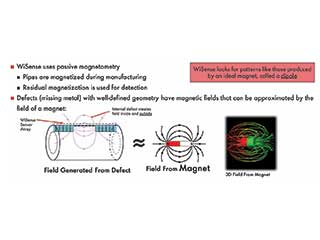
When pipes are manufactured they become magnetised and this residual magnetisation can be utilised for fault detection. Defects or ‘missing metal’ with well-defined geometry create detectable magnetic fields inside and outside the pipe. WiSense is a Non-Intrusive flexible patch containing arrays of 3 axis magnetometers sitting on the outer side of the pipe. The magnetometers sense the pipes’ residual magnetic field, and time series subtraction differentiates defect fields from the common pipe baseline magnetic field. The sensor array within the mounted patch produces B-field ‘maps’ resembling dipole patterns and the built-in algorithms find corroded regions by searching for these dipole patterns. The WiSense patch can be deployed in a number of different pipework configurations including straight and elbow sections,

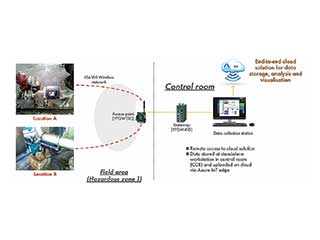
reducer /diffusers, injection points, valves and orifices. The installations from area locations can be monitored on a wireless network through an access point to the control room gateway and a data collection station.

In order to identify defect types, templates are set up by recreating typical defects on pipes using Teflon masking and acid etching of the surfaces to create different types of defects that can then be scanned by the system and used as a model to identify the real and naturally created defects on the pipe. This has been performed on straight and elbow bent pipes both inside and outside. Validation testing can be performed by acid etching on the inside of the pipe while the sensor is on the outside of the pipe monitoring the defect being created. As the magnetometers are detecting dipoles, which are essentially point sources, it is important that real defect geometry is included in the models as they have lateral dimensions and depth, and it leads to a better match than a pure dipole. The technology has been piloted for over 3 years at multiple facilities in downstream as well as upstream areas of Shell operations. Additionally, the technology has gone through independent validation testing with TWI to verify its performance.

In the second part of the talk, the practical benefits of the WiSense technology were further described in relation to commonly applied chemical treatments for corrosion prevention. A mechanistic model was developed to simulate the performance of corrosion inhibition and thereby prediction of inhibited corrosion rates. The overall impact and benefits from corrosion monitoring technology can be significantly enhanced if they are used in parallel with a prediction or simulation technology. The root cause of the majority of Loss of Primary Containment (LoPC) incidents or accidents can often be traced back to degradation mechanisms.

The main driver behind this project development has been that corrosion inhibitors are provided as a “black-box” from the suppliers (exact formulations being closely guarded secrets), which makes it extremely difficult to model the performance of corrosion inhibitors. Additional electrochemical modelling allows testing and simulation of the piping process inhibition mechanisms, without needing to know the underling chemistry of the inhibitor chemical. The simulation can be used to identify both over and under inhibited systems and further, to reduce the cost (corrosion inhibitor qualification programmes. The corrosion monitoring and prediction technologies are used as two complementary tools. Using each tool on a standalone basis has limited value and applicability, however integrating prediction with a real-time feedback loop from sensing allows a step-change in integrity management capability. The combined technologies can help with generating early warnings of integrity issues and facilitate the transition to predictive operation and maintenance.

Upcoming Events:

The branch has several significant events scheduled for later in the summer, including its Annual Corrosion Forum (ACF) on 24th August. This year the event will be held at the TRAC Oil and Gas premises close to Aberdeen Airport.  This will be the first branch event in more than a year to be held in person. The theme for the ACF this year is external corrosion management. The programme consists of 8 presentations from speakers from various companies, all very active in the integrity management field. Practical demonstrations in the TRAC workshops will follow in the afternoon. Those interested in joining this event should register their interest with the branch events co-ordinator, Amir Attarchi (amirattarchi@gmail.com), giving full name, company and contact email address

The branch is also supporting the Institute’s ‘Fundamentals of Corrosion for Engineers (FOCE)’ course, which is to be held between 13th – 17th September at the Aberdeen City Jurys Inn Hotel. This course is designed to provide non-corrosion specialists with insights into the principles of corrosion processes and causes which are specific to a range of common industries including: concrete, coatings, cathodic protection, oil and gas, water and renewables sectors. This an intensive one week, classroom-based course with an examination
on the final day.

Applicants will gain a basic understanding of underlying corrosion processes in a wide range of industries which may offer career growth to an engineer, or to anyone who wants to investigate potential job opportunities in corrosion or related fields. On successfully passing the course exam allows personnel with relatively limited work experience in corrosion to apply for Professional Membership of the Institute of Corrosion.   Those wishing to attend should download the Application Form from the ICorr Website and submit to: admin@icorr.org.  Other general enquiries should be addressed to the Course Leader Dr Jane Lomas on jane7lomas@gmail.com

The branch will also be inviting applications soon for the ICorr Young Engineer Programme (YEP) which it is very pleased to support, following in the footsteps of the highly successful and extremely popular London Branch programmes. For the Aberdeen rotation, the YEP course will reflect the extensive locally based Oil and Gas related Industries and of course also the rapidly growing Renewables Energy Sector. Initial enquiries may be sent to Hooman Takhtechian HTakhtechian@oceaneering.com

A Thank you to Jim Preston

A Thank you to Jim Preston

Jim has been involved with cathodic protection (CP) and structural repair of steel in concrete structures since 1991, starting with Tarmac Construction and their Tarmac Global specialist CP division. This became Corrosion Control Services Ltd where Jim progressed to Director and General Manager. Since 2007 he has been an owner and Managing Director of Corrosion Prevention Ltd. In addition to steel in concrete CP, Jim is an expert in CP for ports and harbours, using both galvanic anodes and impressed current systems. He has also worked in the performance assessment of buried pipelines, including the use of DCVG and CIPS techniques.

He has applied this broad knowledge of CP to the Institute of Corrosion’s Training and Competence assessment of CP personnel. He was also one of the early recipients of the Chartered Engineer award through ICorr, and his application was also the subject of an award for the best in its year from the Certification Body.

Jim has been an active and extremely valuable member of ICorr and the Cathodic Protection Governing Board (CPGB) for many years. Jim was the CPGB Chair for some years and he oversaw the considerable task of the revision of all of the ICorr CP Training Courses in accordance with BS EN ISO 15257. He has passed this responsibility on to Chris Spence.

Jim decided after many years of great service to CPGB that he needed to step back from the committee due to his other commitments.

Jim brought his wealth of knowledge and a was a calming influence to us all at CPGB and on behalf of us I would like to say thank you. His clarity of thought, attention to detail and ability to sort the priorities from those issues of lesser importance have been fundamental in the success of CPGB’s work.

His colleagues also found him to be a calming influence, with far too much common sense for an engineer. He will be missed.

I think that it goes without saying, that on behalf of us all at CPGB,  we would like to offer thanks to the time, dedication, and effort, that Jim has put in to ICorr.

Bill Hedges, President of ICorr, and Chris Spence, chair of CPGB.