The 61st Corrosion Science Symposium (CSS) will be held online during the week commencing Monday 14th September 2020. The CSS Online is the annual meeting for students and researchers working in all areas of Corrosion Science and Engineering. The CSS has been held annually since its launch in 1960 by Prof. L.L. Shreir. Holding a physical event was not going to be possible this year but we believe it is important to keep the CSS running even during these COVID times. There will be no charge for the event.
Abstracts are still being accepted. Please contact Julian Wharton (j.a.wharton@soton.ac.uk) if you wish to submit an abstract.
With the alternative online arrangements, we plan a programme of several sessions staggered through the week. Each session will focus on a series of short (10 min) presentations with extended abstracts made available beforehand. The sessions will be immediately followed by more in-depth online open forum discussion with the presenters.
A key highlight for every CSS is U.R. Evans plenary talk and presentation of the award. The UR Evans Award is the most prestigious ICorr award and recognises outstanding contributions to corrosion science and engineering. This year the award is being made to Prof Robert Cottis. Prof Cottis has been a champion of corrosion education throughout his entire career with seminal contributions within UMIST/University of Manchester and activities linked to the European Federation of Corrosion (EFC) WP6 Corrosion Education and NACE International.
The use of drones for aerial inspection and survey is increasing, and their usefulness is set to increase with a demonstration by AmeyVTOL of a drone inspection carried out beyond the visual line of sight.
AmeyVTOL is a joint venture between Amey and aerial robotics specialist VTOL Technologies. AmeyVTOL’s drone, known as The Flying Wing, has a flight range of up to 100 km, and sensors that enable it to capture and send data in real time.
During the demonstration, The Flying Wing autonomously surveyed an area out of the sight of the pilot up to 2km away.
According to Amey, the success of the trial opens up the use of drones for inspections of long linear infrastructure such as roads, railways and overhead power lines, saving time and cost, and improving the safety of staff.The demonstration project was part of a government-sponsored Rail First of a Kind (FOAK) programme promoted by Innovate UK through the Small Business Research Initiative.
It is reported that AmeyVTOL will now be offering this survey capability to other infrastructure owners and operators.
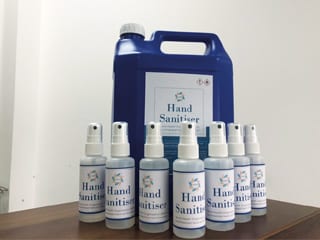
Hexigone Inhibitors, a Sustaining Member Company, who usually manufacture chromate-free corrosion inhibitors, are now using their large mixing vessels to produce hand sanitiser to help protect staff on the front line. The sanitiser, which meets the standard set by the World Health Organisation, is already in use in local organisations.
The UK Government’s innovation agency, Innovate UK, linked-up Hexigone with pharmaceutical giant, Glaxosmithkline, who subsequently donated 8,000 litres of isopropanol to ramp-up production.
For the sanitiser to be effective, it must contain at least 60% alcohol. The batches made by Hexigone are 75% – precisely made to the WHO recommended formulation – ensuring that the coronavirus and other microbial pathogens are killed. Other ingredients include water to dilute, glycerol to moisturise, hydrogen peroxide to kill any fungal spores, and finally, lemongrass essential oil to scent
the sanitiser.
A recent report described the effect of graphene on the corrosion of zinc particles in waterborne epoxy zinc-containing coatings.In the study, graphene/ waterborne epoxy zinc-containing coatings with different graphene contents were prepared, and their corrosion resistance properties were investigated by electrochemical impedance spectroscopy (EIS), immersion testing and neutral salt spray.
The results showed that addition of 0.6 wt% graphene into the coating could remarkably improve its cathodic protection and barrier performance compared to the coating without graphene.
In addition, the effects of graphene on the corrosion evolution of zinc particles in the coating were studied by the field-emission scanning electron microscopy (FE-SEM) coupled with energy dispersive spectroscopy (EDS), which showed that the zinc particles near the interface between a steel substrate and the coating corroded first after the corrosive media diffused into the coating.The zinc particles then continued to be corroded from the interface to upper part of the coating as they provided cathodic protection to the substrate due to the electrical connection of graphene.X-ray diffraction (XRD) patterns confirmed the corrosion products of the zinc particles were mainly consisted of Zn5(OH)8Cl2.H2O.
The study was published in Progress in Organic Coatings, Volume 140, March 2020.
This new study focused on the enhanced corrosion resistance and weathering resistance of waterborne epoxy coatings with polyetheramine-functionalised graphene oxide.Polyetheramine (D230), an epoxy curing agent, was grafted on graphene oxide (GO) surfaces, which can be stably dispersed in a waterborne curing agent for more than 8 months. Waterborne epoxy coatings reinforced by D230-functionalised GO (DGO) were applied on carbon steel surfaces.
According to the electrochemical impedance spectra, the impedance modulus at 0.1 Hz remained at 2.2×10⁹Ω after 150 days of immersion in 3.5% NaCl with a 0.2 wt% DGO-reinforced waterborne epoxy coatings, whilst that of the neat epoxy coating dropped below 1×10⁷ Ω after 10 days. In addition, the addition of DGO was found to enhance the weathering resistance of waterborne epoxy coatings.After 60 days of the UV aging test, the yellow colour index of a neat epoxy coating was 1.6 times that of a 0.5 wt% DGO/epoxy coating. The residual pencil hardness of the 0.5 wt% DGO/epoxy coating was three levels higher than that of neat epoxy coating.
The study was published in the Journal of Coatings Technology and Research, Volume 17 (2020).
A report has been published recently comparing the abrasion resistance of conventional vinyl-based coating systems, polymer with polymer matrix composite coatings, fibrous polymer coatings, and ultrahigh molecular weight polyethylene (UHMWPE).
There is an increased demand for abrasive wear-resistant coatings that add durability to steel hydraulic structures, particularly for those subjected to flowing water with debris and alternate wet/dry cycles. These coating systems provide not only corrosion and chemical resistance, but also good erosion and abrasion resistance to the metallic surfaces, which are constantly exposed to flowing water containing sand particles and debris. Generally, vinyl-based coatings are used on hydraulic steel structures to protect them from corrosion and abrasion.
This new study, by U.S. Army Corps of Engineers, evaluated the abrasion of six coating systems using a reciprocating abrader under dry and wet conditions. The wettability of the coating systems and its effect on the wear rate under the presence of water was also studied. In addition, scanning electron microscopy of the wear tracks on different coatings was conducted to study and identify their failure mechanisms.
Based on the results, UHMWPE and polymer–ceramic composite coatings were found to perform significantly better than the conventional vinyl-based coatings.
The study was published in the Journal of Coatings Technology and Research, Volume 17 (2020).
We use cookies to optimize our website and our service.
Functional
Always active
The technical storage or access is strictly necessary for the legitimate purpose of enabling the use of a specific service explicitly requested by the subscriber or user, or for the sole purpose of carrying out the transmission of a communication over an electronic communications network.
Preferences
The technical storage or access is necessary for the legitimate purpose of storing preferences that are not requested by the subscriber or user.
Statistics
The technical storage or access that is used exclusively for statistical purposes.The technical storage or access that is used exclusively for anonymous statistical purposes. Without a subpoena, voluntary compliance on the part of your Internet Service Provider, or additional records from a third party, information stored or retrieved for this purpose alone cannot usually be used to identify you.
Marketing
The technical storage or access is required to create user profiles to send advertising, or to track the user on a website or across several websites for similar marketing purposes.