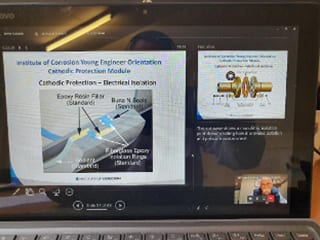
The Young Engineer Programme once again displayed its adaptability as for its June meeting it adopted a new format for the online presentation, and welcomed the host Trevor Osborne for a discussion on cathodic protection.
The former President of ICorr and Managing Director of Deepwater Corrosion Services, with over 40 years of experience in oil and gas, shared his knowledge and specialised understanding in the new look presentation.
The adapted format saw the usual three-hour presentation replaced with it being sent a week in advance to the delegates. Trevor talked about corrosion, and the importance of the Galvanic Series, types of CP, standards and their importance, testing and inspection, failures and Field Joint Coatings.
Among other talking points, Trevor highlighted how electrical isolation in cathodic protection offers three main benefits, as it restricts the required protective current to the surface of the primary structure to produce a uniform polarised level of protection. It also minimises stray DC current interference and prevents galvanic current between metallic structures.
It was the decision to send the presentation to delegates in advance that proved to be the biggest revelation of the evening though, as it allowed questions to be prepared for the following Q&A session, with answers fielded by Trevor and collated by Principal Engineer at INTECSEA, Anthony Setiadi.
The knowledge displayed in the questions showcased the level of understanding within the industry with many of the questions prompting detailed answers from Trevor that caused him to draw from much of his considerable experience in the industry.
“I was extremely encouraged by the response from all of our delegates,” said Trevor Osborne when reflecting on the evening’s presentation. “and it shows the incredible level of interest and knowledge that the young people have within the industry. The future is certainly bright.”
When measuring how well a digital marketing strategy is progressing, there are many metrics which can be measured. However, we should remember the goals for our digital efforts – primarily to drive traffic to our website via organic acquisition (that is growth achieved by our content strategy, and not by paid means such as pay per click advertising).
It is this growth (for example in followers on LinkedIn) that we can market membership and training to – ICorr’smajor business objectives.This review of our progress focuses on three metrics of growth:
• Website visits
• LinkedIn followers
• ‘Click-throughs’
Website Visits
We are posting content on our website to generate interest in ICorr and what we do, but if this is not interesting, informative, or enjoyable, visitors won’t engage with it, and we won’t encourage them to return.We want visitors to return as they are more likely to become engaged with our content and share it – and that promotes organic growth.
Visitor numbers
In the 30 days prior to this review, the ICorr website received 11,761 page views across 4,850 sessions – an increase of 11% and 21% on the previous 30 days respectively. The countries where most sessions derive from are, UK, USA, India, UAE, and Malaysia.
User numbers are up from 3,142 to 3,720, and new user numbers have improved from 2,787 to 3,325 over the period. Our highest ‘referral’ sources are LinkedIn and Facebook, with LinkedIn referred sessions increasing by 237% over the month and Facebook sessions by around 48%.
We will continue to post relevant content and link to social media accounts, and consider ways to further engage on social media to drive traffic to website.
Bounce rate
A bounce is when a visitor enters a page on a site but does not interact further – they don’t click through to a second or third page, or to other page elements. Average bounce rates depend upon the type of website. For example:
• Non-eCommerce content websites (probably the closest type to the ICorr website) can expect to have bounce rates between 35% and 60%
•Within the field of science, average bounce rates are around 53%
Our current bounce rate is 58%, so no cause for alarm, but a number that we will maintain a watchful eye on and seek to reduce by adding links to those pages and posts that currently have no links.
Session duration
This is the time a visitor spends on the website, from first clicking on it until they leave, or after 30 seconds of inactivity. The standard for session duration is two to three minutes, and we are currently right in the middle of this range. We are aiming to improve this by using various tactics, including using more images in content, and understanding the ‘customer journey’ better. However, the most important is to include links between pages on the website – people who are interested in the topic are more likely to click through and remain engaged on the site longer.
LinkedIn followers
As part of our content strategy, we have initiated a social media posting on the site strategy. The aim with this is to help share our content through social media, and encourage more people to follow it. By doing this we build a base that can become brand advocates, share our content further, and grow our membership and marketing potential. While we post to Facebook, Twitter, and Instagram, our focus and best results are on LinkedIn:
When we started with our content strategy at the beginning of February 2020, ICorr had zero followers on LinkedIn
•By the beginning of May, this number had increased to 997
•By mid-June 2020, we have seen another increase to 2,417
Our LinkedIn data allows us to segregate these under several headings. For example, by location, job function, seniority of role, and industry.
This information could be of incredible value when marketing – allowing ICorr to market in a more personalised fashion. For example:
• We now have 573 LinkedIn followers who are at entry level – how many of these could be potential ICorr members?
• We have 624 LinkedIn followers who work in the oil and gas industry – what training courses could we market to these?
• We have more than 300 LinkedIn followers who work at large firms (more than 10,000 employees). How can we encourage them to promote us within their firms?
Now that we have built a firm base, we can begin to explore ways in which we can market our memberships and training, including segmentation, email marketing, and targeted campaigns.
Click-throughs
Click-throughs are an indication of digital engagement with our membership. Focussing on LinkedIn again, we are experiencing industry-beating click through rates.A click-through is where a reader of one piece of content clicks through to a linked piece of content. It is usually associated with paid-for advertising campaigns (for example, pay per click adverts on Facebook) or landing pages on websites.
On LinkedIn, our click through rate (to other ICorr content on the ICorr website) was 4.4% in the first two weeks of July. The highest clickthrough rates are experienced in the dating industry! Technology has a click through rate of 2.09%, the average click through rate in eCommerce is 2.90%, and across all sectors, the average click through rate is 3.17% (data from wordstream).
We need to ensure that we continue to provide content that is relevant to our members and link appropriately.
In summary
Our digital strategy is continuing to drive traffic to the website and connect to a larger following on our social media. This is providing the opportunity to engage a larger target audience to whom ICorr can market its membership and training courses.
The first Apprentice Industrial Coating Applicator Scheme students will be put through their End Point Assessments (EPAs) during mid-August. This is a fi rst for our industry and something to be reallyproud of.
Jack Tighe in association with DN Colleges and ICorr have worked tirelessly behind the scenes to make it happen. Then with the recent appointment of BINDT to carry out the EPA with ICorr representation completes the groups involved. Each student has been well schooled by the Jack Tighe’s team and are now getting excited at the prospect of completion.
Training Courses
We are hoping to begin ICATS courses at Corrosion house providing restrictions continue to be relaxed, and will let you know shortly when the next course has been arranged.
Supervisor course dates will be announced shortly.
Online courses
We have been giving online ICATS access to students during lockdown with controls from the trainer, and it is hoped that this proved very useful to those who used it. This will stop on 1st September when the normal system will again operate.
Up-to-date course information can be found at www.icats-training.org
Welcome to the summer issue of the magazine. Even though the lockdown is easing and companies are getting back to more normal operation, there is still little news from the industry to report on. This month, we have two detailed technical articles as well as the now regular “Ask the Expert” and “Fellow’s Corner” columns.
The first technical article is part one of a 2-part guide to CP for offshore renewable energy infrastructures from Brian Wyatt. This looks at the background to protecting near-shore structures and the need for additional requirements. The second article is by Carmen Andrade, the 2020 Paul McIntyre Award winner. Carmen describes the prevention and on-site measurement of concrete reinforcement corrosion, and includes some personal reflections of her career.
I would also like to echo the President’s remarks about printed vs online versions of the magazine, and welcome readers’ comments. I am always interested to receive articles describing technical advances or interesting Case Studies, for possible publication. This is your magazine, so please also let me know if there are topics of interest to you that have not been covered. You can reach me at, brianpce@aol.com.
Welcome to another jam-packed edition of Corrosion Management! I’ve had to content myself with reading the online version of the magazine in recent months as the printed version is delivered to my office at NPL and I’m still not permitted to access the site. The online version is fantastic but I have to say I do miss having a printed copy to leaf through. There has been debate for many years within Council about whether the magazine should transition to electronic format – at the moment the consensus is that most members still prefer to receive the printed version. However, this may change in the future, particularly as the demographic of the Institute continues to shift, and we are continuously reviewing the options. It may be that we decide to distribute the magazine by email to those who wish to receive it in electronic format, while keeping the printed version for those who prefer this option. If you have any views or suggestions on this please do not hesitate to contact our Editor, Brian Goldie.
As the world cautiously emerges from the Covid-19 lockdown, I’m pleased to say that our operations are returning to something like normal. Our Head Office at Corrosion House in Northampton has been open for several weeks now, with appropriate social distancing, protective equipment and sanitisation arrangements in place. I would like to thank Denise Aldous for her sterling work in coordinating working arrangements in the office during the lockdown to ensure that any disruption in our service to members was minimised.
This gives me great confidence that we will be able to transition smoothly back to lockdown again in the event of a second wave of the virus. Our classroom-based training courses have also restarted, both at our main training provider AR in Sheffield and at our international training facilities. Like many organisations and businesses, we expect to see a dip in revenue in 2020 but I’m encouraged by the fact that the preliminary accounts for the financial year to the end of June suggest that our finances are still holding up well, despite the recent significant investment in the upgrade of our training course offering. This bodes well for the longer term and I and the other Trustees are cautiously optimistic that we can ride out any temporary downturn arising from the Covid-19 pandemic.
One thing you can do to help is to renew your annual membership! These are difficult times but we rely on your subscriptions to deliver the services, activities and events that you expect and deserve as members of a professional society. I greatly value the sense of community and professional pride that membership of ICorr entails and I know that this is reflected across the entire breadth of our membership.
Meanwhile, the success of our online events continues apace, with the Aberdeen Branch holding its second Week of Webinars in conjunction with the Marine Corrosion Forum, and delegates on the Young Engineer Programme attending informative lectures on Cathodic Protection (by Trevor Osborne) and Fire Protection (by Simon Thurlbeck). I would also like to draw your attention to two major conferences coming up in September that will be held online for the first time, the Corrosion Science Symposium (Sept 14-17) and EuroCorr (Sept 7-11). Registration for the CSS is free and I would encourage you to attend as this will be a unique opportunity to catch up on the latest cutting-edge research in corrosion presented by informed and enthusiastic PhD students (see news item later in this magazine – editor).
Two prestigious awards will be presented at these conferences. The first is the U.R. Evans Award, the premier scientific award of the Institute of Corrosion, which will be presented at the CSS to Prof. Robert Cottis of the University of Manchester. The second is the European Corrosion Medal, the major scientific award of the European Federation of Corrosion, which will be presented at EuroCorr to Prof. Stuart Lyon of the University of Manchester. This represents a very impressive double for the university and I would like to take this opportunity to congratulate Bob and Stuart for these significant achievements.
Real-time data to boost your effectiveness and efficiency
In the constant battle against the potentially catastrophic effects of corrosion, coating inspection is a critical strategy. However, for many coating inspectors, recording site data is a laborious task and one that suffers from the potential for costly errors.
Thankfully, the latest coating inspection technology offers a faster and more effective alternative to outdated paper-based inspection methods.
Paper: an outdated technology for coating inspection
We may not view paper as high-tech, but it was certainly so when it was first invented. The ability to record information on something that could be placed in a pocket and transported easily, in a format that was easy to share would have been the height of technology many years ago.
Paper allowed the world to record the results of experiments, gather and distribute news, and create books and maps. In its day, paper was the world’s Google, Kindle, and GPS.
Paper took such a hold on society that it became part of human DNA. We write lists, record memories, read news, and use paper to gain entry to events. Our money is paper.
However, the addiction we have with paper is shifting. All technologies have their day, and in recent years society has been learning to live without paper. Sat Navs have replaced maps. You can carry a whole library of eBooks wherever you go. Recipes are watched on various devices instead of reading from cookbooks.
We are choosing technology to replace paper in many aspects of our lives – including at work. And the corrosion industry is no exception. For example, paint and equipment manufacturers have automated processes. Testing equipment has gone digital and is connected by Bluetooth technology. However, site data hasn’t kept pace with technology – until now.
How are you collecting your site data?
During and after a painting project, there is a lot of data that must be collected and collated daily. This includes:
Labour and shift details
Ambient conditions
Surface preparation
Application sessions
Test data
Plant and equipment and photos
The use of paper is engrained in the DNA of the protective coatings industry. Traditionally, site data is recorded on A4 worksheets to be stored in lever arch files. These files contain daily reports, time sheets, data sheets, and a whole ream of other information. They are stored on shelves and boxes for years.
So why does the industry continue to work this way? If it isn’t broken, don’t fix it, right?
The problem with paper
Setting aside the environmental negatives from our reliance on paper, there are several downsides of continuing to rely on paper as your way of recording and communicating site data.
· Storage space
Those boxes of lever arch files that must be stored take up an incredible amount of space. Shelves and shelves of space, which develop into rooms. Often in basements, and often rarely visited. That unused space costs money.
· Inefficiency and error
Recording information on paper leaves a lot of room for potential errors or misinterpretation of handwritten information.
On top of the inefficiency of space, compiling reports from paper records is inefficient, too – and with more potential for errors to be transferred or multiplied.
· Poor use of time
When using paper systems, the time it takes to compile data, store it, use it and transfer it (often by manipulation, scanning, photocopying, attaching to emails, etc.) is all at a cost. Data held on paper is also of no use until it is stored electronically – how often have you needed information that is unavailable because it remains in a coating inspector’s vehicle because he’s in the field for a few days?
In today’s technological age, the paper system is broken. It’s inefficient, reduces your effectiveness, and it’s costly and environmentally unfriendly.
Elcometer and IRIS – revolutionary painting and corrosion inspection technology
Mobile technology has revolutionised the way we live and work. Given that it is essential that coating inspection tasks are correctly logged and that records are maintained so that they are readily available for review and auditing, digital record keeping in the industry is long overdue. There are two notable systems that offer this functionality – one in the United States and one in the UK. Of course, it should be noted that other commercial systems are available.
ElcoMaster (UK)
ElcoMaster from Elcometer is a software package that allows you to transfer data via Bluetooth and Cloud applications. You can scan handwritten notes and convert to PDF to store in project files. Data can be imported and combined from Elcometer gauges. With this system you can:
Store data in file trees, by project and inspection type
Conduct on-screen analysis
Generate reports instantly using standard or pre-designed templates
Produce bespoke reports
IRIS (UK)
Developed by a team which includes Institute of Corrosion and NACE inspectors, and one of the UK’s leading paint consultants, IRIS (Intelligent Reporting Inspection Software) allows painting contractors and inspectors to record and upload data from their mobile device. The system enables:
Recording of all essential information, including ambient conditions, surface preparation, coating applications and inspections
Data entry to be made online and offline (if no internet connection is available)
Sending of reports (such as daily journals, non-conformance, and corrective actions) to multiple recipients
Compliance with all relevant international standards
Easy file retrieval at the click of a button
Reduction of your carbon footprint by going paperless
The system is compatible with both IOS and Android devices, and allows information and data to be shared in real time.
Managed from a desktop dashboard, remote employees and contractors have access to the system and can create different reports as needed for clients before loading back to the desktop. This is an excellent way to keep track of daily inspections in real time, and enables the recipients to be kept up to speed with quality and whether any Non-Conformance Reports, Compliance Assessment Reports or technical queries are raised.
Summing up
Systems like IRIS and ElcoMaster are changing the way in which painting contractors and inspectors work. Your mobile phone or tablet is now an essential work tool, helping you to work more accurately and more efficiently.
Data collection and distribution that used to take half your day now takes just a couple of minutes. You can get more done in less time, and take your professionalism to the next level in an industry that is becoming more highly regulated, with increasing numbers of companies and regulatory bodies insisting that applicators and inspectors are fully trained to the highest standards.
We use cookies to optimize our website and our service.
Functional
Always active
The technical storage or access is strictly necessary for the legitimate purpose of enabling the use of a specific service explicitly requested by the subscriber or user, or for the sole purpose of carrying out the transmission of a communication over an electronic communications network.
Preferences
The technical storage or access is necessary for the legitimate purpose of storing preferences that are not requested by the subscriber or user.
Statistics
The technical storage or access that is used exclusively for statistical purposes.The technical storage or access that is used exclusively for anonymous statistical purposes. Without a subpoena, voluntary compliance on the part of your Internet Service Provider, or additional records from a third party, information stored or retrieved for this purpose alone cannot usually be used to identify you.
Marketing
The technical storage or access is required to create user profiles to send advertising, or to track the user on a website or across several websites for similar marketing purposes.