This is the fourth time Ceresana has analysed the entire European market for paints and coatings, which totalled 9.1 million tonnes in 2019.
Architectural coatings are the most important application area for paints and coatings, and the report predicts that by 2027, around 58% of all paints and coatings will be used in the construction industry. This usage, the second largest sales market, is heavily influenced by the economic situation of the respective country, and an average growth of approx. 1.2% per year is expected in the European demand for paints and coatings in this area.
In addition to the division between the individual application areas, this market study also examined the demand per product type. The increased focus on sustainability and the protection of the environment is, however, raising interest in water-based paints and coatings as well as other environmentally friendly alternatives. Water-based paints and coatings currently account for about 58% of the entire European market.
Chapter 1 provides a comprehensive account and analysis of the European market for paints and coatings – including forecasts until 2027. It features the development of demand, revenues, as well as production. The different application areas of paints and coatings are examined separately: construction, industry products, transportation, wood processing, and other applications. Demand is additionally split by product types: vinyl, acrylics, alkyd, epoxy, PUR, polyester, other polymers, and other paints and coatings.
Chapter 2 analyses 21 individual European sales markets, such as most EU member states as well as, for example, the United Kingdom, Russia, and Switzerland.
Chapter 3 provides useful company profiles of the most important manufacturers of paints and coatings, arranged according to contact information, revenues, profits, product range, production sites, and profile summary.
Tracy Salt has been appointed as the new product manager for Elcometer. According to the company, Tracy has worked alongside Elcometer’s senior management team for more than 20 years, and not only has an invaluable knowledge of their extensive product range, but also a comprehensive understanding on the product development process within the company. In her new position, Tracy becomes responsible for the management and introduction of its comprehensive range of products specifically designed for the Protective Coatings Industry.
Nearly 20 years after its opening, a multi-year project to repaint the Øresund Bridge, the combined rail and motorway bridge, which links Denmark and Sweden, has begun.
The repainting of this 300,000m2 steel structure has been described as the largest investment in the bridge since its inauguration.
According to the press release, the top layer of the five-layer painting system will wear out within the next 10 years, thus new top coats have to be applied to be able to maintain the lower coats, which protect the steel from corrosion. To achieve the application of two new layers of paint, the bridge consortium ordered special custom-built platforms, allowing painters to be safe from passing trains and traffic. The initial phase of the painting operation will be carried out by Muehlhan Denmark.
Eight technologies that are being developed to help commercialise the floating wind sector have been selected as winners of a technology acceleration competition, funded by the Scottish government and run by the Carbon Trust’s Floating Wind Joint Industry Project (JIP), and share £1m of Scottish government funding.
The competition was designed to address four key industry challenge area that need to be overcome to commercialise floating wind. The four areas were identified in Phase 1 of the Floating Wind JIP: monitoring and inspection, mooring systems, heavy lift maintenance and ‘tow to port’ maintenance.
The successful applicants are from a variety of sectors including oil & gas, IT & telecommunications, and engineering. The innovations range in maturity, therefore the funding will be used to support different activities from desktop studies to offshore demonstration.
The winning companies and technologies were: Fugro, AS Mosley and University of Strathclyde (monitoring and inspection), Technology from Ideas and WFS Technologies (monitoring and inspection), Dublin Offshore (mooring systems), Intelligent Mooring Systems and University of Exeter (mooring systems), RCAM Technologies and the Floating Wind Technology Company (mooring systems),Vryhof (mooring systems), Conbit (heavy lift maintenance), and Aker Solutions (‘tow to port’ maintenance).
According to the Carbon Trust, floating offshore wind is an emerging renewables sector, with significance for places like Scotland where water depths often do not allow for the use of fixed bottom turbines, and that floating wind is forecast to scale up to 12GW of capacity globally by 2030, becoming a market estimated to be worth £32bn.
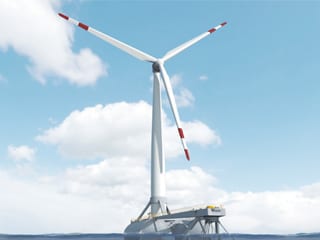
RWE Renewables and Saitec Offshore Technologies have teamed up to develop a floating platform for offshore wind turbines.
The two companies plan to test new approaches to the affordable installation and operation of wind farms in deep waters. They have launched a joint pilot project called ‘DemoSATH’ that will lead to testing of a floating platform next year off Spain’s Basque Coast.
The SATH technology is based on a twin hull made of modular prefabricated concrete elements that are subsequently braced. The objective of the project is to collect data and gain real-life knowledge from the construction, operation and maintenance of the unit. The pilot project will last 3.5 years: 18 months for the planning and construction, followed by a two-year operating phase.
The structure and the 2MW wind turbine will be assembled in the port of Bilbao. The base of the structure will be approximately 30m wide and 64m long. The platform including the turbine will be towed to its anchorage point in a test field two miles off the coast, where the sea is about 85m deep. Hybrid mooring lines, composed by chains and fibre, anchored to the seabed will hold the floating body in position. The plant is expected to go into operation in the third quarter of 2021. The electricity generated during the project will be fed into the Spanish power grid.
DemoSATH will be Saitec Offshore’s second project in open waters, as the deployment of a scaled 1:6 model off the coast of Santander is scheduled for April this year.
AkzoNobel recently released an update on its partnership with Apellix, Jacksonville, Florida, which won the 2019 Paint the Future challenge, for their collaboration on a computer-controlled spray-painting drone.
According to the company, Apellix’s custom-built drone is tethered to the ground for its power and coating supply, however, its flies autonomously.
The drone uses “unique software flight control,” which the companies say can more accurately apply coatings and capture painting data.
While drones fly really well, robots perform repetitive tasks easily, Apellix has been able to combine the best of both worlds.
“Building upon our software-controlled robots that make contact with a structure to take steel and paint thickness measurements, we’ve attached a specially designed spray-painting system to a custom drone controlled by computers, commented Robert Dahlstrom, Apellix Founder and CEO.
The application aims for benefits such as reduced application time and less waste, as well as increases safety.
“Developing a drone is easy,” said Michael Hindmarsh, AkzoNobel Venture Lead. “Spraying paint is relatively easy too. But developing a computer-controlled drone that can spray paint is actually quite challenging. A lot of skill and expertise has to go into getting the drone to apply a good quality coating in a consistent and reproducible manner. That’s where our collaboration comes in.
We use cookies to optimize our website and our service.
Functional
Always active
The technical storage or access is strictly necessary for the legitimate purpose of enabling the use of a specific service explicitly requested by the subscriber or user, or for the sole purpose of carrying out the transmission of a communication over an electronic communications network.
Preferences
The technical storage or access is necessary for the legitimate purpose of storing preferences that are not requested by the subscriber or user.
Statistics
The technical storage or access that is used exclusively for statistical purposes.The technical storage or access that is used exclusively for anonymous statistical purposes. Without a subpoena, voluntary compliance on the part of your Internet Service Provider, or additional records from a third party, information stored or retrieved for this purpose alone cannot usually be used to identify you.
Marketing
The technical storage or access is required to create user profiles to send advertising, or to track the user on a website or across several websites for similar marketing purposes.