As usual, I would like to add my good wishes to that of the new President for a happy and prosperous new year to all members.
We start 2019 with degree of uncertainty as to the outcome of the Brexit negotiations, and how this will affect our industry. According to the British Coatings Federation (representing all the UK coating manufacturers), the industry could suffer severe disruption, a loss of millions of pounds and a drain on investment. The £4b “just-in-time” industry, has more than half of its suppliers based in the EU, and has been forced to activate “no deal” contingency planning which consists of stockpiling key raw materials and finished goods, hiring more warehouse space and setting up legal entities in the EU. Its members are also preparing to grapple with different sets of chemicals regulations, and face tariffs on both raw materials, half of which are sourced in the EU, and on finished products, costing the industry an estimated £150m.
However the European Chemicals Agency (ECHA) is offering help for coatings companies to stay in the British market while still fulfilling all necessary regulations, as not only UK companies will have to pay attention to changes after Brexit, it also affects companies in the EU-27 and EEA that are doing business with UK companies. However potentially the most prominent change will probably be that there will no longer be a REACH registration for UK-companies after Britain leaves the European Union, and thus could prevent the introduction of new materials and products to the EU.
Enough of politics and back to this issue, there are two technical articles covering corrosion protection and monitoring of oil and gas production systems, including those operating at elevated temperature. Hassan Malik discusses the use and positioning of corrosion monitoring points to ensure effective protection of assets, and Dik Bestzig explains how coatings are tested for performance at high temperature operation.
Finally, remember this is your magazine, and I welcome comments and suggestions on the content, and submissions of news items, new products and technical articles. I can be contacted at, brianpce@aol.com
Happy New Year! I trust you all had a relaxing and enjoyable Christmas break. As incoming President this is my first bash at this column so please excuse me if I ramble on a bit!
For those of you who don’t know me, I’m an electrochemist based at the National Physical Laboratory (NPL) in Teddington, southwest London. Over the years my involvement with the Institute has mainly been through the Corrosion Science Division, although I have picked up a reasonable understanding of the broader range of ICorr activities during my 10+ years on Council.
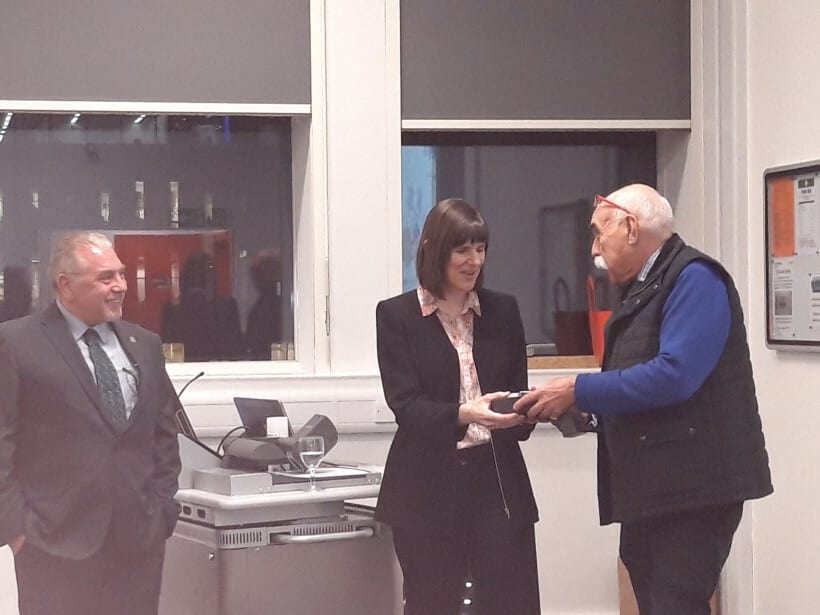
Our esteemed editor, Brian Goldie, was keen to include a photo of me so that you will be able to recognise me – or more likely cross to the other side of the road when you see me coming! The only thing vaguely suitable that I could find was this promotional shot taken recently by the NPL photographer. I feel I must point out that the item I am holding is a reference electrode…and not a pregnancy test as some wags have suggested.
I would like to thank our outgoing President, Sarah Vasey, for the excellent job she has done over the past two years. Sarah has worked tirelessly on behalf of the Institute to oversee a number of important initiatives, most notably the ongoing improvements to our training courses, the appointment of a new Business Development Manager, the increase in our student membership and (with significant input from Trevor Osborne) the successful purchase of our new home at Saxon Court in Northampton. All this on top of one of the busiest day jobs I have ever seen!
It is an honour to assume the role of President and I am very much looking forward to the challenge of building on the achievements of Sarah and previous Presidents. Completing the overhaul of our training course offering will obviously be a major priority. This is by no means a trivial task but is critical to our financial sustainability. Equally important will be the continued drive to recruit younger members, who after all represent the future of the Institute. As Young ICorr Chair, Chris Bridge has done an outstanding job in growing student members (over 100 at the latest count) and I will be working closely with his successor, Simon Bowcock, to maintain this upward momentum.
Right now the Institute is in pretty good shape, thanks mainly to the unstinting efforts of enthusiastic volunteers and committees. However, there is always room for improvement and we as Trustees and Council members are continually looking for new ways to enhance our offering to members. I am keen to meet as many of you as possible during my two year term to hear your views and am looking forward to attending a wide range of local branch activities and events. If you have any ideas for future initiatives I would love to hear them. The key thing is to get involved!
Dr Patrica Conder receiving a token of appreciation from Trevor Osborne, together with Paul Barnes, branch chairman
The January talk of ICorr London branch by Dr Patricia Conder, Sonomatic Ltd, was on “Pipework Corrosion : Prediction and Reality”, and how differences in the spatial pattern of internal pipework corrosion, be it patchy or more uniform, impacts on the effectiveness of inspection, and how this can be used to improve understanding of the underlying corrosion behaviour.
Patricia, discussed how extensive corrosion is easy to find and measure but, in instances where wall loss occurs more randomly, the challenges of matching inspection strategy to the corrosion coverage increase. She discussed how thinking of inspection of as a statistical sampling process helps both inspection strategy and analysis. The audience were challenged to spot the difference between a corroding and non-corroding circuit within a second. This was successfully achieved by means of a graphical overview of the whole circuit inspection history.
This overview presents a route to mine into the data, to examine “groupings” based on corrosion mechanisms, for example testing to see if the bends really are corroding faster than the straights. She also discussed the use of integrity driven corrosion rates, based on how the overall wall loss of the circuit is changing, rather than focusing on per inspection location corrosion rates, which can exaggerate measurement variability. Although historically inspection has been based on manual ultrasonic thickness measurements and radiography, these techniques have only covered relatively small areas overall. Developments for pipework inspection offer everything from screening to more detailed high accuracy mapping. The challenges being to incorporate all these results into a database in a meaningful way to get added value from a change in inspection approach. Patricia finished the talk by reminding us to think corrosion: think spatial.
The September meeting was very well attended. This was hosted by Amey, at their Birmingham offices, with the food kindly sponsored by Impalloy.
The September meeting was very well attended and hosted by Amey, at their Birmingham offices.
Iqbal Johal from the Galvanizers Association (GA) gave a very informative overview of galvanising. He discussed the process itself and its limitations. Iqbal also presented details of a very interesting building which had been specially engineered around the use of galvanising, and its aesthetic appearance. It was also very interesting to learn of the HDG business model, which GA members are very supportive of. Discussions about closer links between GA and ICorr followed, due to what was seen as a common aim of the Institute and Association.
The branch hosted the Institute AGM on 29 November, preceded by a series of technical presentations on pipeline integrity, and a report on both will be included in the Jan/Feb 2019 issue of Corrosion Management.
At the October meeting, Paolo Marcassoli from Cescor gave a very interesting talk on the use of Finite Element Method (FEM) in Cathodic Protection Design. Paolo introduced the advantages of FEM modelling, explained its mathematical principles and presented case studies where the technique had been implemented.
Paolo Marcassoli.
Over the past few years the use of computer aided approaches have improved the design of galvanic and impressed current cathodic protection systems. To ensure that protection conditions are achieved at each point of the structure, correct anode spacing is critical. FEM allows accurate analysis of structures with complex geometries, and the impact of various factors on corrosion control, providing precise prediction of protection current distribution.
FEM is a numerical technique for solving boundary value problems, it minimalizes an error function, generating a stable solution. It solves simple equations over small subdomains, i.e. finite elements, to approximate more complex equations over a larger domain. Such analysis considers both, the primary current distribution related to electrolyte resistivity and the secondary current distribution related to electrode reactions. Boundary conditions are characterized by electrochemical behaviour of the metallic surface under protection, for example through the Tafel equations. The electrical field is then solved using Laplace equation.
The first case study demonstrated the application of FEM on an above ground crude oil storage tank, where the bottom of the tank was protected internally by coating and galvanic anodes, flush-mounted type or zinc ribbon, depending on the water hold-up. This case is described in more detail in the article on page 14. In the second case study Paolo presented how FEM benefits retrofit CP design of offshore assets. This included applications in: offshore platform protected by galvanic anodes, offshore platform retrofitted by impressed current system, subsea pipeline retrofitted by galvanic anode sleds, and Single Point Mooring retrofitted by galvanic anodes clamp and pods. The study showed that FEM modelling in cathodic protection design is a very useful tool that helps to ensure thorough protection of the asset and possible reduction of costs by optimization of anodic system installation, and determining need for a new retrofit system.
This was an excellent talk and was well received by the audience. The technique presented is currently widely used in the industry and is recognized by professional organisations. It surely is a step forward in cathodic protection design and will continue to develop in the future.
The November meeting was devoted to the presentations from the Young Engineers on the results of their YEP case study of a heat exchanger failure. This was the culmination of 12 months of study by the delegates who have worked through modules that span the breadth and depth of the technologies used in our industry.
The YEP delegates and mentors.
It was a truly fantastic evening with 3 excellent presentations from the teams
Team Boran:
Agnieszka Knyter
Rachel Colpitts
Liam Fox
Konstantinos Katsounis
Team Doggett:
Daniel Burke
Oliver Smith
Caroline Earl
Jessica Easton
Team Googan:
Mark Fearns
Stephen Shapcott Liya Guo
There was a good deal of questions from the audience after each presentation and following which the judges retired to deliberate. Bill Hedges from BP, on presenting the award, said how hard it had been to select a winner as they were all so good. However there has to be a winning team and that was Team Doggett, who will be travelling to the USA in April 2019 to attend the NACE Conference in Nashville, where a whole programme of events will be arranged. They will post a blog of their activity and learnings on a daily basis on the Institute website. The organisers are grateful to the President and staff of NACE for pledging their support to the winners whilst they are in Nashville by providing free conference registrations, and access to the student award ceremony.
The winning team will also present their conference learnings during the London branch 2019 winter series lectures.
The response from the delegates attending this programme has been incredibly encouraging;
“This programme has altered the way I think about my work and how I carry it out”
“I have found a new job and moved to London living in Kew Gardens and cycling to work each day. I love it”
“I hadn’t realised the value of ICorr and I will go back to work on Monday and encourage them to engage”
A comment from one of the senior engineers in our fraternity gave the programme even more credibility, “This is probably the most important function in the UK Corrosion calendar, it’s truly fantastic”
It’s also interesting to note that Agnieszka of Team Boran, travelled from Poland in 2015, under her own steam, to hear the previous YEP case study presentations, and decided then she wanted to be involved in the next YEP programme.
Thanks go to all those involved in the process; the organising committee, the lecturers, the hosts, the mentors, the judges, the delegates, and if course a big thank you to the sponsors of the event, BP.
The winning team and mentor, Rob Doggett with Bill Hedges.
The second joint meeting of the branch with the SCI London Group was held on 25 October, at their prestigious headquarters in Belgrave Square. This ultra-modern auditorium made for a most comfortable setting and was enjoyed by an attendance of over 60.
The evening chairman, John T O’Shea, a Past President of ICorr, began the procedures by thanking Dr Fred Parrett, currently Hon. Treasurer of the SCI London Section, for all his work in helping to organise this event.
John O’Shea introducing the evening.
The first presentation “A Fighting Ship” was based around the Mary-Rose project at Portsmouth. This was given by Professor Eleanor Schofield, Head of Conservation and Collections Care at the Mary Rose Trust. Eleanor graduated from Imperial College, where she also received her PhD in Material Science. She has recently received an Honorary Chair at the University of Kent, at Canterbury.
Professor Schofield began her talk by correcting the too often quoted story that the Mary Rose sank in 1545 on her maiden voyage. In fact she was built in 1510 and served for 34 years as the flagship of Henry VIII’s navy in many battles, particularly in wars against France. Following the lifting of the ship out of the seabed mud, the timber hull was treated over many years by spraying with water and polyethylene glycol to prevent further deterioration once it was exposed to the air.
Perhaps less well known is the work in restoring and maintaining over 19,000 artefacts that had also been recovered. A significant part of the collection was the 1200 + iron cannonballs, which had been exposed to sea-water since the ship sank, and which were in danger of corrosion when exposed to the air due to the chloride in sea-water. It was vital that ways were found of preserving the these, as it was recognised that while the cannons were made to last and be used many times, the cannonballs were only needed for a one-off use, and thus greatly inferior in their quality and standard of manufacture.
Professor Eleanor Schofield.
Initially researchers attempted to remove chloride from the cannonballs, by soaking in water with and without chemical treatment. Chloride reduction by heating in an atmosphere of hydrogen was also attempted, but unfortunately these methods did not successfully prevent disintegration when they were later put on display. To better understand this problem, Professor Schofield, established a joint research project with the department of archaeology at UCL and the UK Diamond Light Source in Didcot which is the UK’s national synchrotron. This works like a giant microscope, harnessing the power of electrons to produce penetrating bright light X-rays, which combined with absorption spectroscopy, and fluorescence mapping, made it possible to visualise the differences in the corrosion profiles. These could be traced to the treatments applied in the 35 years since the cannon balls were recovered with the Mary Rose. The results revealed detailed maps of the elements involved in the corrosive process, giving an unprecedented insight into conservation on a molecular scale. This crucial information will help to protect these and other cultural heritage artefacts for many decades to come.
The second presentation, “Fighting Corrosion” was given by Jim Glynn, a previous chairman of London Branch. Jim concentrated on the “dynamic duo” of corrosion protection – a suitable protective coating as the primary source of defence, supported where appropriate by a cathodic protection system to prevent any corrosion occurring at areas of coating damage.
It is often commonly believed that rusting is a simple, chemical oxidation reaction – but it is not. Aqueous corrosion is a complex, multi-stage step process which includes electron transfer at the molecular level. Thus these electro-chemical reactions during corrosion can be influenced by the external application of electrical potentials. Under the right circumstances, corrosion can be stopped by applying the appropriate level of negative potential using a DC current supply.
Jim presented many examples where the correct conditions of a good coating and a suitable working cathodic potential were present. However, he also described many examples where this was unsuccessful. These included a pipeline coating that had totally disbonded and broken away from the pipeline, due to a higher potential than required being applied, which generated hydrogen gas on the surface of the pipeline, causing the coating damage.
He also described Thermally Sprayed Aluminium (TSA) applications, which are excellent protective coatings when properly applied. The aluminium content can act as its own in-built cathodic protection anode. However, in the wrong environment, the aluminium can be quickly used up, and premature failure occurs.
Jim Glynn.
Jim expanded his presentation to compare recent case studies of retro-fitting remote anode beds to two similar North Sea platforms which had exceeded their design life, but it was decided that the protection of these structures subsea could be extended using additional cathodic protection. One had been fully coated with coal tar epoxy, while the legs on the other had been left bare, but with a built-in corrosion factor that should have exceeded its expected life. The coated structure required a current output of 1,000 Amps, while the bare steel legs needed around 7,500 Amps, to produce the correct negative potentials, with these high DC currents supplied by banks of adjustable transformer rectifiers located on the platform decks.
Jim also interspersed a number of quiz questions, asking the audience to identify some notable “Dynamic Duos” in life, film and comic books, which was well received and considered a fun way to conclude the presentations.
The vote of thanks was given by Dr Parrett and he presented the speakers with ICorr engraved pens, as a memento of the evening, which was followed by refreshments and networking in the Garden Rooms.
The branch has now moved its activities to the Sir Ian Wood Building, Robert Gordon University (RGU), which provides ‘State of the Art’ Teaching / AV Facilities, and kicked off its new session with some thoughtful insights into the complex issue of Preferential Weld Corrosion (PWC) in a presentation by Neil Gallon and Michael Young of Rosen. This meeting was also the annual joint event with TWI (The Welding Institute) North Scottish Branch.
Pre-September meeting networking at the Robert Gordon University.
PWC is of increasing concern to many operators, especially in relation to ageing assets. This talk helped explain what exactly PWC was, and discussed some of the many complex welding parameters / considerations and features that can lead to PWC. The talk also discussed procedures for diagnosis of PWC, identification of mitigation options, and highlighted several other difficulties and issues that can arise with both of these aspects in relation to PWC management.
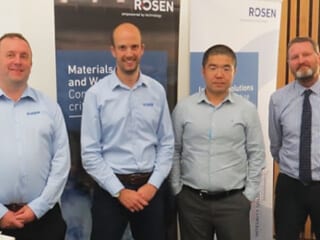
September speakers (L to R), Neil Gallon and Michael Young (of Rosen) with Aberdeen Branch chair Dr Yunnan Gao, and Mark Bragg, Technical Secretary of TWI North Scottish Branch.
September speakers (L to R), Neil Gallon and Michael Young (of Rosen) with Aberdeen Branch chair Dr Yunnan Gao, and Mark Bragg, Technical Secretary of TWI North Scottish Branch.
Immediately preceding the September event, committee Member – Ms. Zahra Lotfi, Snr. Corrosion Engineer, Oceaneering International, gave a presentation to students of the School of Engineering, explaining how corrosion control is an essential part of engineering design and maintenance of every aspect of our lives – our buildings, transport, gas, oil, water industries, and emphasising how all depend for their survival on its prevention. This event was part of a series of talks to Aberdeen University and RGU University students to encourage them to take up free ICorr membership and to become more involved in the corrosion community.
The well attended September event on PWC for subsea and topsides welded systems.
The well attended September event on PWC for subsea and topsides welded systems.
Vice chair Stephen Tate followed on from these university presentations by providing assistance to the AFBE-UK Transition and Interview Programme on 13th October. AFBE-UK promotes higher achievements in education and engineering particularly among people from black and minority ethnicity backgrounds. Interested parties can seek further information at https://afbe.org.uk/about-us
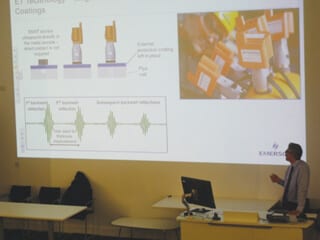
In October, Chris Burke, Technical Consultant / Product Manager of Emerson – Permasense gave a presentation on “Non-intrusive wall thickness monitoring”. Permansense was originally a joint research project between BP and Imperial College, London, and is now part of Emerson, operating worldwide with currently over 20,000 sensor devices in-service.
Changes to process operations can often have a significant impact on plant integrity. For example the onset of sand production can be caused through increases in the drawdown on a well and high flowrate from bringing on new or previously shut-in wells, and which can impact on the effectiveness of chemical corrosion inhibitors. Current long-term risk-based asset integrity methodologies cannot predict these sudden operational events, meaning the increased levels of erosion or corrosion that these events can cause can often go undiscovered until the next planned inspection, and risk failing before that.
Chris spoke about optimizing plant integrity through continuous wall thickness monitoring using fully wireless ATEX rated equipment for automated UT, that can be very quickly set-up at upstream and downstream energy sites.
Chris Burke of Emerson-Permasense, explaining sensor technology.
Chris Burke of Emerson-Permasense, explaining sensor technology.
This talk complemented the September one, in that the sensors are now also being installed to monitor PWC, and this will be the subject of a future technical article.
The presentation reviewed the increasing use being made by many operators of continuous / automated wall thickness monitors as a means to not only track erosion and corrosion in areas of concern, but as a means of identifying underlying process operations responsible – thereby facilitating and validating corrosion mitigation strategies online so that timely, evidence-based, integrity management decisions can be made.
Advantages of these new tools to corrosion / integrity engineers were discussed in great detail, prompting many questions from the large audience on matters relating to sensor installation methods, durability, system size, and data management.
All past Aberdeen ICorr Presentations may be found on:
https://sites.google.com/site/icorrabz/resource-center
Full details of future events can be found on the diary page of the magazine and on the website, or contact: ICorrABZ@gmail.com
We use cookies to optimize our website and our service.
Functional
Always active
The technical storage or access is strictly necessary for the legitimate purpose of enabling the use of a specific service explicitly requested by the subscriber or user, or for the sole purpose of carrying out the transmission of a communication over an electronic communications network.
Preferences
The technical storage or access is necessary for the legitimate purpose of storing preferences that are not requested by the subscriber or user.
Statistics
The technical storage or access that is used exclusively for statistical purposes.The technical storage or access that is used exclusively for anonymous statistical purposes. Without a subpoena, voluntary compliance on the part of your Internet Service Provider, or additional records from a third party, information stored or retrieved for this purpose alone cannot usually be used to identify you.
Marketing
The technical storage or access is required to create user profiles to send advertising, or to track the user on a website or across several websites for similar marketing purposes.