Simon Bowcock has been appointed the as the new Young ICorr council member. He will take over from Christian Bridge who made a significant contribution in re-establishing Young Icorr, leading initiatives to increase student membership and organising young professional networking events. This included a very successful event in collaboration with The Welding Institute and the London Materials Society attended by over 50 young engineers. The Institute would like to thank Christian for all his efforts during his tenure and wish him well in his future endeavours.
We are looking to proactively engage students from university and looking for volunteers to deliver a 15-minute presentation to materials and corrosion departments around the country. This approach has proven very successful at the University of Oxford with a recent presentation by Chris Bridge and Simon encouraging over 32 students to sign up. In addition, London Branch took part in the recent Imperial College Materials Society career fair with Mash Biagioli manning the ICorr stand. There was a good turnout of students, and 50 of them took away Institute membership packs, however it is too early to determine how successful this was.
If you are interested in volunteering at a university event, then please contact, admin@icorr.org
Each year the Institute of Corrosion bestows a range of internationally-renowned awards in recognition of excellence in corrosion science and engineering, and to reward outstanding service to the Institute and the wider corrosion community. Many of these awards are open to nomination by members of the Institute. Below is a brief description of each award together with details of how to nominate potential candidates.
U.R. Evans Award
The U.R. Evans Award is the premier scientific award of the Institute of Corrosion and is presented annually for outstanding international achievements in pure or applied corrosion science. The recipient is selected by a Corrosion Science Division panel and presented with a sword and an engraved plaque at the annual Corrosion Science Symposium. The recipient is also granted Honorary Life Fellowship of the Institute. Nominations may be submitted at any time via email to the CSD Chair, Julian Wharton (J.A.Wharton@soton.ac.uk).
Paul McIntyre Award
The Paul McIntyre Award is presented to a senior corrosion engineer, who, as well as being a leading practitioner in his field, has advanced European collaboration and international standards development. The award consists of an engraved trophy, which is presented at the annual CED Working Day meeting. The recipient is requested to present a brief overview of their activities and encouraged to prepare an article for publication in Corrosion Management. Nominations should be submitted to the CED Chair, Nick Smart (nick.smart@woodplc.com), by 28 February 2019.
H.G. Cole Award
The H.G. Cole award is in the form of a poignard and is made in recognition of exceptional services to the development of the Institute. It is only awarded on an occasional basis, typically every 5 to 10 years, reflecting the highest possible level of commitment of the recipient to the activities of the Institute. Nomination and selection for this award is administered by the ICorr Awards Committee. Nominations may be made at any time to the Awards Committee Chair, Gareth Hinds (gareth.hinds@npl.co.uk).
Honorary Fellowship
Honorary Fellowship is awarded in recognition of outstanding service to the Institute over many years. The recipient is bestowed the suffix FICorr (Hon) and all future membership fees are waived. Nominations for Honorary Fellowship must be submitted via Council.
T.P. Hoar Award
The T.P. Hoar Award is presented to the author of the best paper published in the scientific journal Corrosion Science during the previous calendar year. The winning paper is selected by a sub-committee of the Corrosion Science Division and the author receives a certificate and a cash sum of £300.
Galloway Award
The Galloway Award is presented to a student author for the best publication describing original research in corrosion science and engineering, as judged by a sub-committee of the Corrosion Science Division. The winning paper is published in Corrosion Management and the prize consists of a certificate and a cash sum of £250. The Institute does not retain copyright of the material so this does not prevent separate publication of the work in a scientific journal. Submissions (in the form of papers published within the past 12 months or draft publications) may be sent via email at any time to the CSD Chair, Julian Wharton (J.A.Wharton@soton.ac.uk).
Lionel Shreir Award
The Lionel Shreir Award is made to the best student presenter at the annual Corrosion Science Symposium. Selection of the recipient is carried out by a sub-committee of the Corrosion Science Division. The award consists of a certificate and a cash prize.
For further details on the Institute awards, including lists of past recipients, please visit https://www.icorr.org/icorr-awards/
So many times we have heard the expression – ‘He was a Gentleman and a Scholar’ – and that was exactly what Gordon Currer was.
A kindly man, very mild mannered and thorough to the extreme in his duties as a dedicated technologist. Always keen to pass on knowledge and learning (with patience) to those students that had an aptitude to learn the mysterious art of Cathodic Protection.
Gordon was a Chartered Engineer and held membership in the Institute of Electrical Engineers; the Institute of Corrosion and Technology as well as the National Association of Corrosion Engineers.
He wrote many papers and gave countless lectures and presentations; both throughout the UK and the rest of the world. With a career spanning over fifty years he once listed all the countries he had visited purely for business purposes – the tally was an impressive thirty seven.
Like many in the enigmatic world of Cathodic Protection he entered that world by accident. In his own words he said, “When I look back over my working life I contrast the relatively dreary (and certainly un-exciting) beginnings of travel by bus and underground into London each day with the subsequent worldwide travel I have experienced with my duties in Cathodic Protection – and generally enjoyed”.
It was thanks to an advertisement in the Hertfordshire Mercury in February 1956 that Gordon was offered his first post by John Gerrard – himself a former employee of the Kuwait Oil Company. From little acorns the Company of MAPEL expanded from Woolmer Green to Tottenham with John Gerrard the then Managing Director and Gordon’s retirement finally being from the Stotfold office.
During his pioneering days with MAPEL a lot of the CP testing techniques (that are practised today) were trialled and refined by him and his colleagues of that time. It was refreshing to hear some of his humorous memories, which revealed that he too, in all his reverence, went through quite difficult practical learning curves as they built up procedures and routines that now form part of the CP standards of today. His favourite was the colleague that never stopped talking but suddenly went quiet on a Current Drainage survey with which they were experimenting with using a heavy duty welding generator. The verbiage apparently restored itself in earnest when the gentleman was released from the test circuit!
He recalled his first overseas trip was to Nigeria in 1958 and encompassed travel to Benin, Ghana and the Ivory Coast. Apart from a short spell in a tiger moth with the Air Cadets he had never flown before. He and a colleague left Heathrow in a West African Airways ‘Argonaut Airliner’ having 4 piston engines and propellers giving a cruising speed of 265mph. The passage through Lagos Airport was fast, pleasant and informal as still under British rule, in contrast to difficulties he experienced with entry and exit in the 1990’s – not helped by his passport being stolen.
Having worked many years with MAPEL and as a senior team member he played a great part in building the Company up to become one of the most respected in the NDT/CP industry. An extremely loyal team of stalwarts was the result of his leadership. There were no bosses unless the chips were down and a serious problem needed attendance. Gordon would then deal with the issue with clarity and a quiet firmness respected and appreciated by all.
As a memory and in a lighter vein, the following portrays the deep effect he had on all those within his team. For example, once design values were known it was a case of anode distribution. In truth there were many positions and all would work but some gave better spread than others. Gordon was a stickler for change until it was deemed to be perfect. Nowadays when layout changes to a new design are made, those who worked with him use the familiar quote “You are doing a Gordon on me”.
With the close co-operation MAPEL had built up with British Gas by mutual agreement Gordon moved across, with some selected engineers, to the Gas Council offices in Hinckley. They helped form the corrosion division responsible for the production and implementation of Cathodic Protection systems for all the major high pressure gas feeder mains throughout the UK. Gordon stayed with British Gas for over 13 years before returning to MAPEL as their Chief Engineering Manager. Even now, crews working in the East Midlands have reported back that they are referring to drawings, drawn from the archives signed by GWC.
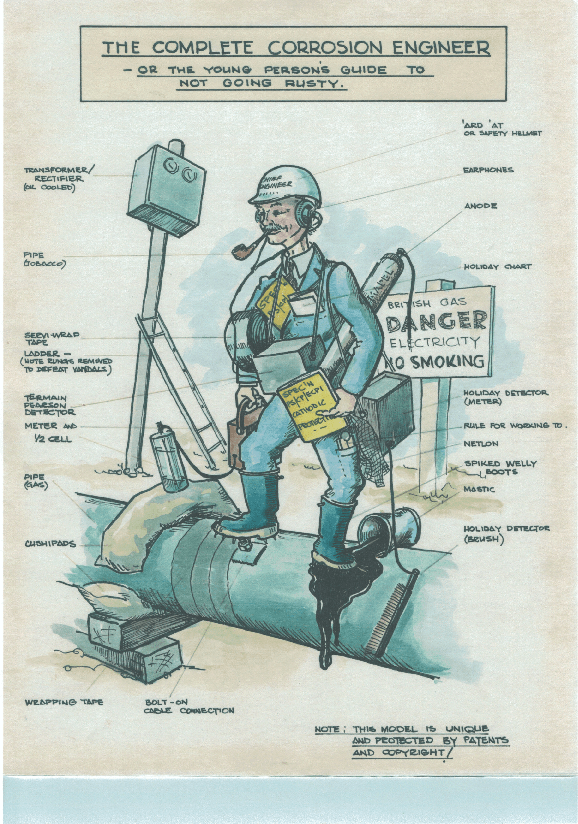
By reviewing the caricature (opposite) – presented to him upon his departure from British Gas containing one hundred well wisher signatures, it is abundantly clear in itself what a popular and respected person Gordon was.
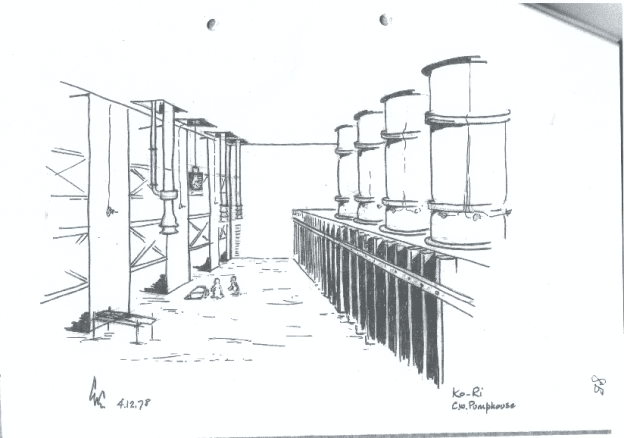
His true values and courage came to the fore at MAPEL when let down by two senior engineers he took on recovering a very serious project on the Kori Nuclear Power station in South Korea. He worked in the most arduous conditions without complaint; completing the venture for GEC spanning 1978/79. His love of art kept him sane and diverted his mind off home as he worked many hours in the stinking depths of the cooling water pump-house, wearing thigh boots whilst knee deep in dead mussels. His sketch dated 4.12.78 (below) being the evidence of a man devoted to a duty that very few would have endured.
In 1987/88 his time was focussed on a feasibility study for Mobil Oil based around the Yanbu Oil Refinery on the Red Sea coast of Saudi Arabia.
In 1990 he developed a design for the Adnoc Oil Refinery in Abu Dhabi and then in 1993 as a retained consultant for MAPEL he travelled a circuitous route into Libya to work on the Great Man Made River project for Brown and Root and the Turkish company STFA.
These are just snippets of the countless large projects he was involved with over the years.
On retirement he still maintained the interest and took on some private consultancy work representing the writer on project work in Trinidad and Barbados.
Both him and his wife Sheila enjoyed many happy days with Andre Lange and his family at Marine Consultants, based in Port of Spain, Trinidad. This, he always said was the icing on the cake finishing his years of travel in Libya/Saudi Arabia/Abu Dhabi etc etc and the memories remain on the sideboard at his home in Frisby –on-the-Wreake enjoyed by his devoted wife Sheila, two daughters Jill and Deborah and their son Tim.
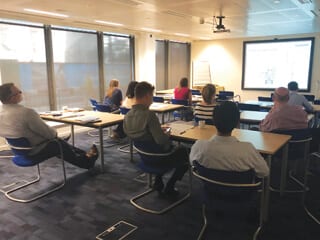
The October meeting, held as usual at the offices of McDermott’s in Paddington, was the penultimate meeting of the Young engineer Programme (YEP). The subjects for this meeting were “Presentation Skills” given by David Mobbs and “Inspection methods” given by Ian Daniel from Sonomatic.
The culmination of this programme is the presentation by the delegates of their Case Study solutions, and as this meeting was fast approaching, the presentation skills section was a timely reminder on how to prepare for a presentation that is concise, and the do’s and don’ts in developing an effective presentation. This is a skill that we are all required to use in our everyday working life, but few are ever trained in. The team mentors (John Boran, Rob Doggett and Chris Googan) were also present which gave the opportunity for some last minutes discussion on the results of their investigation into the Case Study and possible solutions, with one team having a draft presentation already prepared.
After the presentation on training, Ian Daniel described the various methods of inspection and the benefits of each, and how it’s possible to combine the various techniques to broaden the amount of useful information obtained.
Non-intrusive inspection, NII, was a key aspect of the discussion, as many operators are looking to “zero man entry” over the life of the asset. The presentation covered developments in storage tank bottom inspection, and remote monitoring via robotics.
The evening closed with a dinner and the opportunity to network.
A report on the Case Study presentation evening can be found on page 8 of this issue.
This is a very exciting time for ICATS as we launch the new ICATS course material and prepare for the introduction of the updated website and online registration/renewals.
The new ICATS course addresses every aspect of Protective Coating application including:
Health and Safety
Surface preparation
Metal spray
Paint application
Fire protection
Access options and specific industry requirements
Trouble Shooting
During November we introduced this new course to our Trainers at seminars in Bristol, Manchester, Edinburgh and Northampton. These were a great success, and also included an overview of the ICATS development plans and a detailed look at the new programme.
We are also about to introduce our new website which will work much better with smart phones and tablets than the old site, and is part of a wider ICATS update.
As previously announced, the Protective Coating Apprenticeship Programme is progressing and a pilot programme begins in January 2019.
For further information on any of the above please contact the office, at correx@icorr.org, or phone 01604 438222.
Another year is almost over, and if you’re like me, you’ll have wondered where the time has gone, with all those things you planned to do, but haven’t managed. I had hoped to get more cutting-edge technical articles in each issue, but didn’t quite manage this. However this issue has a bumper four technical articles, two relating to testing and two about above ground storage tanks.
There is a short piece on measuring dry film thickness of thermal sprayed aluminium coatings and the importance of the measuring method, and a thought-provoking look at specifications and protective coating testing, by experts from AkzoNobel.
The articles on storage tanks cover the use of Finite Element Modelling to more accurately design the cathodic protection system, and how looking at an alternative industry helped solve a corrosion protection problem.
Looking forward to next year, there are exciting developments in our training programmes and our move to new offices, and I look forward to bringing you news of these. I would welcome technical article submissions from members (and their colleagues) on their developments in corrosion protection and control. These can be sent to the editor, brianpce@aol.com. A list of the editorial themes planned for next year can be found in the media pack at, www.icorr.org/publications.
All that remains is for me to wish all readers the compliments of the season.
Brian Goldie, Consulting Editor
We use cookies to optimize our website and our service.
Functional
Always active
The technical storage or access is strictly necessary for the legitimate purpose of enabling the use of a specific service explicitly requested by the subscriber or user, or for the sole purpose of carrying out the transmission of a communication over an electronic communications network.
Preferences
The technical storage or access is necessary for the legitimate purpose of storing preferences that are not requested by the subscriber or user.
Statistics
The technical storage or access that is used exclusively for statistical purposes.The technical storage or access that is used exclusively for anonymous statistical purposes. Without a subpoena, voluntary compliance on the part of your Internet Service Provider, or additional records from a third party, information stored or retrieved for this purpose alone cannot usually be used to identify you.
Marketing
The technical storage or access is required to create user profiles to send advertising, or to track the user on a website or across several websites for similar marketing purposes.