


The cart is empty!
Aberdeen Branch News
The third branch event of 2018 took place on Tuesday the 27th March, with 32 attendees representing major companies including, Aberdeen Foundries, ABR Engineering, Atkins, Axiom NDT, CAN Offshore Ltd, DNV GL, ICR Integrity Ltd, Lloyds Register, Lux Assure Ltd, Maersk Oil (now TEP UK Ltd), Oceaneering, One Subsea, Plant Integrity Management Ltd, PROSERV, Shell UK Ltd, Sonomatic and Wood plc.
The event was an industrial visit to the premises of Element Materials Technology in Aberdeen, to attend a technical presentation of “Sour Service Testing of Carbon Steel Girth Welds” by Phil Dent, Element’s Global Corrosion Specialist, followed by a visit to the new H2S / Sour Service Laboratories.
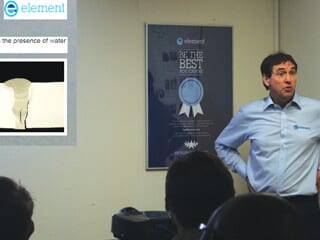
Phil Dent, Element’s Global Corrosion Specialist explains SSC Phenomenon.
Ian Farquharson, General Manager of Element Aberdeen and Edinburgh branches, introduced Element, and noted that is ranked as the 5th biggest materials testing and certification firm in the world following its recent merger with EXOVA. He also mentioned that Element Aberdeen is a UKAS and ISO/IEC 17025 accredited laboratory which offers one of the most comprehensive ranges of metallurgical materials testing and analysis services in the UK.
Phil Dent started his technical presentation by defining sour service conditions, followed by a description of the various types of sour service cracking mechanisms, and the environmental factors affecting the susceptibility of materials under sour service regimes. The sour service cracking mechanisms which were presented included Sulphide Stress Cracking (SSC), Hydrogen Induced Cracking (HIC), Stress Orientated Hydrogen Induced Cracking (SOHIC), and Soft-Zone Cracking (SZC). The various test methods such as the Four Points Bend test (NACE TM0316), C-Ring test (NACE TM0177, Method C), Full Ring test (BS 8701), and Uniaxial tensile test (NACE TM0177, Method A) were also explained.
The corrosion testing laboratory visit was supervised by Paul Roberts, Corrosion and Chemistry Manager, who explained that the corrosion testing services cover a full range of environmental testing simulations, including pipeline corrosion testing for sour and non-sour applications, hydrogen testing, pitting, full ring tests, as well as SCC tests.
Element Laboratories in Aberdeen also specialise in materials qualification for sour service applications and offer standard HIC, SSC tests and also more specialised Full Ring and SOHIC tests and follow international testing standards and protocols such as those from ASTM, IP MIL and NACE. Paul summarised the procedures for the H2S sour service axial tensile test, high temperature / high pressure, electrochemical tests and strain gauging.
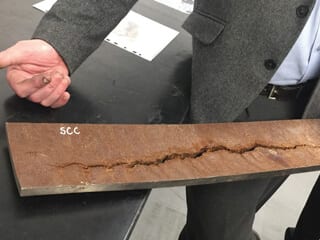
Element Laboratory Example of Serious SCC Type Cracking.
The questions raised by attendees during the technical presentation and laboratory visits were well responded to by the hosts. This event attracted a high interest within the professionals and executives of major oil and gas operators, engineering consultancies, and service companies in Aberdeen, to visit one of the major testing and materials qualifications bodies here in United Kingdom. Overall, it proved to be an excellent event in every respect.
The April evening meeting had 78 attendees, and followed on from a very successful visit to Aberdeen by the Marine Corrosion Forum.
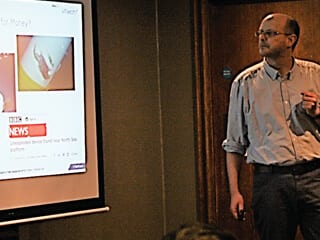
George Gair – Global Inspection Manager for Subsea 7 presenting to ICorr ABZ.
George Gair of Subsea 7, started the evening session with a thought provoking theme ‘Subsea Inspection – The Future’, that considered many aspects of the current cost reduction environment where there is a major focus now on how to reduce costs by incorporating new philosophies / technologies.
Very clearly the drive is to produce new and robust methods of harvesting sensor data, and subsea hardware suppliers are looking at increased in-situ equipment monitoring and intervention methods (the oceanographic community has developed remote seabed environmental monitoring systems). George highlighted many significant indicators that show a definite trend towards smarter systems, a key driver being to learn and incorporate inspection technologies from other industries such as Aerospace, Automotive, Medical and Power Generation, together with more efficient use of gathered data.
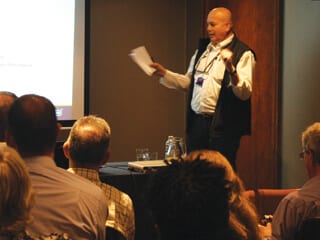
Monzar Najami – Principal Inspection Engineer of Oceaneering International.
Monzar Najami and Hooman Takhtechian of Oceaneering International followed on with a similarly stimulating discussion on the theme of, ‘Integrity Management of Brownfield Projects: Challenges and Rewards’, highlighting the many important analysis and data gathering areas of modern RBI – Risk Based Inspection methodologies.
The presenters informed the audience that the greatest challenge to developing and implementing an asset integrity programme during Brownfield development projects, is the fact that project schedule and milestones often take primacy over integrity management processes, and in particular emerging vital integrity related interventions which can lead to conflict and disagreement. Any delay in the implementation of these activities impedes the Integrity Management Programme (IMP) and increases the level of risk to the facilities in the operating stage.
Key stages in an IMP project were highlighted as:
a)
Identify stakeholders early in the project (project team, operations, planners, site personnel)
b)
Define strategies and processes and add activities to the construction plan (integrated project activity approach)
c)
Analyse historical data (collect the available list of failures, anomalies and review root cause analysis)
d)
Material fitness for new process (review threats assessment and existing material suitability)
e)
Baseline inspections: Get in early (define scope and input your inspection requirements in the manufacturer’s ITP)
f)
Brownfield revamp activities: Scrutinize output (repair recommendations were challenged and resulted in major cost saving, and change in material selection)
g)
Tagging and RBA output alignment with the existing CMMS (understand the existing Computerized Maintenance Management System prior to your RBA to avoid major re-work)
h)
Deployment of new and advanced inspection technologies (to achieve major cost savings)
A wide range of questions followed the very comprehensive presentation and all the presenters’ slides are available on, https://sites.google.com/site/icorrabz/resource-center.
For information about all forthcoming Aberdeen branch activities, please contact, Dr Yunnan Gao, ICorrABZ@gmail.com. To sign up to the branch mailing list, go to, https://sites.google.com/site/icorrabz/home
ICorr Aberdeen will host its Annual Corrosion Awareness Event on Tuesday 14th August 2018. For further details please contact: Corrosion Awareness Chair, Steve Tate on, steve_f_tate@hotmail.com