In 2019 ICorr and the Hydrocarbon Passive Fire Protection Network (PFPNet) signed a collaborative agreement to develop an industry leading training course specifically aimed at Inspectors involved with the installation of hydrocarbon passive fire protection materials. Initially the course will be targeted at epoxy intumescent materials but will be quickly followed with further training relative to cement-based fire protection products.
PFPNet was chosen by ICorr as it is an independent industry group whose membership comprises a number of leading companies in the oil, gas and hydrocarbon processing industries, from owners to engineers, leading construction contractors, regulatory authorities, manufacturers of passive fire protection and contractors who apply these materials. The world leading expertise available through the PFPNet membership provided a high level of confidence for ICorr in assigning the development of this important training course them.
Passive fire protection is a critical item in personnel safety, it is also there to protect valuable assets against fire and by preventing escalation of an incident. However, to work correctly and maintain its integrity over the lifetime of an asset means it must be installed to the highest standards available, thereby making correct inspection of installation core to its success.
The hydrocarbon passive fire protection training course will, as indicated, be aimed at Inspectors responsible for installation of products, but it could equally benefit engineers and others who wish to understand the reason why passive fire protection is important, and the processes involved in its installation.
Key areas of the course
content include:
• Introduction to the types of passive fire protection (PFP) used and why it is important
• Types of structure that are protected by PFP
• Qualification and approval of PFP materials and the importance of ensuring compliance with project specification and regulatory requirements
• Installation of products from surface preparation through to final finish coat
• The impact of incorrect installation and defects, and how this affects both fire integrity and long-term performance
• Installation planning, importance of Quality Control at all stages and the responsibilities of the parties involved
• The role of the Inspector in ensuring a successful installation
The course is a full five-day programme and on the fifth day attendees will be required to complete an end of course examination, and their success will depend upon achieving sufficient marks against a defined set of questions.
ICorr and PFPNet believe that this training course will set a new standard in the industry for PFP inspection, and with cooperation of their respective members, particularly asset owners, will be looking to establish the course as the benchmark for inspector and engineer training.
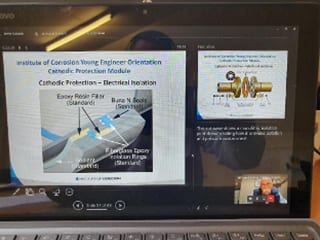
The Young Engineer Programme once again displayed its adaptability as for its June meeting it adopted a new format for the online presentation, and welcomed the host Trevor Osborne for a discussion on cathodic protection.
The former President of ICorr and Managing Director of Deepwater Corrosion Services, with over 40 years of experience in oil and gas, shared his knowledge and specialised understanding in the new look presentation.
The adapted format saw the usual three-hour presentation replaced with it being sent a week in advance to the delegates. Trevor talked about corrosion, and the importance of the Galvanic Series, types of CP, standards and their importance, testing and inspection, failures and Field Joint Coatings.
Among other talking points, Trevor highlighted how electrical isolation in cathodic protection offers three main benefits, as it restricts the required protective current to the surface of the primary structure to produce a uniform polarised level of protection. It also minimises stray DC current interference and prevents galvanic current between metallic structures.
It was the decision to send the presentation to delegates in advance that proved to be the biggest revelation of the evening though, as it allowed questions to be prepared for the following Q&A session, with answers fielded by Trevor and collated by Principal Engineer at INTECSEA, Anthony Setiadi.
The knowledge displayed in the questions showcased the level of understanding within the industry with many of the questions prompting detailed answers from Trevor that caused him to draw from much of his considerable experience in the industry.
“I was extremely encouraged by the response from all of our delegates,” said Trevor Osborne when reflecting on the evening’s presentation. “and it shows the incredible level of interest and knowledge that the young people have within the industry. The future is certainly bright.”
When measuring how well a digital marketing strategy is progressing, there are many metrics which can be measured. However, we should remember the goals for our digital efforts – primarily to drive traffic to our website via organic acquisition (that is growth achieved by our content strategy, and not by paid means such as pay per click advertising).
It is this growth (for example in followers on LinkedIn) that we can market membership and training to – ICorr’smajor business objectives.This review of our progress focuses on three metrics of growth:
• Website visits
• LinkedIn followers
• ‘Click-throughs’
Website Visits
We are posting content on our website to generate interest in ICorr and what we do, but if this is not interesting, informative, or enjoyable, visitors won’t engage with it, and we won’t encourage them to return.We want visitors to return as they are more likely to become engaged with our content and share it – and that promotes organic growth.
Visitor numbers
In the 30 days prior to this review, the ICorr website received 11,761 page views across 4,850 sessions – an increase of 11% and 21% on the previous 30 days respectively. The countries where most sessions derive from are, UK, USA, India, UAE, and Malaysia.
User numbers are up from 3,142 to 3,720, and new user numbers have improved from 2,787 to 3,325 over the period. Our highest ‘referral’ sources are LinkedIn and Facebook, with LinkedIn referred sessions increasing by 237% over the month and Facebook sessions by around 48%.
We will continue to post relevant content and link to social media accounts, and consider ways to further engage on social media to drive traffic to website.
Bounce rate
A bounce is when a visitor enters a page on a site but does not interact further – they don’t click through to a second or third page, or to other page elements. Average bounce rates depend upon the type of website. For example:
• Non-eCommerce content websites (probably the closest type to the ICorr website) can expect to have bounce rates between 35% and 60%
•Within the field of science, average bounce rates are around 53%
Our current bounce rate is 58%, so no cause for alarm, but a number that we will maintain a watchful eye on and seek to reduce by adding links to those pages and posts that currently have no links.
Session duration
This is the time a visitor spends on the website, from first clicking on it until they leave, or after 30 seconds of inactivity. The standard for session duration is two to three minutes, and we are currently right in the middle of this range. We are aiming to improve this by using various tactics, including using more images in content, and understanding the ‘customer journey’ better. However, the most important is to include links between pages on the website – people who are interested in the topic are more likely to click through and remain engaged on the site longer.
LinkedIn followers
As part of our content strategy, we have initiated a social media posting on the site strategy. The aim with this is to help share our content through social media, and encourage more people to follow it. By doing this we build a base that can become brand advocates, share our content further, and grow our membership and marketing potential. While we post to Facebook, Twitter, and Instagram, our focus and best results are on LinkedIn:
When we started with our content strategy at the beginning of February 2020, ICorr had zero followers on LinkedIn
•By the beginning of May, this number had increased to 997
•By mid-June 2020, we have seen another increase to 2,417
Our LinkedIn data allows us to segregate these under several headings. For example, by location, job function, seniority of role, and industry.
This information could be of incredible value when marketing – allowing ICorr to market in a more personalised fashion. For example:
• We now have 573 LinkedIn followers who are at entry level – how many of these could be potential ICorr members?
• We have 624 LinkedIn followers who work in the oil and gas industry – what training courses could we market to these?
• We have more than 300 LinkedIn followers who work at large firms (more than 10,000 employees). How can we encourage them to promote us within their firms?
Now that we have built a firm base, we can begin to explore ways in which we can market our memberships and training, including segmentation, email marketing, and targeted campaigns.
Click-throughs
Click-throughs are an indication of digital engagement with our membership. Focussing on LinkedIn again, we are experiencing industry-beating click through rates.A click-through is where a reader of one piece of content clicks through to a linked piece of content. It is usually associated with paid-for advertising campaigns (for example, pay per click adverts on Facebook) or landing pages on websites.
On LinkedIn, our click through rate (to other ICorr content on the ICorr website) was 4.4% in the first two weeks of July. The highest clickthrough rates are experienced in the dating industry! Technology has a click through rate of 2.09%, the average click through rate in eCommerce is 2.90%, and across all sectors, the average click through rate is 3.17% (data from wordstream).
We need to ensure that we continue to provide content that is relevant to our members and link appropriately.
In summary
Our digital strategy is continuing to drive traffic to the website and connect to a larger following on our social media. This is providing the opportunity to engage a larger target audience to whom ICorr can market its membership and training courses.
The first Apprentice Industrial Coating Applicator Scheme students will be put through their End Point Assessments (EPAs) during mid-August. This is a fi rst for our industry and something to be reallyproud of.
Jack Tighe in association with DN Colleges and ICorr have worked tirelessly behind the scenes to make it happen. Then with the recent appointment of BINDT to carry out the EPA with ICorr representation completes the groups involved. Each student has been well schooled by the Jack Tighe’s team and are now getting excited at the prospect of completion.
Training Courses
We are hoping to begin ICATS courses at Corrosion house providing restrictions continue to be relaxed, and will let you know shortly when the next course has been arranged.
Supervisor course dates will be announced shortly.
Online courses
We have been giving online ICATS access to students during lockdown with controls from the trainer, and it is hoped that this proved very useful to those who used it. This will stop on 1st September when the normal system will again operate.
Up-to-date course information can be found at www.icats-training.org
Welcome to the summer issue of the magazine. Even though the lockdown is easing and companies are getting back to more normal operation, there is still little news from the industry to report on. This month, we have two detailed technical articles as well as the now regular “Ask the Expert” and “Fellow’s Corner” columns.
The first technical article is part one of a 2-part guide to CP for offshore renewable energy infrastructures from Brian Wyatt. This looks at the background to protecting near-shore structures and the need for additional requirements. The second article is by Carmen Andrade, the 2020 Paul McIntyre Award winner. Carmen describes the prevention and on-site measurement of concrete reinforcement corrosion, and includes some personal reflections of her career.
I would also like to echo the President’s remarks about printed vs online versions of the magazine, and welcome readers’ comments. I am always interested to receive articles describing technical advances or interesting Case Studies, for possible publication. This is your magazine, so please also let me know if there are topics of interest to you that have not been covered. You can reach me at, brianpce@aol.com.
We use cookies to optimize our website and our service.
Functional
Always active
The technical storage or access is strictly necessary for the legitimate purpose of enabling the use of a specific service explicitly requested by the subscriber or user, or for the sole purpose of carrying out the transmission of a communication over an electronic communications network.
Preferences
The technical storage or access is necessary for the legitimate purpose of storing preferences that are not requested by the subscriber or user.
Statistics
The technical storage or access that is used exclusively for statistical purposes.The technical storage or access that is used exclusively for anonymous statistical purposes. Without a subpoena, voluntary compliance on the part of your Internet Service Provider, or additional records from a third party, information stored or retrieved for this purpose alone cannot usually be used to identify you.
Marketing
The technical storage or access is required to create user profiles to send advertising, or to track the user on a website or across several websites for similar marketing purposes.