





The President Writes

The President Writes

Welcome to another jam-packed edition of Corrosion Management! I’ve had to content myself with reading the online version of the magazine in recent months as the printed version is delivered to my office at NPL and I’m still not permitted to access the site. The online version is fantastic but I have to say I do miss having a printed copy to leaf through. There has been debate for many years within Council about whether the magazine should transition to electronic format – at the moment the consensus is that most members still prefer to receive the printed version. However, this may change in the future, particularly as the demographic of the Institute continues to shift, and we are continuously reviewing the options. It may be that we decide to distribute the magazine by email to those who wish to receive it in electronic format, while keeping the printed version for those who prefer this option. If you have any views or suggestions on this please do not hesitate to contact our Editor, Brian Goldie.

As the world cautiously emerges from the Covid-19 lockdown, I’m pleased to say that our operations are returning to something like normal. Our Head Office at Corrosion House in Northampton has been open for several weeks now, with appropriate social distancing, protective equipment and sanitisation arrangements in place. I would like to thank Denise Aldous for her sterling work in coordinating working arrangements in the office during the lockdown to ensure that any disruption in our service to members was minimised.

This gives me great confidence that we will be able to transition smoothly back to lockdown again in the event of a second wave of the virus. Our classroom-based training courses have also restarted, both at our main training provider AR in Sheffield and at our international training facilities. Like many organisations and businesses, we expect to see a dip in revenue in 2020 but I’m encouraged by the fact that the preliminary accounts for the financial year to the end of June suggest that our finances are still holding up well, despite the recent significant investment in the upgrade of our training course offering. This bodes well for the longer term and I and the other Trustees are cautiously optimistic that we can ride out any temporary downturn arising from the Covid-19 pandemic.

One thing you can do to help is to renew your annual membership! These are difficult times but we rely on your subscriptions to deliver the services, activities and events that you expect and deserve as members of a professional society. I greatly value the sense of community and professional pride that membership of ICorr entails and I know that this is reflected across the entire breadth of our membership.

Meanwhile, the success of our online events continues apace, with the Aberdeen Branch holding its second Week of Webinars in conjunction with the Marine Corrosion Forum, and delegates on the Young Engineer Programme attending informative lectures on Cathodic Protection (by Trevor Osborne) and Fire Protection (by Simon Thurlbeck). I would also like to draw your attention to two major conferences coming up in September that will be held online for the first time, the Corrosion Science Symposium (Sept 14-17) and EuroCorr (Sept 7-11). Registration for the CSS is free and I would encourage you to attend as this will be a unique opportunity to catch up on the latest cutting-edge research in corrosion presented by informed and enthusiastic PhD students (see news item later in this magazine – editor).

Two prestigious awards will be presented at these conferences. The first is the U.R. Evans Award, the premier scientific award of the Institute of Corrosion, which will be presented at the CSS to Prof. Robert Cottis of the University of Manchester. The second is the European Corrosion Medal, the major scientific award of the European Federation of Corrosion, which will be presented at EuroCorr to Prof. Stuart Lyon of the University of Manchester. This represents a very impressive double for the university and I would like to take this opportunity to congratulate Bob and Stuart for these significant achievements.

Revolutionary Coating Inspection Technology

Revolutionary Coating Inspection Technology

Real-time data to boost your effectiveness and efficiency

In the constant battle against the potentially catastrophic effects of corrosion, coating inspection is a critical strategy. However, for many coating inspectors, recording site data is a laborious task and one that suffers from the potential for costly errors.

Thankfully, the latest coating inspection technology offers a faster and more effective alternative to outdated paper-based inspection methods.

Paper: an outdated technology for coating inspection

We may not view paper as high-tech, but it was certainly so when it was first invented. The ability to record information on something that could be placed in a pocket and transported easily, in a format that was easy to share would have been the height of technology many years ago.

Paper allowed the world to record the results of experiments, gather and distribute news, and create books and maps. In its day, paper was the world’s Google, Kindle, and GPS.

Paper took such a hold on society that it became part of human DNA. We write lists, record memories, read news, and use paper to gain entry to events. Our money is paper.

However, the addiction we have with paper is shifting. All technologies have their day, and in recent years society has been learning to live without paper. Sat Navs have replaced maps. You can carry a whole library of eBooks wherever you go. Recipes are watched on various devices instead of reading from cookbooks.

We are choosing technology to replace paper in many aspects of our lives – including at work. And the corrosion industry is no exception. For example, paint and equipment manufacturers have automated processes. Testing equipment has gone digital and is connected by Bluetooth technology. However, site data hasn’t kept pace with technology – until now.

How are you collecting your site data?

During and after a painting project, there is a lot of data that must be collected and collated daily. This includes:

  • Labour and shift details
  • Ambient conditions
  • Surface preparation
  • Application sessions
  • Test data
  • Plant and equipment and photos

The use of paper is engrained in the DNA of the protective coatings industry. Traditionally, site data is recorded on A4 worksheets to be stored in lever arch files. These files contain daily reports, time sheets, data sheets, and a whole ream of other information. They are stored on shelves and boxes for years.

So why does the industry continue to work this way? If it isn’t broken, don’t fix it, right?

The problem with paper

Setting aside the environmental negatives from our reliance on paper, there are several downsides of continuing to rely on paper as your way of recording and communicating site data.

·         Storage space

Those boxes of lever arch files that must be stored take up an incredible amount of space. Shelves and shelves of space, which develop into rooms. Often in basements, and often rarely visited. That unused space costs money.

·         Inefficiency and error

Recording information on paper leaves a lot of room for potential errors or misinterpretation of handwritten information.

On top of the inefficiency of space, compiling reports from paper records is inefficient, too – and with more potential for errors to be transferred or multiplied.

·         Poor use of time

When using paper systems, the time it takes to compile data, store it, use it and transfer it (often by manipulation, scanning, photocopying, attaching to emails, etc.) is all at a cost. Data held on paper is also of no use until it is stored electronically – how often have you needed information that is unavailable because it remains in a coating inspector’s vehicle because he’s in the field for a few days?

In today’s technological age, the paper system is broken. It’s inefficient, reduces your effectiveness, and it’s costly and environmentally unfriendly.

Elcometer and IRIS – revolutionary painting and corrosion inspection technology

Mobile technology has revolutionised the way we live and work. Given that it is essential that coating inspection tasks are correctly logged and that records are maintained so that they are readily available for review and auditing, digital record keeping in the industry is long overdue. There are two notable systems that offer this functionality – one in the United States and one in the UK. Of course, it should be noted that other commercial systems are available.

ElcoMaster (UK)

ElcoMaster from Elcometer is a software package that allows you to transfer data via Bluetooth and Cloud applications. You can scan handwritten notes and convert to PDF to store in project files. Data can be imported and combined from Elcometer gauges. With this system you can:

  • Store data in file trees, by project and inspection type
  • Conduct on-screen analysis
  • Generate reports instantly using standard or pre-designed templates
  • Produce bespoke reports

IRIS (UK)

Developed by a team which includes Institute of Corrosion and NACE inspectors, and one of the UK’s leading paint consultants, IRIS (Intelligent Reporting Inspection Software) allows painting contractors and inspectors to record and upload data from their mobile device. The system enables:

  • Recording of all essential information, including ambient conditions, surface preparation, coating applications and inspections
  • Data entry to be made online and offline (if no internet connection is available)
  • Sending of reports (such as daily journals, non-conformance, and corrective actions) to multiple recipients
  • Compliance with all relevant international standards
  • Easy file retrieval at the click of a button
  • Reduction of your carbon footprint by going paperless

The system is compatible with both IOS and Android devices, and allows information and data to be shared in real time.

Managed from a desktop dashboard, remote employees and contractors have access to the system and can create different reports as needed for clients before loading back to the desktop. This is an excellent way to keep track of daily inspections in real time, and enables the recipients to be kept up to speed with quality and whether any Non-Conformance Reports, Compliance Assessment Reports or technical queries are raised.

Summing up

Systems like IRIS and ElcoMaster are changing the way in which painting contractors and inspectors work. Your mobile phone or tablet is now an essential work tool, helping you to work more accurately and more efficiently.

Data collection and distribution that used to take half your day now takes just a couple of minutes. You can get more done in less time, and take your professionalism to the next level in an industry that is becoming more highly regulated, with increasing numbers of companies and regulatory bodies insisting that applicators and inspectors are fully trained to the highest standards.

For more information about Coating and Inspection training, check out our dedicated training course pages.

Coating Inspector Training at ICorr is Recognised by Petrobras

Coating Inspector Training at ICorr is Recognised by Petrobras

Examining the New N-2941 Standard

The critical nature of coating inspector training has been highlighted by the new standard published by Brazil’s Petrobras, one of the giants in the global oil, natural gas, and energy industry.

We’re delighted to announce that Petrobras has recognised the high standards of the training courses offered by the Institute of Corrosion through its training partners. Inspection of coatings is a key practice in management of corrosion.

Now, Petrobras has confirmed that ICorr’s Level 2 Coating Inspector and Level 3 Coating Inspector courses will give you the certification to inspect corrosion management coatings when working for Petrobras or any of its units or subsidiaries.

N-2941: Petrobras going over and above national standards

Petrobras has published its standard N-2941 (Personal Competence for Inspection Activities) to establish what certification professionals must hold to carry out a range of corrosion management tasks and responsibilities. Inspection activities applicable under this standard include those aimed at:

  • Improving reliability of coatings
  • Reduce the need for rework
  • Increase the security of installations
  • Improve operational continuity

The rigorous nature of certification required by Petrobras ensures that the standard of those inspecting its corrosion protective paint systems meet at least the minimum requirements of national and international standards.

Indeed, N-2941 cites many of these standards to make it clear that these standards (in part or their entirety) constitute requirements for N-2941. These standards include:

  • ABNT NBR 15218 – Criteria for Qualification and Certification of Painting Inspectors Industrial
  • ABNT NBR 16049 – Onshore pipelines – Qualification and certification of People – Inspectors

ICorr Coating Inspector Training is Accredited by Petrobras

Under the standard, issuance of personal competence certificates may only be made by:

  • Certification bodies that have been accredited for their training and certification processes and competence in providing training
  • Those bodies that are accredited by N-2941 to provide personal certification of competency

The Institute of Corrosion is now one of only five bodies that have been recognised by Petrobras to provide training that meets the requirements of ABNT NBR-15218, with both our Level 2 and Level 3 training now recognised under the standard.

The Benefits of ICorr Coating Inspector Training

Our Level 2 and Level 3 Coating Inspector courses are comprehensive and aligned to international standards as well as the current best working practices.

The Level 2 Course is designed to prepare ICorr Level 1 Painting Inspectors for the Level 2 exam. The course goes into greater depth of the syllabus in Level 1, and includes the practical use of equipment needed for an inspector to carry out his or her duties.

The Level 3 Course is designed for Level 2 Inspectors wit more than 3 years of coating inspection experience. With this qualification, you will be able to:

 Direct any inspection or test operation for which they are certified

  • Assume full responsibility for an inspection or test facility and staff
  • Establish and/or validate work instructions or procedures
  • Interpret normative documents
  • Designate the extent of inspection and the test methods and procedures to be used

It has been agreed that an experience assessment will be added to all ICorr certifications for those engaged in painting and coating inspection.

ICorr – supporting corrosion professionals around the world

When rebranding the Institute of Corrosion earlier this year, we set out our mission to support corrosion professionals around the world. Our focus is on the people who make the corrosion industry vibrant and innovative, and our purpose is to ensure that we hep to advance science, technology and ideas; influence policy and decision-making; and ensure a healthier and safer environment.

Our digital communication strategy is now starting to pay dividends (for example, with the Institute of Corrosion booming on social media), but it is behind the scenes that much of the work is done by so many people.

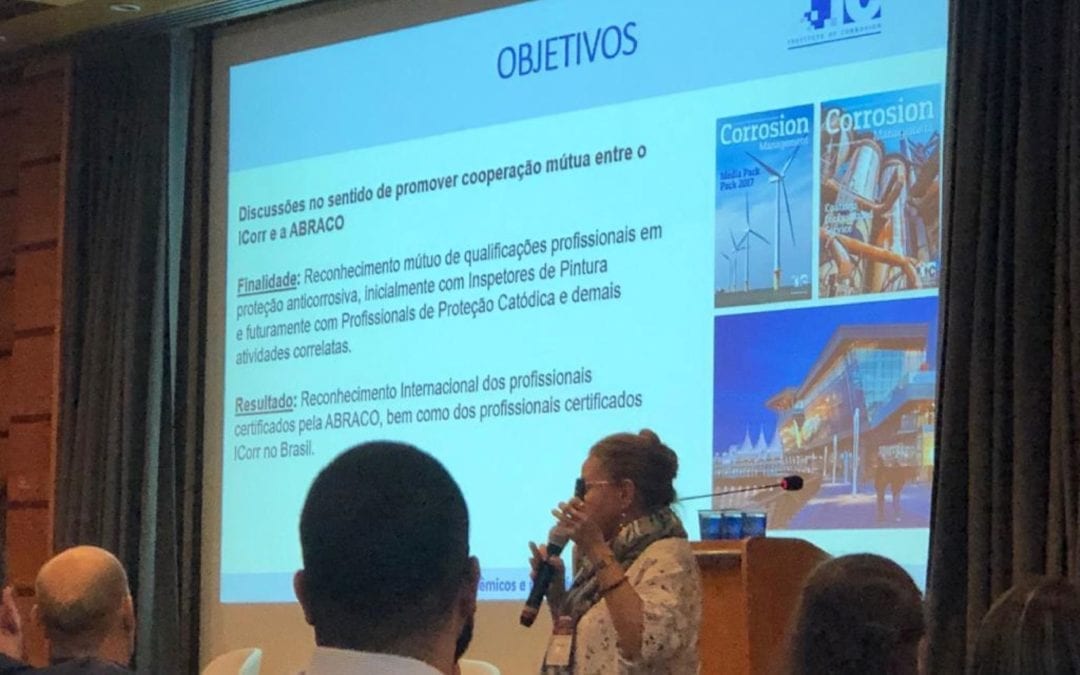
One of these is Lucia Fullalove FICorr MSc BSc, and Director at Fullalove & Associates Corrosion Consultancy Ltd. With her help and expertise, ICorr has been working closely with the Brazilian Association of Corrosion (ABRACO) on Paint Inspector and Paint Applicator’s courses.

The Institute was further introduced to the Brazilian market on 3rd December at the VI SBPA – the Brazilian Seminar of Paint Application. At that event, Lucia delivered a well-received presentation to the ABRACO-organised Brazilian Coatings Seminar discussing greater collaboration and cooperation between ABRACO and ICorr.

Speaking of these latest exciting developments, ICorr President Gareth Hinds says:

‘I’m delighted that ICorr certification of Level 2 and Level 3 Coating Inspectors has been formally recognised in the new Petrobras standard. This reflects our status as a leading global provider of training in this area and the excellent relationship with our sister society in Brazil, ABRACO.

“I’m pleased to announce that we have recently signed a Memorandum of Understanding with ABRACO to develop further training activities together and I look forward to strengthening this relationship further in the years to come.’

With the dedication and expertise of Fellows and Members of ICorr, we continue to spread our membership’s knowledge, experience, and expertise to an increasingly global audience.

If you would like to learn more about our Coatings Inspector Training, or to enquire about membership options available to you, please email the Institute of Corrosion at admin@icorr.org.

The Critical Nature of Coating Inspection in Corrosion Management

The Critical Nature of Coating Inspection in Corrosion Management

The Essential Role of the Coating Inspector

Effective corrosion management relies on coating inspection, carried out by a certified coating inspector. In this article, you’ll learn why coating inspection is critical, and the responsibilities of contractors and asset owners.

Quality of protective coating is not just desirable – it’s critical

As consumers, we are used to goods and services that we buy meeting a certain standard. In fact, quality is something we expect. After all, if the produce we buy from a supermarket isn’t up to scratch, we won’t shop there again. We expect a restaurant that comes recommended to produce the finest cuisine with exceptional service. If we’re disappointed, we make a complaint and refuse to pay the service charge.

However, in some situations we cannot afford to take a chance on quality. In industries such as oil and gas, rail, highways, and infrastructure, poorly executed work can be disastrous – not only financially but also with potential loss of life.

When a coating is applied to an asset, its primary purpose is to protect it against corrosion and give longevity of life to the asset; this process needs managing. The coatings need to be applied correctly by trained and certificated applicators, and certificated inspectors play a vital role in ensuring the process is delivered correctly.

A coating inspector’s work is to confirm that coatings have been applied correctly, to prevent corrosion that can have disastrous consequences.

Why can’t we just trust coating applicators?

In the UK, coating applicators are trained and qualified under the Industrial Coating Applicator Training Scheme (ICATS). Such training should ensure that applicators carry out their work in a professional manner and deliver a high quality of work. But it’s not quite that simple, and the risks associated with errors are too large to leave work unchecked.

People make mistakes, and a quality check makes sure that mistakes are corrected before they become expensive errors. A specification could be misread, or a detail missed.

In short, the coating inspector is a safety net, to help avoid dire consequences of human error.

Who is responsible for coating inspection?

The responsibility for coating inspection falls on both the contractor and the asset owner.

Contractors should have their own coating inspectors to check the work of their applicators. This is a mandatory requirement in industries such as rail and highways. It’s good business practice, and helps to foster good client relationships by ensuring quality of work is maintained.

However, the asset owner should never rely on the contractor to confirm the quality of their own work. That’s one huge conflict of interest to be avoided. So, good asset owners will employ their own coating inspectors, or hire a third-party coating inspector to check the protective coating application a second time. Using this strategy, asset owners should avoid the disasters that could be caused by contractors who may be tempted to cut corners.

In summary

Protective coating systems are complex. As we have been highlighting in our series outlining ISO 12944, coating is impacted by a range of factors that include:

Such factors make application complicated. It is therefore preferable for highly trained and suitably qualified professionals to collaborate. This should ensure that:

  • Specifications are met
  • Standards are maintained
  • Quality is assured

While the contractor will wish to ensure their work is of the highest quality, the ultimate responsibility rests on the asset owner. After all, it is in their best interests to make certain that disastrous failures of coating systems are avoided – a valuable by-product of which is that properly applied protective coatings will protect assets more effectively and reduce the costs of ongoing maintenance.

For more information about our Coatings Inspector Training, please email the Institute of Corrosion at admin@icorr.org.

61st Corrosion Science Symposium (Online)

61st Corrosion Science Symposium (Online)

The 61st Corrosion Science Symposium (CSS) will be held online during the week commencing Monday 14th September 2020.  The CSS Online is the annual meeting for students and researchers working in all areas of Corrosion Science and Engineering.  The CSS has been held annually since its launch in 1960 by Prof. L.L. Shreir. Holding a physical event was not going to be possible this year but we believe it is important to keep the CSS running even during these COVID times.  There will be no charge for the event.

To register for the event please visit the Eventbrite page:  61st Corrosion Science Symposium

Abstracts are still being accepted.  Please contact Julian Wharton (j.a.wharton@soton.ac.uk) if you wish to submit an abstract.

With the alternative online arrangements, we plan a programme of several sessions staggered through the week.  Each session will focus on a series of short (10 min) presentations with extended abstracts made available beforehand.  The sessions will be immediately followed by more in-depth online open forum discussion with the presenters.

A key highlight for every CSS is U.R. Evans plenary talk and presentation of the award.  The UR Evans Award is the most prestigious ICorr award and recognises outstanding contributions to corrosion science and engineering.  This year the award is being made to Prof Robert Cottis.  Prof Cottis has been a champion of corrosion education throughout his entire career with seminal contributions within UMIST/University of Manchester and activities linked to the European Federation of Corrosion (EFC) WP6 Corrosion Education and NACE International.

Download Presentation Programme