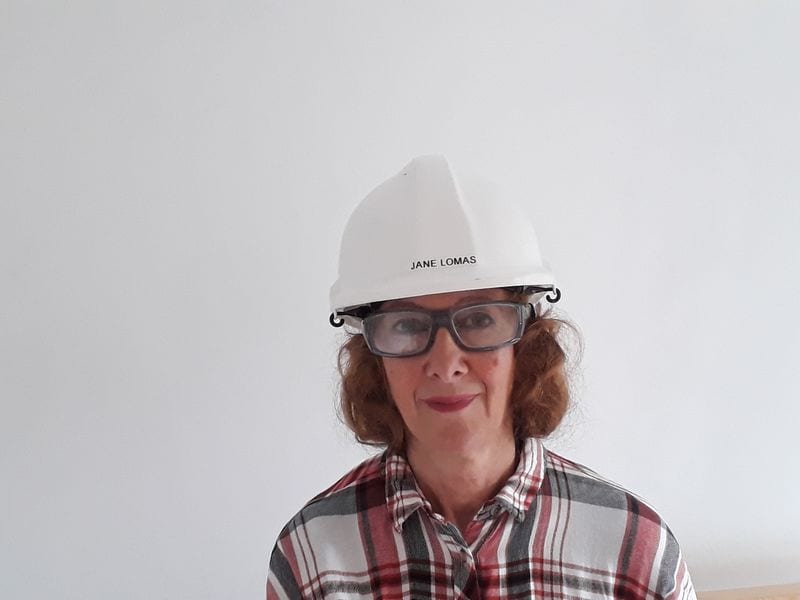
We kicked off our monthly ‘Meet the Corrosion Specialist’ last month, with our magnifying lens on Bill Hedges. This month we’ve had the spotlight on Dr Jane Lomas (FICorr), Corrosion & Coatings Engineer at Amtec Corrosion Consultants.
We asked Dr Lomas about her professional life, career advice she would give to younger corrosion specialists, and took a peep into her private life.
Here’s the 11 questions we posed in the 11 minutes we took of Jane’s valuable time.
1. What did you aspire to be when you were younger?
Whilst at junior school I was always interested in science and wanted to be a famous scientist. Later I aspired to a career in genetic engineering.
2. So how did you end up as a corrosion specialist?
Having completed a degree in biochemistry and considering my options, my attention was caught by an advertisement for a course in corrosion engineering at the University of Manchester Institute of Science & Technology (UMIST), which would allow me to use my knowledge of microbes in an unusual industry. I applied and was accepted on the course and have ‘been in rust’ ever since.
3. What was your first job like?
After passing the corrosion course, I stayed at UMIST for a few years and carried out research into a range of corrosion-related problems including car paint, concrete repair materials, ship paint, water treatment, batteries, and others! I was also involved in a number of investigations into paint failures.
4. You decided to stick with coating failures. How did your career progress?
In 1985 I started a small business with a couple of colleagues to work on paint failures. Initially the projects were mainly on ships and I spent a lot of time at sea carrying out paint failure investigations. Later the work diversified into paint on land-based structures including buildings, factories, trains and Blackpool Tower. 35 years after starting up, we are still running the business and still enjoying the varied and interesting work.
5. What have you enjoyed most about your career in corrosion?
It is great finding out details about industries that I haven’t worked in before, as there is always something new to learn. I also like being able to ask a lot of questions!
6. What career advice would you give to a young corrosion specialist?
Find a comfortable pair of boots and overcome a fear of heights! Seriously though, most of my early jobs involved a lot of walking and climbing up and down ladders and scaffolding. The corrosion always seemed to be at the top of a building or the bottom of a deep tank on a ship. I would also say never be afraid to ask questions.
7. What is in store for corrosion professionals?
Managing and adapting to the new corrosion issues that will arise as novel materials are invented or used in increasingly challenging environments.
What have you gained from your membership of ICorr?
As a young corrosion engineer, Professional Membership of the Institute of Corrosion provided prospective employers with assurance that I had proven skills in corrosion, whilst I built up my years of experience.
9. What is your favourite food?
It varies because I love to try the local food when travelling. Often my short-term favourite is from the last country visited, but I like to cook curries at home.
10. What do you like doing most outside of your professional life?
Walking in the countryside with family and friends.
11. Tell us a secret about yourself, something that might surprise fellow members (and something we can print!).
I sometimes sing with a rock and blues band to raise money for charity.
What do you want to ask a corrosion specialist?
Our members never cease to amaze us. How about a long walk in the countryside, before tucking into a homemade curry, and then attending a gig in which Dr Jane Lomas is starring? Sounds like a perfect way to relax at the weekend.
Now, over to you. Let us know what you’d like us to ask the next ICorr member we put in the hotseat for 11 questions in 11 minutes. Send us an email, and we’ll try to include your question.
The next article in this series from Fellows of ICorr who have made a significant contribution in the field of corrosion control is by Ali N Moosavi, a Project Manager with DNV-GL, who describes his personal experience with the use of pipeline liners by a major Oil and Gas company in the Middle East.
Protection of pipeline internal
surfaces, and the use liners in the Oil and Gas Industry
The owners and operators of pipelines in the oil and gas industry have a range of options available to them for the internal protection of their pipelines from corrosion. These include from doing nothing, to cleaning, using coatings, chemicals and internal liners.
Do Nothing
This option is used where:
• Expected life of the line is too short to require any protection
• Corrosivity of the liquid passing through the line is insignificant
• Economics dictate repair and replace strategy
Use Cleaning Pigs
This is a very effective method but is labour intensive and requires the lines to be piggable. It is particularly effective in lines where the main mode of corrosion is Under Deposit Corrosion, or Microbially Influenced Corrosion (MIC), which normally occurs at the 6 o’clock position.
Internal Coating
This option can be very effective but requires a very high degree of quality control and quality assurance at the application stage. Also, assuring that the coating coverage of the weld joints is undamaged is challenging. There is also some concern that any holidays in the coating can result in accelerated localised corrosion at the exposed location. Furthermore, detachment of coating on a widescale basis can lead to a blockage of the pipeline.
Anti-Corrosion Chemicals
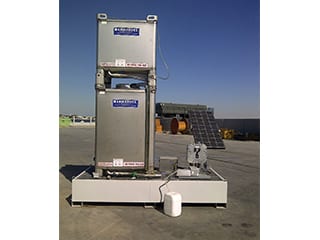
This is a widely used method in the oil and gas industry. It requires chemical injection facilities and also that operators ensure that a minimum level of chemicals is maintained in the tank and the injection pumps are working. Often a cocktail of chemicals, such as corrosion inhibitor, oxygen scavenger, biocide, etc. is required. In the warmer climate of Middle Eastern countries, solar powered automatic chemical injections systems, with automatic warning if the tank runs low, are increasingly being used.
Cladding
Internal cladding of pipelines with between 1-3 mm of a corrosion-resistant alloy (CRA) material is only used where corrosivity is high, the line is critical, and a relatively long design life is required. It is relatively expensive and is rarely used for very long pipelines. It has the advantage of being a “fit and forget” measure with no further activities required from operators, and no need for any other internal corrosion control measures, such as chemical inhibition. It is also much more reliable than internal coating or liners.
Corrosion Resistant Alloys (CRA) for pipeline material
This option is by far the costliest option and its use is extremely rare, especially for lines of any considerable length. To economically justify this option would require an extremely critical line with severe threats of both internal and external corrosion, and it would be for a very short length. However, this option is used more commonly for downhole casing and tubing in extremely corrosive conditions, as the cost of any workover due to corrosion of downhole equipment is very high.
Non-metallic Pipelines
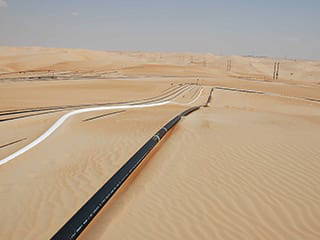
Various non-metallic materials are used for construction of pipelines. These range from Poly Vinyl Chloride (PVC) to Glass Reinforced Epoxy (GRE). The use and selection of the specific non-metallic material for a pipeline depends on the maximum pressure and temperature of the operating environment, and the temperature/pressure limitations of the pipeline material. The vast majority of non-metallic pipes are used to transport water. With advances in the technology of these pipelines, more resilient forms of non-metallic lines, such as High-Density Polyethylene (HDPE) and GRE, have been used to transport crude oil. Basically, the smaller the pipeline diameter, the higher its limits for pressure and temperature. These lines offer internal and external corrosion resistance and do not require any additional corrosion protection measures such as chemical inhibition. They are unlikely to need cleaning by pigs as deposits cannot adhere easily to non-metallics. Such pipelines can be “rolled on” the ground.
However, non-metallic pipelines installed in moving soil conditions, such as deserts, can suffer from vibration and become deformed. They also must be resistant to solar radiation.
A non-metallic pipeline (white) rolled on the desert floor.
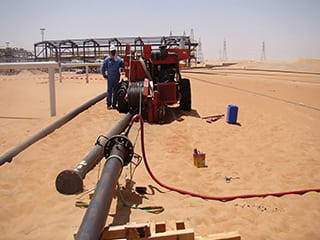
The wireline machine used for pulling a liner through the host pipeline.
It is with great regret that we report the death of another of the great and good of ICorr. Barry died on 5th May aged 83, a victim of Covid 19. He was born on 27th December 1936 in Lower Broughton Salford, and went to Broughton Secondary Modern School, leaving at the age of 15 to work in a paint factory. He went to night school to study Chemistry and Paint Technology at Newton Heath Tech, where he met his life-long friend Ray Stott. Both of them joined ICorr and attended all the Monday evening lectures and symposia where Barry could be guaranteed to ask searching questions. He served on the North-west branch committee as Chairman and later Treasurer. He also served on Council for many years. Despite his lack of opportunity to go on to higher education he became a Fellow of OCCA, a Fellow of ICorr and a Chartered Scientist, he was considered by his peers to be a very clever man and the most knowledgeable person in the paint industry in the field of corrosion protection. He did his National Service as a medic in the RAF, stationed in London, during which time he continued his night school studies. Barry worked for England Hughes Bell for many years and later with Corroless International – whenever the brand was sold Barry was always part of the deal and moved through several companies including Unitor and Mason’s Paints. He spent many years travelling abroad mainly in the Middle East, Malaysia and Singapore on trouble shooting and technical support. Finally when semi-retired he worked for Alocit Systems; it was when he was travelling to their UK offices in Norfolk that his career came to an abrupt end, a speeding BMW smashed into the back of a queue of traffic on the A1 catapulting Barry’s car into the central barrier, although he appeared to be unhurt at the time his health rapidly deteriorated, a minor fall at home, and a check-up at A&E resulted in a broken hip when he fell off the trolley whilst waiting for attention, this was followed a few months later by acute neurological problems which left him with a speech impediment and balance problems. He remained on North West branch committee until his late seventies when his deteriorating health forced him to move into sheltered accommodation in Holmfirth, closer to his younger daughter, Lisa. He spent his final days in a care home in Barnsley where he contracted the virus.
Barry was married to Marie for 44 years and would often quote how many days hours and minutes. They spent their married life living in Bolton and had two daughters Diane and Lisa, and four grandchildren. His own lack of opportunity resulted in him encouraging both his daughters to attend university. In his younger years he enjoyed motorcycling, he played golf and was a keen walker, and a long-term member of the Crown Walking Club. He was a lifelong Manchester City supporter, proudly wearing his scarf even through the doldrum years and was elated with the rapid rise to the top in recent years. He took a keen interest in all types of public transport, but particularly buses, he could tell you the numbers, routes and timetables of all the buses, not just locally, but in the many of the places he had visited over the years. He was particularly excited when on holiday in Malta he discovered that all the service buses were ex UK of various vintages, some of which I am sure he knew personally. It is understood that this fascination started at an early when at the age of two or three he would disappear only to be discovered at the end of the street watching trams. After he retired, he loved to go on coach holidays, he would turn up with his suitcase and five carrier bags of things which he couldn’t fit in much to the dismay of the driver. This expanded to seven on the return trip as he insisted on carrying his dirty washing home in black bin liners. Barry took a scientific interest in food, extoling the virtues of chicken soup and making his own home-made soups. When in late middle age he was diagnosed with Type 2 diabetes knowing he had to cut his sugar intake he reasoned that scones had less sugar than cake and cream had none, so he could have scones with jam! and cream, and because they had less sugar than cake he could have two!
He will be sadly missed, not just for his idiosyncrasies and eccentricities, but for his vast knowledge and experience. Even to the end he was talking about organising a joint OCCA / ICorr symposium with the theme the A-Z of Coatings. Barry’s funeral was held on 26th May, it is so unfortunate that we couldn’t give him the send-off he deserved.
Brenda Peters
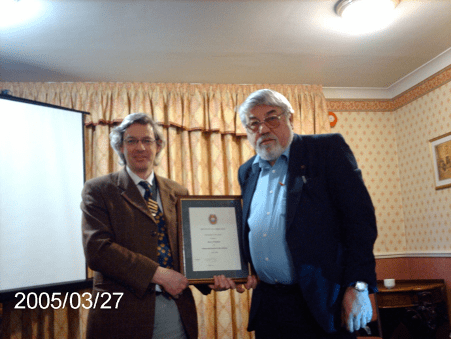
Barry receiving the Presidents Plaque from the then President, Stuart Lyons.
Following on from the success of its week long April joint webinar event with MCF, ICorr Aberdeen held its 8th event of the 2019/2020 session during 6-10 July 2020 with a very comprehensive marine focussed ‘Webinar Week’ comprising of some excellently delivered papers by:
• Roger Francis, (RF Materials – Improving the Corrosion Resistance of Duplex Stainless Steel Welds).
• Adnan Syed, (Cranfield University – Hot Corrosion Mechanisms for Gas Turbines).
• Lars Lichtenstein, (DNV GL – Improvements of the DNVGL-RP-0416 and DNVGL-RP-B401 – Upcoming Revisions).
• Brian Wyatt, (Corrosion Control Ltd – Cathodic Protection of Offshore Renewable Energy Infrastructure).
• Andrew Woodward and Chris Matthews, (Connector Subsea Solutions Ltd – Use of CRA’s in Mechanical Connectors for CRA Clad or Lined Pipe Repairs).
The heavily over-subscribed webinars, which had more than 500 attendees, were jointly chaired by Phil Dent (MCF) and Stephen Tate (ICorr-ABZ), with Lewis Barton (MCF) as webinar facilitator.
This time around, a very effective 4-pronged promotional attack was deployed, with excellent Social Media blogs provided by Michael Barton for the HQ website, Dr Yunnan Gao promoting at the Aberdeen end, Lewis Barton via the MCF website and LINKEDIN pages, and further additional support provided by Gareth Hinds and Brian Wyatt of ICorr Council.
There was excellent participation by the attendees via Web Chat for all the Q&A Sessions, and all the presenters’ responses are also now loaded onto the ICorr/MCF websites.
All the webinar presentations had excellent technical content that highlighted the particular challenges of the marine environment, in terms of correct materials selection, correct application of corrosion control methods, the importance of good quality control at fabrication, and having appropriate inspection and maintenance regimes.
Roger Francis discussed in great detail the development of modern Duplex stainless steels from the early 1980’s onwards, with particular emphasis on the jointing processes / joint design and how to avoid corrosion failures of welds resulting from disturbed metallurgy, the importance of having adequate post-weld treatments / checks, (such as post-weld pickling / use of shielding welding gases during fabrication and the use of Feritscope checks on the HAZ of production welds that can be used to measure the ferrite content through magnetic induction), and in also having suitable weld testing programmes in place at fabrication stage, over and above that of ASME IX, and he proposed some suitable tests. Roger also emphasised the need to perform corrosion tests not just on the PQR (Procedure Qualification Record), but also based on the individual welder qualifications, in order to ensure that each welder fully understands what is necessary to produce an acceptable’ weld quality.
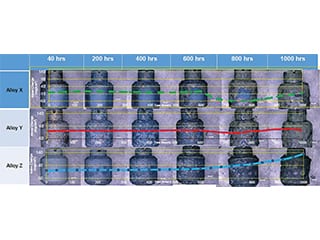
Adnan Syed described a very interesting journey through hot corrosion mechanisms of jet engines and industrial gas turbine components, (this being a well-known issue for the aviation and power generation industries). The talk included the possible hot corrosion mechanisms occurring in the gas turbine combustion environment, and some of the challenges industry is facing in their understanding and managing of turbine component degradation. He discussed the two main types of attack: Type I (high temperature corrosion) attack, in the range of 750 to 900 C, mainly due internal sulphidisation, and Type II (low temperature hot corrosion) attack, at temperatures in the range of 600 to 750 C (maximum rate of attack in the range of 675–730 C) and associated with pitting type attack. The importance of good alloy quality and the prevention of corrosion damage related to salt deposit chemistries was emphasised, along with ongoing Cranfield laboratory corrosion experiments and the use of thermodynamic software to help identify the phases formed, which in turn enables a better understanding of the mechanisms involved
Cranfield University – Adnan Syed. Examples of macrographs and mass change data for high temperature corrosion testing.
Lars Lichtenstein then considered the harsh operating environment for Marine Wind Turbines being increasingly deployed in our coastal waters, bringing us up to date on ongoing revisions to DNV GL documents on corrosion protection for wind turbines (which are under internal revision), DNVGL-RP-0416 and DNVGL-RP-B401. Changes highlighted included more guidance on the useful coating lifetime as introduced in DNV-OS-J101:2011 for the first time, and the relation with fatigue calculation and surface preparation, including the need for weld grinding. In particular the level of coating quality required at the end of the lifetime, andthe degree of effort needed to be put into inspection and repair of 15+ year old coating systems, so as to ensure ongoing integrity. Lars also discussed the issue of coating breakdown factors with regards to CP system calculation and on current drain of buried structures. He further highlighted new information on material selection for bolts and stainless steel, and what boundary conditions should be considered.
Brian Wyatt nicely linked into the previous day’s discussion on standards and recommended practices and emphasised the multiple zones / environments requiring many different corrosion control considerations / solutions within the Wind Energy Sector.
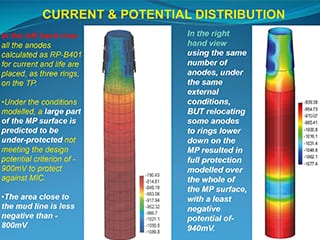
He highlighted the lack of competency seen in some projects performed to date and gaps in guidance that urgently require to be addressed as the renewables industry accelerates in scale. Velocity effects are a particular consideration resulting in increased levels of oxygenation at the steel/water interface which demand more robust CP designs, both in mechanical and electrochemical terms. The nature of the support structures, and limited scope for lower cost onshore anode installation, also lead to challenges to uniform anode distribution, particularly on Monopile type structures that replaced the earlier jacket type wind farm structures, that were more similar to the established requirements and practices of the Oil and Gas Industry, for which earlier DNV Codes were intended to cater for (editor, see technical article later in this magazine).
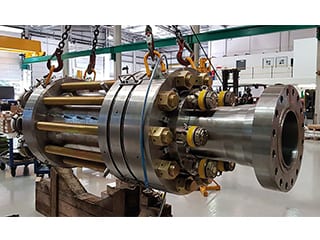
Andrew Woodward and Chris Matthews wrapped up the week with a great talk on outcomes from their recent joint industry project (JIP) with Chevron and Woodside Petroleum, as part of a new technology development programme in line with DNVGL-RP-A203. They have recently developed a new patented method of sealing on the inside of a CRA clad or lined pipe, thus enabling a permanent subsea repair solution. The new seal in the “CLiP” Connector takes advantage of the corrosion resistant and ductile properties of Alloy 625 (UNS N06625) and experience gained through extensive testing of graphite in order to create a seal that conforms to NACE MR0175 / ISO15156-3. The seal forms around all pipeline manufacturing tolerances and even localised irregularities such as internal weld seams. The seal can be easily integrated into existing mechanical connector configurations and is able to be adapted for both diver installed and remote repairs. The technology qualification was completed through a combination of analysis (including development of a parametric FEA model to cover all future design scenarios), 3rd party material testing, and component testing in specialised test rigs; all culminating in full scale testing within a mechanical connector. The presentation focussed on the analysis and testing aspects of the technology qualification process which highlighted all key failure modes that had to be addressed.
There has been much debate of late concerning the impacts of the coronavirus outbreak, but the success of these recent Joint and Online Events has proven beyond doubt that such obstacles can be overcome and that the thirst for corrosion learning remains as strong as ever.
As usual, full details of future branch events can be found on the ICorr Website, or by contacting: ICorrABZ@gmail.com, and copies of the majority of past branch presentations can be found at: https://www.icorr.org/aberdeen/ and a photo gallery for all Aberdeen events may be found at: https://sites.google.com/site/icorrabz/event-gallery. See also ICorr Aberdeen on LinkedIn at https://www.linkedin.com/in/aberdeen-icorr/.
It should be noted that the planned ‘Industrial visit (Oceaneering), an “Alternative / Interactive Industrial Event’, will now take place on 25th August 2020, and readers should also be aware of the upcoming Aberdeen joint event with TWI on 24th September 2020 covering Environmental Corrosion of Fasteners. More details of both events will follow soon on the ICorr website and social media. All of Aberdeen’s remaining 2020 events will be Online.
Brian Wyatt – Corrosion Control Ltd. Example of Advanced CP Modelling used to optimise Galvanic Anode Positioning.
Connector Subsea Solutions Ltd – Andrew Woodward and Chris Matthews. An assembly showing the use of CRA’s in subsea clad pipelines and repair of connections. DNV GL approval was awarded to the CRA clad and lined pipe end seal in December 2019.
The Corrosion Science Symposium is one of the premier events in the Institute of Corrosion’s calendar. This year it’s not going to be quite the same as before, but we think you’ll like what we’ve done to ensure it is an equally engaging and enlightening an event as it has always been. The key to its success, as ever, is those who
attend – you.
The CSS has traditionally been a two-day meeting held in a prestigious location befitting of its status, and last year’s event was held as part of Electrochem 2019, at the University of Strathclyde’s Innovation Centre in Glasgow.
Although it is an informal meeting of the CSD in which corrosion scientists, corrosion engineers and PhD students can gather, hear talks on corrosion, and discuss relevant corrosion issues, it does include certain formalities. Presentations of some of the Institute of Corrosion Awards are made during the CSS, including the presentation of the UR Evans Award – the premier scientific award of ICorr, and the Lionel Shreir Award – for the outstanding student talk given during the CSS.
With a more unpredictable future than at any time in our history, the CSS has been moved from a physical space to cyberspace this year. While the exact format is still being finalised, the date and an outline of the format have been set. As it’s going online, rather than an intense two days of sitting in front of a screen, it is being extending to three or four sessions during the week beginning 14th
September 2020.
The exact format, times, and technology being used will be announced nearer the date. One thing is for certain, though – being online, the CSS will be more accessible this year than it has ever been. Consequently, many more international students are expected to take part, and that could lead to some exciting competition for the Lionel Shreir Award, the winner of which will be selected during CSS, and it is currently planned to present the it online on the final evening.
We use cookies to optimize our website and our service.
Functional
Always active
The technical storage or access is strictly necessary for the legitimate purpose of enabling the use of a specific service explicitly requested by the subscriber or user, or for the sole purpose of carrying out the transmission of a communication over an electronic communications network.
Preferences
The technical storage or access is necessary for the legitimate purpose of storing preferences that are not requested by the subscriber or user.
Statistics
The technical storage or access that is used exclusively for statistical purposes.The technical storage or access that is used exclusively for anonymous statistical purposes. Without a subpoena, voluntary compliance on the part of your Internet Service Provider, or additional records from a third party, information stored or retrieved for this purpose alone cannot usually be used to identify you.
Marketing
The technical storage or access is required to create user profiles to send advertising, or to track the user on a website or across several websites for similar marketing purposes.



 9. What is your favourite food?