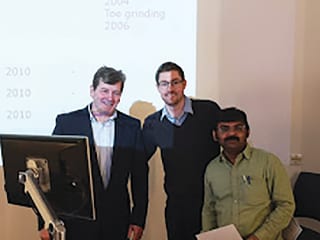
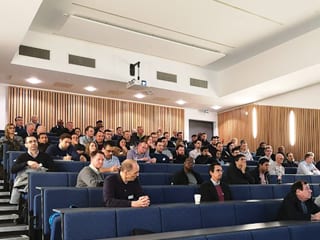
The February talk was given by George Winning, Technical Service Manager for Clariant Oil Services in Africa, a Fellow member of ICorr and London branch committee member. George explained in his presentation why the corrosion inhibitor injection systems are required, and reviewed typical systems and corrosion control options, both mechanical and chemical. This was an excellent talk which produced significant discussion amongst those attending.
Within oil and gas operations there is a need to maintain and optimise production through life. One of the most common options to achieve this is the use of water injection to maintain reservoir pressure. With the use of these systems comes issues regarding corrosion as the presence of oxygenated water, scale and microbial growth can lead to premature failure unless efficiently mitigated.
The above corrosion threats were outlined in the presentation, followed by discussion on how the various systems used, amongst seawater, aquifer water, river water and other systems such as PWRI and water and gas (WAG), determine the most suitable mitigation methods.
This led onto the need for the fit-for-purpose design of the system, the maintenance of any mitigation measure and the required monitoring to ensure safe and efficient operation.
This brought up a discussion on many subjects covered. These included microbial monitoring of the system and identification of the most reliable methods, which opened up a philosophical debate on whether any method is truly reliable and led to a conclusion that a number of methods, Serial dilutions, ATP, qPCR or even H2S monitoring should be used in conjunction with trend mapping to ensure the system is running at its optimum level. Other questions revolved around reliability of systems, particularly the deoxygenation system, with the conclusions that effective maintenance and monitoring of the system to identify problems at an early stage are imperative to allow changes to the operation to be made and the system optimised. It was also highlighted that water injection systems are regularly overlooked, as they are not seen as the sales point in oil and gas production, and leaks are not of high environmental concern. This is a mistake as these systems are the most important measure taken to maintain oil production in the secondary oil recovery phase of a project and overlooking these in the short term will affect the economics of the asset in the long term.
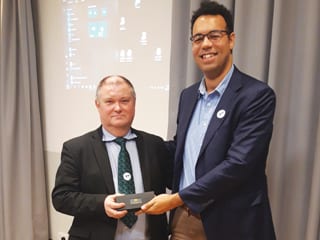
The talk was well received being described as ‘Master Class’ and well delivered with clear and relevant arguments made. It was closed with a vote of thanks and a presentation to the speaker.
The branch held its 5th event of the 19/20 season at RGU Aberdeen, with a paper entitled “Structural Integrity Issues: under-deck, air-gap, splash zone assessment / deterioration / repair mechanisms, (for corroded / fatigued conductors, caissons and risers)” by Chris Tierney, SETS. This was a highly successful 1st joint presentation with EI – The Energy Institute, with 75 attendees.
The first part of the presentation considered, conductor integrity, hidden risks and corrosion mitigation, and in the second part Chris discussed new platform-launched technologies for repair of caissons and conductors subsea on ageing assets. After a decade in the subsea engineering sector with Technip, Chevron Upstream Europe, and Pro Dynamic Lifting (PDL), Chris founded SETS in 2011 as a subsea engineering and consultancy specialist. A platform splash zone is an area of multiple risks to production due to the high likelihood of mechanical damage to elements running through this area, cracking and in some geographical locations, very high corrosion rates. SETS provide innovative, engineering and tooling services to deliver efficient conductor management and repair solutions. The company have continued to innovate, learn and produce solutions for this difficult work zone and have been at the forefront of the design and development of technically advanced subsea tooling for conductor cleaning and inspection, clamp repair and shim installation. Unusually, their technology is remotely operated from topside, eliminating the requirement for diver support, and dramatically reducing time and cost. Their success in this area has resulted in the recent acquisition of the company by AquaTerra ( Kintore, Aberdeenshire).
The SETS presentation concentrated on conductors but the technology is equally applicable to caissons and risers. Conductors run from seabed to wellhead, providing environmental protection to the most vulnerable well components. A conductor should be considered a complex system, and its integrity managed accordingly, spanning wells, structural and operational functions. The condition of conductor and guide frames at the spider deck reflect the condition of these at the first elevation subsea. These are the most highly utilised areas in a conductor system, subjected to the greatest environmental loads and generally where majority of defects present themselves. The presentation discussed in detail, marine corrosion, fretting, fatigue, damage mechanisms and progression rates affecting conductors on ageing assets. Chris explained how different marine environments worldwide impact on conductor, caisson and riser integrity and following this, there were many thoughtful questions from the audience.
A full house, attended this first IE/ICorr joint event.
Branch chair, Stephen Tate, closes the event with Certificates of Appreciation to Roy Milne (Vice Chair of EI – Energy Institute and Chris Tierney, Managing Director of SETS.
The February 2020 evening meeting with 55 attendees opened with a discussion of the new ICorr logo and re-branding of the Institute to provide a much needed re-start and more professional focus, with the key being firmly on corrosion prevention by all available means. Following this introduction, there were very informative twin presentations by DNV-GL on risk based inspection activities, covering both PSVs (Pressure Safety Valves) and FPSO’s (Floating Production, Storage and Offloading) units.
The first presentation, by Dr Chris Bell discussed how data analysis of servicing has helped reduce cost and improve safe interval servicing of PSVs. PSVs are installed in process and utility systems to prevent build-up of internal pressure, or external effects such as fire. Over pressurisation of any vessel, or other equipment item, with energy released from the pressurised fluid, or the hazardous or flammable nature of the contents, can have significant consequences on a platform. Valves can block through build-up of wax, gunk or corrosion products within the system and the PSV will fail to lift. For this reason, PSVs are classed as safety critical when protecting hydrocarbon containing equipment and must be safety tested on a regular basis. The testing cannot generally be done in-situ, and valves most usually have to be taken onshore, tested, refurbished and refitted. Typically there are over 100 PSVs on a platform so it is worth optimising the maintenance interval. This can be done by data analysis to find the appropriate time to service the valve based on previous history and ensure a safe practice whilst minimising costs, and the inspection interval can be set so that the residual risk of failure is acceptable.
0.5 billion hours of service data for PSVs have been analysed from 10,311 tests and 544 failures by DNV-GL to allow optimisation of maintenance intervals and manage the inspection of PSVs. A methodology was developed that combined qualitative and quantitative RBI analysis. This multi-layered assessment gained the most information possible from the data, and as an outcome, the average maintenance interval was changed from 37 to 44 months and the test failure rate dropped. So, for an average PSV maintenance cost of £1000, total cost has now reduced by £ 1.1m from £6.5m to £5.4m per year.
The second presentation was by Dr Madhu Parlapalli, who presented a paper on risk based inspection (RBI) of FPSO Cargo Tanks. Risk based inspection in the oil and gas industry of piping, pressure vessels and other critical equipment has been used more recently for planning structural inspections. For floating structures like FPSOs where there are additional requirements to satisfy in the form of Classification Society rules, although risk based approaches are allowed under these rules there are relatively few examples of where this has been applied to plan structural inspections on FPSOs, for items such as cargo or ballast tanks.
It is operationally quite inconvenient to carry out inspections of these tanks on a fixed 5-year interval in line with a standard Class schedule. A risk based inspection schedule has to take account of all relevant degradation mechanisms and the corresponding means of inspection. For FPSO cargo tanks the main degradation threats are fatigue cracking and corrosion / coating degradation and of course general inaccessibility for inspection. The RBI process involves developing a structural hierarchy of ‘accessible’ elements, identifying the relevant ‘failure modes’ and damage mechanisms then evaluating the ‘probability’ ranking for the relevant mechanism. The ‘consequence’ ranking for safety, environment or business impact is then added, and the risk level is evaluated using an agreed risk matrix with the client/owner. An inspection plan can then be developed for different inspection activities to form an optimised inspection schedule. Case studies were presented for ‘hotspots’ identified on an FSPO and RBI analysis used to look at the fatigue degradation mechanism and a coating degradation mechanism. An extensive Q&A followed these 2 excellent papers.
Branch chair, Stephen Tate with Dr Chris Bell and Dr Mahdu Parlapalli of DNV-GL.
Full details of future branch events can be found on the diary page of this magazine and on the website, or by contacting: ICorrABZ@gmail.com. Copies of the majority of past branch presentations can be found at: https://sites.google.com/site/icorrabz/resource-center, and a photo gallery for all Aberdeen events can be found at: https://sites.google.com/site/icorrabz/event-gallery
A special reminder is drawn to the August 2020 Annual Corrosion Forum (ACF), which unfortunately has now been cancelled owing to the Covid.19 outbreak and knock-on financial effects.
Solent Protective Coatings are a forward looking company combining the latest innovations, technologies, techniques, equipment and products with excellent experience, and can offer solutions to all aspects of surface preparation, corrosion protection and application of protective coatings both for preservation and presentation.
Their staff have considerable experience in operations undertaken by the company and have established a very good reputation for service and quality. The overall intent of the company philosophy is to create a strong relationship with their customers, professional teams and the supply chain, which is based on trust and co-operation and represents a genuine partnership.
Their key services include abrasive grit blast surface preparation, passive fire protection, thermal spraying, protective coatings application, and UHP water blasting. Their expert staff and partners are available to ensure that your project is full specified and planned with the right people, equipment and materials to deliver the results you require.
Hexigone manufacture corrosion inhibitors that are safe, smart and up to ten times more effective than other alternatives. Their vision is to create a more sustainable world through ‘chemically intelligent’ coatings developed in collaboration with industrial partners.
Their technology, Intelli-ion, protects in a completely unique, ‘smart’ way via three modes of electrochemical protection. The active ingredient sits dormant in a micro-reservoir and is triggered ‘on demand’ when corrosion ions are sensed at the coating surface. These are then sequestered into the coating, preventing cathodic disbondment and filiform corrosion. Due to the micro-reservoir system, Intelli-ion is able to offer corrosion protection using chemicals that were previously incompatible with coatings – significantly increasing the lifetime of the end product.
As a new company to the coatings industry, they have already made global connections with over 50 partners formulating with their product, which has three variations (AX1, AX2, AS1) that are suitable for drop-in replacement within primers and solvent borne systems for ferrous and non-ferrous substrates. High performance has been seen across the O&G, ACE, marine, aerospace, automotive refinishing and architectural industries.
Forward Protective Coatings Ltd is one of East Midlands foremost industrial coatings applicators, specialising in painting steelwork for most industries. They can apply most paint systems on structural steel and fabrications and also on stainless steel and aluminium items. Operating from a 30,000 square feet facility based in Mansfield, Nottinghamshire, they have a lifting capacity of up to 20 tonnes. As well as applying protective paint systems, they can also apply thermal spray coatings, passive fire protection and powder coatings, and have crews to provide on-site touch up or full paint systems.
FPC pride themselves on providing the highest quality products with a service that is one of the best in the industry, and have experience in providing coatings for the most demanding of industries and are able to tailor inspections and certifications to meet any client requirements.
We use cookies to optimize our website and our service.
Functional
Always active
The technical storage or access is strictly necessary for the legitimate purpose of enabling the use of a specific service explicitly requested by the subscriber or user, or for the sole purpose of carrying out the transmission of a communication over an electronic communications network.
Preferences
The technical storage or access is necessary for the legitimate purpose of storing preferences that are not requested by the subscriber or user.
Statistics
The technical storage or access that is used exclusively for statistical purposes.The technical storage or access that is used exclusively for anonymous statistical purposes. Without a subpoena, voluntary compliance on the part of your Internet Service Provider, or additional records from a third party, information stored or retrieved for this purpose alone cannot usually be used to identify you.
Marketing
The technical storage or access is required to create user profiles to send advertising, or to track the user on a website or across several websites for similar marketing purposes.