As the uncertainty around the oil prices puts even more pressure on efficiency and cost savings, Fleming is bringing back this successful training, updated with the latest developments to find the best possible cure for the hidden threat!
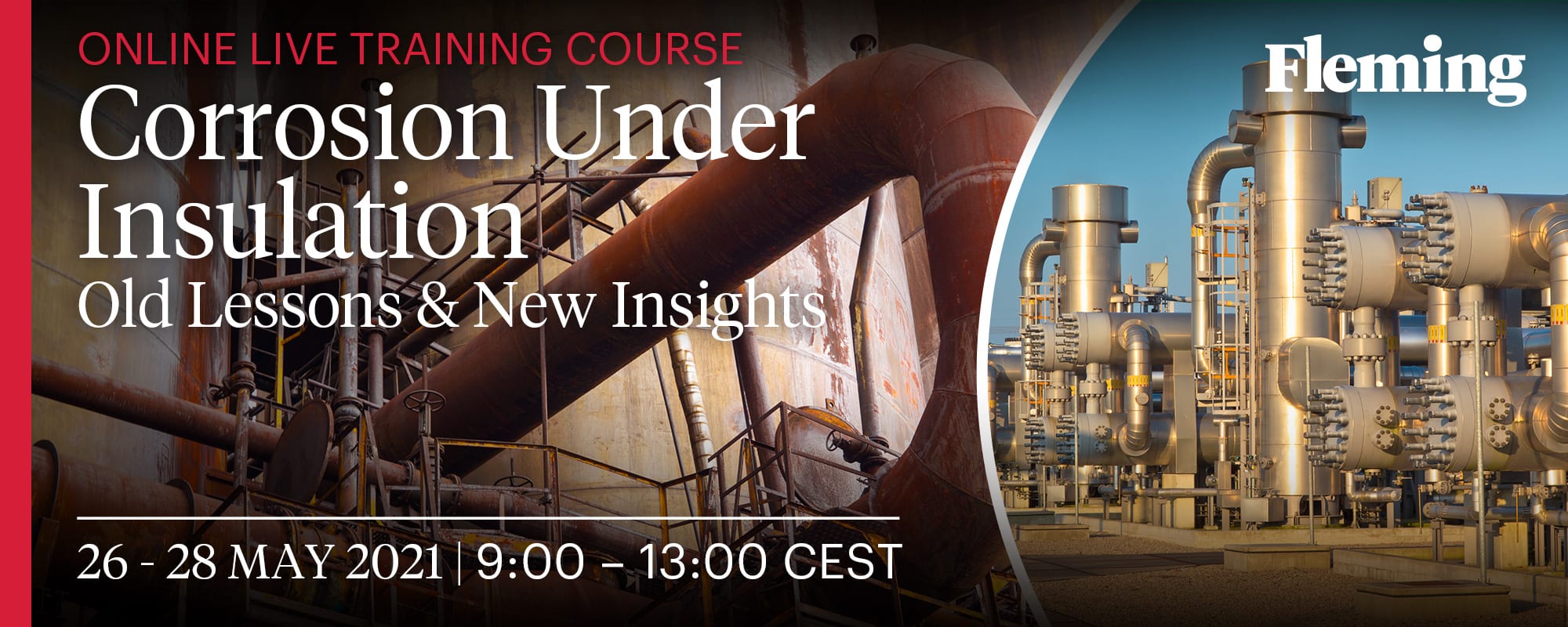
Save the dates for the upcoming Corrosion Under Insulation Masterclass taking place on 26 – 28 MAY 2021 (9:00 – 13:00 CEST) via online live stream.
Request the event brochure to see the detailed program.
Have a little sneak peek into the key topics:
Understanding key characteristics of corrosion under insulation (CUI)
Examples of critical CUI failures
Elements of reliable CUI management
Risk-based prioritization and prediction methods
Design considerations (insulation systems and coatings)
Direct and indirect detection and monitoring technology
An overview of published guidance
Latest innovation status and projects
For more information about the training and its expert leaders, please visit the event website.or download the event brochure to see the detailed program
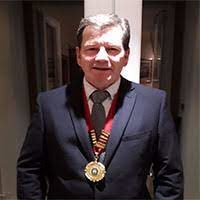
This month, we have been speaking to Stephen Tate, twice past Chair of the Aberdeen Branch of the Institute of Corrosion and recently elected as the Institute’s Vice President. Here is what he told us about his career to date – plus a couple of little-known facts about his personal life.
Here are the 11 questions we posed in the 11 minutes we took of Stephen’s valuable time.
1. What did you aspire to be when you were younger?
One of the things l fancied doing at school was joining the RAF and later becoming a pilot. My eyesight let me down on that one, but l did get to fly in my teens as rear passenger in a Tiger Moth.
After that disappointment, I moved onto matters nearer the ground and studied Building and Surveying at Guildford Technical College. There I learned most of the key trades like bricklaying, joinery, and technical drawing; all of which l enjoyed very much, being a practical sort of person.
Later in life l was a member of the Caledonian Self-Build Housing Association in Scotland. There, I could put my knowledge to good use in a team of 30, and I ended up with a 4-bedroom house in Udny Green, near Aberdeen. This was great for our growing family: my wife Eleanor, children Rachel and Christopher, and, of course, our many lovely pets.
2. So, how did you end up as a corrosion specialist?
In the 1970s, l spent quite a few years in the construction industry. This included periods with major organisations such as British Rail and British Airports, working in design departments on interesting projects such as Dover Hoverport and Heathrow re-modelling.
I also spent some time with private architects in Sussex, preparing drawings as an Architectural Technician. Again, I was involved in many interesting projects, including a Cheesery and interiors for the Rudolf Steiner School in Aberdeen.
There was a bit of a slump in the late 70s, but by good chance l picked up some fabrication and QA work in the newly developing oil and gas industry. Consequently, l spent the first part of the 1980s at the BAM HCG Schiedam Shipyard near Rotterdam, where l learned many new skills that have stayed with me for life.
One of many achievements there was that we built and land tested the first major UK North Sea Subsea Template, a 9-well Underwater Manifold Centre (UMC) for Shell Cormorant Field that went on to produce oil for the next 20 years.
3. What was that first job like?
Absolutely fantastic! l had a great Mentor in Dr Marco Fabbri of TRW Ferranti, someone who really believed in me – and living in Holland was marvellous!
In addition to working with Dutch people every day and learning their culture and humour, l learned all about cathodic protection (CP), welding, hydraulic testing, inductive connectors, and subsea control systems. After this l studied Offshore Corrosion and Materials Engineering (OMACE) more formally at Newcastle Polytechnic and then RGU Aberdeen (at that time, RGIT).
On the downside, l distinctly remember the cold weather of the docks and my visits to hospital after falling off some very icy steelwork (HSE was its infancy at that time).
4. You decided to stick with oil and gas. How did your career progress?
After my subsea experiences, l moved into the pipelines and CP industry. I was involved in quite a few new-build projects in Europe and Africa over the next 16 years with ACEL (Aberdeen Corrosion Engineers Ltd.) including the Trans Mediterranean Gas Pipeline, as well as offshore diving projects in the Middle East.
I later completed an MBA with Dissertation in Integrity Management and moved on to work with some major North Sea inspection and verification companies including CAN Offshore, DNV, Oceaneering, and Stork. For a lot of this time, l was seconded to major O&G operators such as British Gas, ConocoPhillips, Shell, and Talisman Energy, working in both upstream and downstream operations in the North Sea and Middle East.
Since 2016 l have been kept very busy assisting the operations and projects teams at Total E&P, a role that l enjoy very much under the leadership of Dr David Hillis, a very capable metallurgist.
5. What have you enjoyed most about your career in corrosion?
The variety of technologies, locations, people, and cultures that l have been fortunate to learn from and witnessing some extremely difficult projects come to fruition. Total, (soon to be TotalEnergies in the new world of renewables) is very much a global company with many interesting activities.
6. What career advice would you give to a young corrosion specialist?
Don’t lock yourself in the office.
You need to spend a lot of time at the coalface, learning what works and what doesn’t. P&IDs only really mean something when you see them in the flesh and can see them being played out in the control room with all the active alarms in operation.
7. What is in store for corrosion professionals?
A great future. Corrosion professionals and their expertise will always be required across many industries. Ensuring corrosion control is considered at all stages of the lifecycle is an integral part of project planning and giving added value to the end user.
If anything, it is even more relevant now, as many companies try to balance both ageing assets and diversification (with new corrosion issues of the renewables sector and impacts of climate change on temperature and humidity). We all have an important role to play in sharing our knowledge on these matters.
8. What have you gained from your membership of ICorr?
Just being a member alone is not enough. To get the full benefits of our very unique institution you must become actively involved in it. The networking opportunities, knowledge, and experiences of the ICorr branches are enormous.
Having spent nearly 10 years recently on the Aberdeen Committee, I have first-hand experience of how important ICorr is to local industry – and how respected it is as an organisation. ICorr, although growing every day, is still small enough to care and is primarily a Charity, not a business!
Finally, ICorr has brought me many new friends and opportunities and has been a big part of my life.
Let’s get personal with the corrosion professional!
We know that corrosion scientists aren’t all work and no play, so we asked Stephen three final questions to learn a little more about him personally.
9. What’s your favourite food?
Definitely Indian. A good flavoursome curry like a Rogan Josh.
However, for UK food, roast lamb always hits the nail for me. Maybe because it reminds me of my parents (both now sadly passed). When l was a child, we often had a nice Sunday Roast after going to Church and Sunday School. That was our reward for good behaviour, l guess.
10. What do you like doing most outside of your professional life?
I do like my trees, especially the fabulous Fagus Sylvatica ‘Purpurea’. Over the years, I have acquired several acres of former Forestry Commission land that l manage near our house in rural Aberdeenshire close to the River Ythan. At the weekends l might be seen driving my JCB 3CX or Takeuchi mini digger.
I also enjoy designing and landscaping gardens, and have done quite a few projects for my colleagues in the oil and gas industry.
I collect artwork, too. Mainly watercolours by local Scottish artists, such as harbour and coastal scenes. My favourite local artist is Kanita Sim (you can find her work online at Scottish Scene and Kanita Sim Art).
11. Tell us a secret about yourself, something that might surprise fellow members (and something we can print!)
You could say l am a bit of a Beatles fanatic – I have been since the 60s. They were such an extremely talented band.
l once owned a Beatles jacket, and I saw all their movies at the local Odeon. I went inside Abbey Road Studios a few years back, and I’ve been fortunate to see Paul McCartney in concert several times.
What do you want to ask a corrosion specialist?
Family. Trees. Art. Music. Indian food. The perfect foil for the intensity of life as a corrosion specialist. Yet it may have been so different. If Stephen had been blessed with 20/20 vision, he could have had a career in the skies – though we think you’ll agree that his work has taken him to the highest levels.
Like so many other members of ICorr, Stephen has enjoyed a career that has delivered huge variety of work and, aided by his involvement with the Institute of Corrosion, a network of professional colleagues and friends around the world.
Now, over to you. Let us know what you’d like us to ask the next ICorr member we put in the hotseat for 11 questions in 11 minutes. Send us an email, and we’ll try to include your question.
It’s that time of year again – corrosion awards season is approaching, and the Institute of Corrosion is calling for nominations. This is your chance to tell us who you consider would be a worthy recipient of one of the Institute’s awards that recognise outstanding achievement, extreme excellence, and superior service to the Institute and wider corrosion community.
Many of these awards are open to nomination by members and non-members. Take a look at the description of each award below. If you know someone who you think deserves one of the awards, then please let us know. We include how to nominate in each description.
The Lionel Shreir Award
This corrosion award is presented to the best student presenter at the Corrosion Science Symposium. A sub-committee of the Corrosion Science Division judges the presentations, and awards the certificate and a £125 cash prize based on criteria that include:
Originality
Evidence of knowledge of corrosion science
Clarity
Rapport with the audience
Clarity of answering questions
2020 Winner: Christos Kousis (University of Manchester)
To be considered to present, please submit a 200-word abstract that details a 10-minute talk you would like to give at this year’s symposium. We’ll let you know if yours has been selected for presentation ahead of the symposium in September 2021.
For the opportunity to be awarded the highly sought-after certificate and cash prize, send your abstract to j.a.wharton@soton.ac.uk.
The Galloway Award
The Galloway Award is presented to the student author that the judging committee decides is the best published paper that describes original research in corrosion science and engineering during the past 12 months.
The winner receives a cash prize (this year, £300) and a certificate, and a summary of the work is published in the Corrosion Management magazine. The Institute of Corrosion does not retain copyright of the material, allowing the winner to publish elsewhere.
2020 Winner: Arpit Goyal (Coventry University)
Arpit’s paper, ‘Predicting the corrosion rate of steel in cathodically protected concrete using potential shift’ was published in the Construction and Building Materials Journal. This work examined the possibility of predicting the corrosion rates using polarisation data and the Butler-Volmer equation to develop cathodic protection criterion for reinforced concrete exposed to the atmosphere.
Submissions for this year’s Galloway Award should be in the form of a paper published in the last 12 months (or a draft publication) and sent to the CSD Chair Julian Wharton by email.
The T.P. Hoar Award
This award is reserved for those authors who have papers published in Corrosion Science during the previous calendar year. A sub-committee of the Corrosion Science Division selects the winning paper, with the recipients announced by the end of the year. The winning authors receive a certificate and a cash sum of £400.
2020 Winner: Rigel Hanbury and Gary Was (University of Michigan)
Rigel and Gary jointly authored the paper titled ‘Oxide growth and dissolution on 316L stainless steel during irradiation in high temperature water’, which describes a novel approach to study 316L oxide growth and dissolution under simultaneous proton radiation and corrosion in 320 °C hydrogenated water, using a helium bubble. Helium implantation was chosen because it is chemically inert and, compared to heavier noble gases, it generates fewer radiation defects and has a greater implantation range.
The Paul McIntyre Award
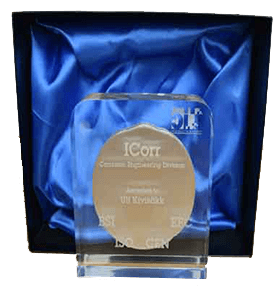
This is the premier award of the Institute of Corrosion in the field of corrosion engineering. It is presented to a senior corrosion engineer who is a leader in their field and has advanced European collaboration and the development of international standards.
The recipient of this award receives an engraved trophy of a modern design and is asked to present a brief overview of their activities as well as prepare an article for publication in the Corrosion Management magazine.
The winner of the 2020 Paul McIntyre award was Carmen Andrade. Until her retirement, Dr Carmen Andrade was a Research Professor at the Institute of Construction Sciences “Eduardo Torroja” of the Spanish National Research Council (CSIC), working in the field of concrete durability and reinforcement corrosion.
At present Dr Andrade is visiting Research Professor at the International Centre for Numerical Methods in Engineering (CIMNE). She is the author of numerous papers, has been editor of several books, and has supervised around 30 PhD theses. She has received several awards, including the R. N. Whitney Prize 2013 by NACE, Robert L’Hermite Medal 1987 from RILEM, “Manuel Rocha” of the Presidency of Portugal, and the “ALCONPAT Prize” in recognition her distinguished career.
She is an honorary doctor of the University of Trondheim (Norway) and of the University Alicante (Spain).
She has participated in several standardisation committees at National, European and International level and has been President of several international organisations related to her specialty (UEAtc, RILEM, WFTAO and the Liaison Committee which brings together the Associations: CIB, FIB, IABSE, IASS, RILEM and ECCE).
At present she is also the President of ALCONPAT, the Latin American Association of Control of Quality, Pathology and Recovery of Structures. She has been General Director of Technology Policy of the Ministry of Education and Science, and advisor to the Secretary of State for Universities in the Ministry of Science and Innovation, Spain.
2021 Winner: To be announced on 28th April 28 2021
The winner is always announced at the annual Corrosion Engineering Division Working Day and Symposium. To attend this year’s Working Day, which will be held online via Zoom, on the subject of ‘Managing Corrosion in Low-Carbon Energy Technologies’ please download the information leaflet and return the registration form.
U.R. Evans Award
The premier scientific award of the Institute of Corrosion, the U.R. Evans Award is presented by the President of ICorr to an eminent researcher, corrosion scientist, academic, or industrialist as reward for outstanding achievements in pure or applied corrosion science.
The recipient is selected by a Corrosion Science Division panel and invited to give a talk at the Corrosion Science Symposium.
The recipient of this award receives a broadsword, and one that takes an edge – which has proved somewhat problematic in previous years. It can be difficult taking the sword back through airport security or displaying it in your office at university!
The sword symbolises our collective and eternal struggle against corrosion, and the U.R. Evans awardee is also recognised with the granting of an Honorary Life Fellowship of the Institute of Corrosion.
The sword’s design has been modified slightly over time, and is no longer made from stainless steel. While a proper sword, if kept in non-ideal conditions it can corrode slightly. “But clearly, the recipient should be able to deal with any corrosion, given their background,” says Dr Julian Wharton – to whom you should submit nominations via his email.
2020 Recipient: Robert Cottis (University of Manchester)
Professor Robert Cottis was appointed Professor Emeritus in Corrosion Science and Engineering on his retirement in 2011 after an exceptional career in the field of corrosion science. Here’s a potted history of his life in corrosion science:
Graduated in Natural Science, specialising in Metallurgy in 1967
Awarded a PhD in 1973 for work on electrodeposition in the fluidised electrode at the Department of Metallurgy and Materials Science at Cambridge
Appointed as a Project Manager, then Research Manager at the Fulmer Research Institute
Worked on long-term research in the general area of corrosion, especially on corrosion fatigue
Undertook many short-term failure investigations and other consultancy work
Joined the Corrosion and Protection Centre, UMIST in 1979, initially as a lecturer, then senior lecturer, reader, and professor
Active in the development of teaching in the field of corrosion, Professor Cottis was responsible for the development of a distance learning approach to the MSc in Corrosion Control Engineering.
He was the Director of the TLTP Consortium – which developed the Ecorr courseware to support corrosion teaching – and the founding editor of the open-access online Journal of Corrosion Science and Engineering.
In 2005 he was awarded the T.J. Hull Award of NACE International for services to NACE in the field of publications, and he is a NACE Fellow.
Who will be this year’s recipient of the U.R. Evans Award? Send your nominations to Dr Julian Wharton. Then watch for details of this year’s Corrosion Science Symposium to find out.
We use cookies to optimize our website and our service.
Functional
Always active
The technical storage or access is strictly necessary for the legitimate purpose of enabling the use of a specific service explicitly requested by the subscriber or user, or for the sole purpose of carrying out the transmission of a communication over an electronic communications network.
Preferences
The technical storage or access is necessary for the legitimate purpose of storing preferences that are not requested by the subscriber or user.
Statistics
The technical storage or access that is used exclusively for statistical purposes.The technical storage or access that is used exclusively for anonymous statistical purposes. Without a subpoena, voluntary compliance on the part of your Internet Service Provider, or additional records from a third party, information stored or retrieved for this purpose alone cannot usually be used to identify you.
Marketing
The technical storage or access is required to create user profiles to send advertising, or to track the user on a website or across several websites for similar marketing purposes.