



Corrosion Engineering and Low-Carbon Energy Technology with the CED

Corrosion Engineering and Low-Carbon Energy Technology with the CED

Working Day and Symposium: Managing Corrosion in Low-Carbon Energy Technologies

On April 28th, 2021, you’re invited to the latest in a series of working days hosted by the Institute of Corrosion’s Corrosion Engineering Division.

Because of coronavirus restrictions, you can participate from anywhere in the world. All you need to do is register and join us on Zoom. This symposium is also a designated meeting of the European Federation of Corrosion, so it is one that corrosion engineers and specialists won’t want to miss.

Why corrosion engineering and low carbon technology?

Over recent years, low carbon technologies have become a strategic priority. The whole of society, from governments to the man on the street, has become focused on green issues. Technology is playing its part, across most industries, as we seek to develop greater sustainability through green, carbon-neutral technologies and innovations.

However, many of the technologies and equipment are deployed in severe corrosive environments – such as off-shore and near-shore wind turbines and pipelines – as well as providing new corrosion challenges (as in the case of biofuels).

This working day and symposium will give all delegates the opportunity to learn and exchange information across many aspects of managing corrosion in low-carbon energy technologies.

A Great Opportunity to Network

Although this working day is being held online, once more it gives you the opportunity to do some serious networking with corrosion specialists from many different industry sectors. Of course, you will also learn about some of the latest developments in managing corrosion in low-carbon energy technologies, including:

  • Wind power
  • Biofuels
  • Nuclear power
  • Hydrogen power
  • Carbon capture and storage (CCS)

After the talks, we will break into the individual CED working groups, or join a general discussion group on corrosion in low carbon energy technologies. The agendas for these will be published here when possible.

The CED Working Day programme

We’ll convene online at 9:15 am. Our Chair, Nick Smart, will present a welcome address at 9:30am, and the technical talks will begin at 9:45am.

During the day, there will be five talks, each lasting 30 minutes, including discussion. Lunch break between 12:40am and 1:30pm will be preceded by presentation of the 2021 Paul McIntyre Award and a short talk by the recipient.

There will be one final talk after lunch, before we break for the CED Working Group meetings.

A closing discussion rounds the day off at 4:45pm.

(All times are BST)

About the talks

As ever, we have gathered some of the leading names in their respective fields to present to you. The five talks, in order of presentation, are:

·       Pipeline Materials in a Hydrogen Environment, presented by Nancy Thompson (SGN) and Dr Julia Race (University of Strathclyde)

Nancy Thomson is experienced in high pressure oil and gas pipelines, onshore and offshore around the world. With an MSc, Nancy’s most recent work includes innovation projects on the Local Transmission Network (LTS) and investigating the repurposing of the LTS for hydrogen and CO2.

Dr Julia Race has a wide range of research expertise in metallurgy, failure analysis, welding and corrosion in the power, petrochemicals, and energy sectors. She worked in industry for more than 20 years, and for seven years as an integrity consultant for GE Oil and Gas. Now in an academic career, she joined Strathclyde University in 2014, where she continues to research CCS and hydrogen transport.

·       Cathodic Protection of Offshore Wind Design Using Upcoming ISO 24656, presented by Birit Buhr Jensen (Ørsted)

Birit Buhr Jensen is a senior lead specialist at Ørsted, specialising in cathodic protection and corrosion protection of steel structures, and corrosion evaluation and monitoring, assessment, repair, and sustainability of reinforced concrete structures.

·       Corrosion Challenges for Reliable Biorefineries, presented by Francois Ropital (IFPEN)

Francois Ropital is qualified as a Materials Engineer, Doctor of Chemical Engineering, and HDR (Habilitation à Diriger des Recherches) in Applied Chemistry and Industrial Process Engineering. He has been Editor-in-Chief of the journal ‘Oil and Gas Science and Technology – Revue d’IFP Energies Nouvelles’, is co-director of the ‘Study of reaction mechanisms on an adapted scale’ of IFPEN fundamental research, and is the associate university Professor (PAST) at INSA-Lyon, MATEIS Laboratory and Department of Materials Science and Engineering. He is also Chairman of the Working Party “Corrosion in refinery and petrochemistry” of the European Federation of Corrosion. Francois has authored two books, several book chapters, more than 50 peer-reviewed publications, and 20 patents.

·       Advanced Testing methods for PWR Environments that Could Support Other Zero Carbon Technologies, presented by Stuart Medway (Jacobs)

Dr. Stuart Medway works for Jacobs, where he is the technical lead for high temperature corrosion within the Material Science and Structural Integrity (MSSI) business. Stuart has been performing and developing laboratory research programmes to understand material performance in representative environments for over 14 years. Many of these have been focussed on stress corrosion cracking (SCC) of materials in the primary cooling circuit of pressurised water reactors, where he is a recognised expert in this field. Stuart has been part of the EPRI expert panel for SCC of nickel-based alloys for a number of years and is the current technical chair for the Environmental Degradation of Materials in Nuclear Power Systems conference.

·       Methodology for Corrosion and Environmental Assisted Cracking Risk Assessment for Industrial Carbon Capture, Utilisation and Storage (CCUS), presented by Ivan Gutierrez (Pace Flow Assurance), Brad Healey (Oil and Gas Corrosion Ltd), and Matt Healey (Pace Flow Assurance)

Ivan Gutierrez is a national expert member of several national and international corrosion committees and task forces, and helps oil and gas operating companies to manage the risk of corrosion, delivering technical support throughout the life cycle of assets, from concept and Front End Engineering Design (FEED), through Engineering, Procurement, Installation and Commissioning (EPIC) operations, integrity management and evaluating options for asset life extension.

Brad Healey is a process engineer at Oil and Gas Corrosion Ltd. He works on global projects, manages a team of engineers, and has presented at the NACE conference. He has completed an industry-backed dissertation project regarding offshore H2S disposal methods and is now an industrial supervisor for an MEng project investigating the long-term environmental impact of scrubber discharges related to offshore H2S management.

Matt Healey is director at Pace Flow Assurance, with around 20 years of experience in CCUS, oil & gas, and large infrastructure projects.

How do you register for the working day?

You can register for this exciting Working Day and Symposium by downloading the event information and registration form and following the registration instructions. We look forward to seeing you there, from the comfort of your own home or workspace.

For details about membership of the Institute of Corrosion, visit our membership page.

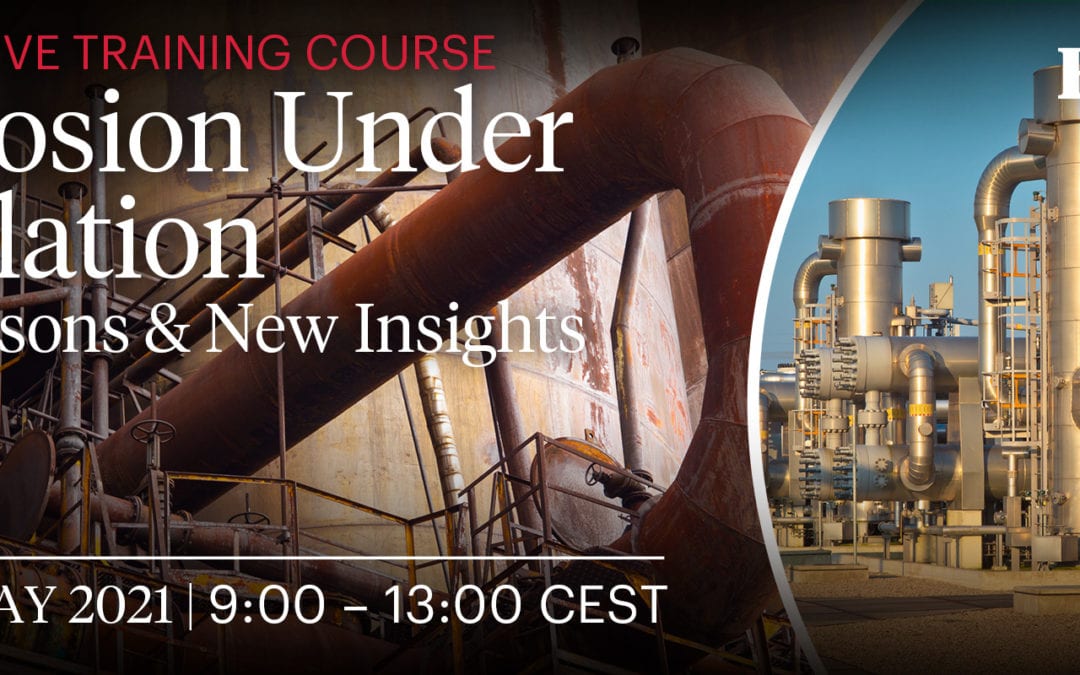
Corrosion Under Insulation

Corrosion Under Insulation

I am happy to announce that our highly-demanded masterclass is coming back this May. As corrosion hasn’t slowed down in the current climate, make sure to join us online live!

Corrosion Under Insulation
26 – 28 MAY 2021 | 9:00 – 13:00 CEST

These are your key takeaways from attending:

  • Understand the options available to combat CUI and their strengths and limitations
  • Learn about common mistakes
  • Learn about the CUI innovation initiatives
  • Benefit from the combined experience of ourtrainers
  • Engage in technical and scientific discussion
  • Is a life expectancy of 25+ years possible?

For more information, please visit the event website.or download the event brochure to see the detailed program

“Great course, gave excellent insight and provided us with the tools to tackle this problem at our own plant.”Leon Kanters, Reliability Engineer, Trespa, Netherlands

Fellow’s Corner

Fellow’s Corner

This series of features in Corrosion Management intends to highlight industry wide engineering experiences, practical opinions, and guidance, to give improved awareness for the wider public, and focused advice to practicing technologists. The series is written by ICorr Fellows who have made significant contributions to the field of corrosion protection through past industry involvements. Corrosion Management is pleased to publish this month’s contribution by Bijan Kermani, FICorr.

Metallic Materials for Hydrocarbon Production
Several categories of alloy are used in the energy sector, and in particular, in hydrocarbon production facilities, to enable successful and trouble free operations. The majority of the components of these facilities are manufactured from metallic materials, commonly carbon and low alloy steels (CLASs), which are readily available in the volumes required and able to meet many of the mechanical, structural, fabrication and cost requirements. However, the inherent corrosion resistance of CLASs is relatively low, and their successful application requires combination with one or more whole-life forms of corrosion mitigation against both internal and external exposure conditions, and/or the use of corrosion resistant alloys (CRAs).

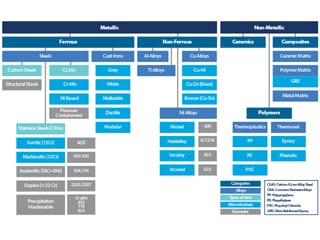
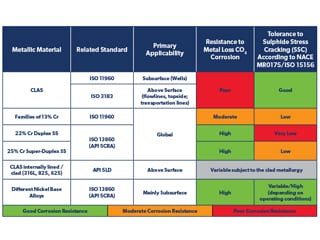
The main materials used in hydrocarbon production fall broadly into three categories, ferrous, non-ferrous and non-metallic materials, in which ferrous materials covers three types, carbon steels, CLASs and CRAs, broad details of which are summarised in Table 1. This article briefly addresses only the ferrous materials, which are the essential materials of construction for CAPEX intensive items (tubular and pipeline), their ranges, examples, related standards and their resistance to principal types of corrosion threat in hydrocarbon production (metal loss CO2 corrosion. and resistance to sulphide stress cracking, SSC, in the presence of H2S). These are summarised and characterised briefly in Table 2 and are as follows:

CLASs: A wide variety of CLAS grades are used across this industry sector and are the principal materials of construction and the first, optimum, and base-case choice for many applications. They normally have low metal loss corrosion resistance. The most notable categories of CLAS according to the application include, structural services and pressure containment.

Structural Services
These commonly utilise “structural” steel products in the form of rolled plate, various sectional shapes and tubular sections, although cast or forged products may also be used. Typical applications include offshore structures, sub-sea module support frames, pipe racks, process equipment saddles and, in some instances, low criticality storage tanks. They contain Mn (typically 0.5 – 1.5%) and limited quantities of other alloying elements such as Nb, Ti and V. Structural Steels generally have adequate properties over a range of temperatures lying between approximately -50°C to +50°C, depending on the local environmental conditions, e.g. in arctic, temperate or tropical conditions. They are normally weldable and have a yield strength not exceeding 350 MPa.

Pressure Containment
C/Mn or lean alloy steels may be used for process plant, vessels, pipe work, pipe fittings and valve bodies requiring pressure containment. However, steels with an increased alloy content of Cr, Ni, Mo, so called low alloy steels, are employed to give mechanical properties suitable for a temperature range lying within the limits of approximately -80°C (characteristic of Joule Thompson cooling) to approaching 600°C (characteristic of a number of refining processes). Typical applications requiring pressure containment include drill pipe, casing and tubing, linepipe, process pipework, pressure vessels and heat exchangers. Generally CLAS has low resistance to metal loss corrosion while sour service grades have good tolerance to SSC.

While metallic materials used for subsurface applications (wells) are seamless with relatively high strengths (normally yield strength >500 MPa) and have no requirement for welding (threaded connections are used), other applications including, flowlines, topside/surface facilities and pipeline/trunklines require materials with the ability to be welded and normally have lower yield strength (not exceeding 700 MPa).

Table 1. Range of metallic and non-metallic materials used in the construction of hydrocarbon production facilities.

Table 1. Range of metallic and non-metallic materials used in the construction of hydrocarbon production facilities.

Table 2. Range of CAPEX intensive metallic materials (tubing and pipelines) and their relative corrosion performance.

Table 2. Range of CAPEX intensive metallic materials (tubing and pipelines) and their relative corrosion performance.

The new generation of low Cr containing steels with 1 to 5%Cr offer slightly improved metal loss corrosion resistance, optimality for well completion applications.

CRAs: While CLASs, or in combination with corrosion prevention systems, may offer suitability for some applications, corrosion resistant alloys (CRAs) containing amongst other elements, Cr, Mo, N, W, Nb, Ni, Co have emerged as alternative more corrosion resistance choices. Increasing alloying elements invariably leads to increasing costs. Even though CRAs are more costly to procure in terms of CAPEX, they may offer more favourable whole life cost with lowering risk in terms of corrosion threats.
CRAs are primarily restricted for use in subsurface (well completion) and as internal cladding of manifolds and internal cladding of risers due to their relative cost. However, based on whole life cost comparison they may become economical for specific applications.
There are many categories of CRAs. These are generally divided into groups or families of alloys that have common characteristics or microstructures. These are summarised in Table 1 and include: 13Cr Steels. The family of 13Cr stainless steel (SS) exhibit good metal loss corrosion resistance with good strength. They contain 13%Cr and some other minor elements. A new generation of this family contains 15-17Cr, or alloyed 13Cr containing Ni and Mo, have improved metal loss corrosion and top temperature limit. They are primarily for subsurface applications, although weldable/lean grades are considered for infield flowline/pipeline applications. Generally, they have low resistance to sulphide stress cracking (SSC).

Duplex Stainless Steels
Duplex and super duplex SS derive their properties from the balance of phases between ferrite and austenite by the addition of Cr, Ni and Mo. They are designed to provide better corrosion resistance than the 13Cr families, particularly resistance against chloride pitting corrosion and they have higher strengths, although their tolerance to environmental cracking (EC) in the presence of H2S is low.

Other CRA
Other types of CRA include several categories of alloy containing varying amounts of Cr, Ni, Mo and other alloying elements, and also Ti alloys some of which do not fall into the ferrous category. These offer superior metal loss, corrosion, as well as tolerance to environmental cracking (EC) in the presence of H2S, chloride, and also when elemental sulphur is present. While some grades of Ti alloys have been successfully used in well completion (sub-surface), these are not covered in the present article.

Additional reading: B Kermani and D Harrop, Corrosion and Materials in Hydrocarbon Production; A Compendium of Operational and Engineering Aspects, Wiley, 2019.

Ask the Expert

Ask the Expert

In this issue the questions relate to monitoring of CP on pipelines and what causes amine blush on epoxy coatings. Readers are reminded to send in their technical questions for possible inclusion in the column in future.

Question:
I maintain a buried pipeline in an environmentally sensitive area and I wish to follow best practice in monitoring the CP system on it. I am thinking of fitting remote monitoring but I am concerned how accurate and reliable any reference electrodes that I use with a data logging system will be. Related to this I do not want to excavate to install the reference electrode to pipe depth, can I bury the reference electrode just below the surface near the existing Test Point? BK

Answer:
The practice you describe is one that is widely followed, for example in GRTgaz France on their high- pressure gas transmission system they use remote monitoring equipment from Italy and fixed reference electrodes often buried close to the surface under open bottomed surface boxes to aid their location and replacement. National Grid in the UK use remote monitoring extensively. However, there are a number of issues for you to consider:
1. Fixed reference electrodes can be significantly unreliable and their electrode potential can drift significantly from what you and the manufacturer may expect. This may be particularly so with electrodes in soils with significant groundwater movement. It is recommended that all fixed reference electrodes are supported with a method such as a UPVC tube from ground level to electrode level to permit a calibrated, portable reference electrode, likely a Cu/CuSO4 to be deployed close to the fixed electrode and the drift assessed. Depending upon how important the accuracy is, this should be done frequently.
2. Placing electrodes remote from the pipe will introduce errors in measurement, more in high electrical resistivity soils than in low, this is due to IR errors due to CP current flowing in the soil. The errors may be low with the electrode directly over the pipe and if your pipe coating quality Is high.
3. You might also consider deploying a steel ‘coupon’ that most remote logging systems will permit to be switched ‘OFF’ for Instant OFF measurements that should be more accurate in respect of IR errors in the soil. But if your reference electrode is in error these data will also be in error.
4. Large, simple, old fashioned porous pot Cu/CuSO4 reference electrodes are pretty reliable if properly constructed but there may be concerns regarding soil contamination with CuSO4. If you use these with coupons, the coupon should be remote (upstream of downstream along the pipe, not laterally spaced from the pipe) from the Cu/CuSO4 electrode to prevent CuSO4 leaching into the soil and plating out on the coupon. If this happens all the measured data will be wrong.
5. In France they consider that the values they measure in the way above to be accurate only to 50-70mV. So be cautious with data close to under or over-protection values if the data come from this sort of installation. B.Wyatt, Corrosion Control Ltd
In GRTgaz France, we have installed and used Remote Monitoring Systems (RMS) with fixed reference electrodes for about 8 years. They are installed in open bottomed surface boxes to be regularly compared to a portable reference electrode (during detailed and comprehensive assessment of CP by a CP operator in the field). As they are used for general assessment of CP, the requirement for their accuracy is lower than that for portable reference electrodes used in the field for detailed and comprehensive assessment of CP ±100 mV for a fixed reference electrode to be compared to ±20 mV for a portable reference electrode. To facilitate the evaluation of the accuracy of fixed reference electrode, GRTgaz France decided to install them in the open bottomed surface boxes as it is then easy to minimise the gap between both electrodes (fixed buried and portable) and to change the fixed reference electrode when required (which is very seldom, as we have had good performance from our reference electrodes!). Sylvain Fontaine, Cathodic Protection Expert, GRTgaz, Compiègne, France

Question:
What causes amine blush on epoxy coatings? PS

Answer:
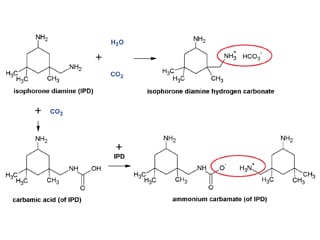
Amine blush is a combination of three unwanted reactions between amines and moisture/carbon dioxide which lead to the formation of amine hydrates (with water), ammonium carbamates (with carbon dioxide) or carbonates (with carbonic acid). It is the latter of these which presents the biggest problem as the reaction is irreversible and leads to surface defects which are difficult to remove (carbonation). In epoxy coating systems this will normally be at the surface/air interface as a result of the amines in the curing agent. Since carbonation is essentially an acid/base reaction it is kinetically favoured over the amine/epoxy reaction which we would prefer. This is particularly problematic in application conditions of low temperature and high humidity where the amine/epoxy reaction is retarded even further, and we have high levels of carbonic acid.

Figure 1. Reactions of isophorone diamine with H2O and CO2.

Figure 1. Reactions of isophorone diamine with H2O and CO2.

It has often been suggested that the way to resolve this would be to make the amine-epoxy reaction faster, but using more basic amines simply leads to more carbonation as they will more readily produce blushing via the acid/base interaction. It is interesting to note that in the past when the use of aromatic amine curing agents was more common there was no issue with blushing when using these products because aromatic amines are not basic. Of course, these products are now considered as toxic and as a result are no longer allowed in many parts of the world.

We can see from this that using less basic amines should therefore lead to improved blushing resistance, but they will also produce slow hardeners with long drying times. The question then becomes, how do we produce hardeners which will give the best combination of drying times and resistance to blushing? This is particularly relevant for solvent free systems where we have no drying advantage from the use of solid binders. Curing agent manufacturers have over time developed curing agents with improved resistance to blushing using various formulating methods. For example, forming amine adducts will improve the performance against bushing because the adduction process will remove some of the more basic amine functionality in the curing agent which is often responsible for blushing. It will also improve the compatibility of the amine with the resin thus reducing migration of free amine to the surface of the coating. Advances in curing agent development mean that today the best performing hardeners for blushing resistance in topcoats are based on formulated adducts of one or more amines.

Of course, epoxy resin and curing agent manufacturers can develop and test their resins and hardeners in combination as clear coatings, but the final paint will be formulated by coatings manufacturers where the fillers and additives used will also have an effect on the carbonation resistance of the end product. Even with the recent advances in curing agent performance, the end result will still depend on correct mixing and application of epoxy systems on site ensuring that the conditions in which the coating is applied meet with the manufacturers recommendations.
Stuart Darwen, CTP Advanced Materials GmbH, Germany