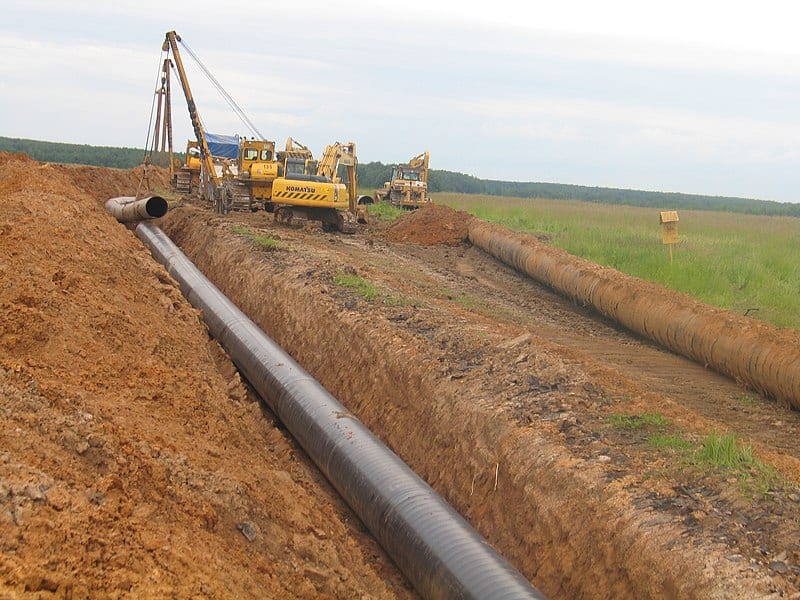
Cathodic protection is a key technology for protecting against corrosion because it can be easy to apply and can be monitored 24/7. It’s as near to a set-it-and-see-it method for keeping buried, immersed or steel in concrete metal structures safe from corrosion as we can get. Plus, it’s cost-effective and works on many metals, as well as steel. It even works for atmospherically exposed steel when embedded in concrete.
Without going into too much depth – we just don’t have time in this article – let’s look at a few basics of cathodic protection.
What causes corrosion in the first place?
Corrosion is caused by a metal being in contact with a corrosive environment. Factors like the metallurgical condition of the metal, connection to dissimilar metals or varying levels of oxygen exposure can speed up the corrosion process.
You see, metal wants to go back to its natural state (ore) through a process known as corrosion. This is the metal “rusting” away. It’s an electro-chemical process that involves the flow of electrical currents, with an anodic reaction involving the oxidation of the metal to its ions.
So, how does cathodic protection actually work?
The idea behind cathodic protection is to turn the entire surface of the metal into a “cathode”, thus stopping the corrosion process.
An external “anode” is connected to the vulnerable metal with the result that the metal structure should not corrode. There are two main types of cathodic protection:
Galvanic Anodes: These are sacrificial castings or extrusions of metal (usually aluminium, zinc, or magnesium) connected to the structure. They “take one for the team” and corrode first, sparing the main structure.
Impressed Current: Here, a power source feeds a continuous low-level DC electrical current to the structure, keeping corrosion at bay. The most used metals to form the impressed current anodes are mixed metal oxide coated titanium and high silicon cast iron.
Practical uses of cathodic protection
This isn’t just theoretical stuff; it’s widely used in various industries. You’ll find cathodic protection in underground pipelines, bridges, tunnels, ships’ hulls, harbour structures, and particularly offshore structures like pipelines, oil/gas platforms, subsea structures and FPSOs. It is essential in the design of cost effective offshore renewable energy. It’s an essential tool to extend the lifespan of these costly structures and can even make them more economical to build.
Whilst the most common use of cathodic protection is for the external surfaces of metal structures it is also used to protect the internal surfaces of:
Ship’s tanks (product and ballast)
Storage tanks (oil and water)
Water-circulating systems (e.g. power stations)
Tidal barrages
What about wind turbine foundations offshore?
Good question! Offshore wind turbine structures face unique challenges like high water flow rates and seabed movement. While typical offshore cathodic protection systems may fall short of requirement for these conditions, we can modify them to help protect such structures.
First, we must consider how offshore structures face corrosion challenges in various zones:
Atmospheric Zone: This part’s above water, exposed to wind, sun, and rain, and does not come into direct contact with seawater. Cathodic protection is not applied here, as it is not in contact with the sea water (the electrolyte). Instead, corrosion control is provided by use of suitable coatings.
Splash Zone: This is where waves and salt spray hit. It’s a tricky area needing both high performance coating and cathodic protection, as it is constantly exposed to a corrosive environment.
Submerged Zone: Always underwater, this part needs full-time cathodic protection, which may be in combination with a high-performance coating.
Subsoil Zone: Buried in ocean mud, this zone is vulnerable to microbiologically influenced corrosion. Cathodic protection is necessary here too, at least near the seabed level.
Design considerations: Doing it right
Designing a cathodic protection (CP) system isn’t a one-size-fits-all affair. Various parts of a structure may require different treatment based on environmental factors, and the best time to get this right is at the design stage – long before anything is built.
The aim is to distribute the protective current uniformly over the structure and to make provisions for any predictable environmental changes. Importantly, the design should include a host of calculations, from the surface area that needs protection to the specific requirements for the variations in CP current demand in distinct locations. To provide effective cathodic protection, without disrupting the integrity of the structure, we must consider factors that include not only the environment, but also:
Metocean conditions, notably tide and wave levels, water velocity at different depths, temperature, and salinity
Surface area of the structure
Coating efficiency
The above will combine to determine the localised CP current demands of the structure, which will vary with time
Electrical resistance of anodes (galvanic or impressed current)
External power supply and cabling requirements for impressed current systems
Number and distribution of anodes
Monitoring instruments
Want to know more about cathodic protection in the modern world?
Cathodic protection has been around for a long time – since the 1820s, when Sir Humphrey Davy made its first practical use. But it has advanced a lot since, and is continually being innovated for use in the modern world.
Or, if you are a young engineer seeking to accelerate your career, why not become involved in the Young Engineer Programme? During this programme, you’ll benefit from a series of lectures from renowned industry experts – including Brian Wyatt who will be presenting on cathodic protection, including its relevance in offshore wind.
Make a Date to Visit Us in Aberdeen on 4/5th October 2023
The Floating Offshore Wind event returns on October 4th and 5th 2023, and promises to be another record-breaking event. The Institute of Corrosion are pleased to announce that we will be exhibiting this year.
In this article, you’ll learn why you should attend Floating Offshore Wind 2023 (FOW23), and why you should make ICorr one of your primary targets in the exhibition hall.
What Is FOW23?
Hosted by RenewableUK and Scottish Renewables, FOW23 is a must-attend event for those in the renewables sector. Especially if you are involved in the design, production, installation, and maintenance of offshore wind facilities.
The event will be attended by more than 2,000 industry professionals. It’s an incredible networking opportunity, with many key players to meet and discuss potential solutions to the technical challenges presented in the industrialisation and commercialisation of floating wind installations.
In addition to thousands of attendees, there will also be 100 speakers from 30 countries as well as 140 exhibitors.
Where Is FOW23 and How Do You Get There?
FOW23 is being held at P&J Live, Aberdeen.
This state-of-the-art events venue is around six miles north-west of Aberdeen’s city centre. If you are travelling by car, it’s easily accessed from the A96 Aberdeen-to-Inverness link road.
For those travelling by public transport, Dyce Train Station is only 1.5 miles away with regular trains both north and south.
If you are planning to fly to Aberdeen, Logan Air are offering discounted flights for event attendees – you’ll need to use the promo code ‘RUFOW30’ when booking.
Corrosion – A Significant Challenge for Floating Offshore Wind
Corrosion is a crucial issue in marine environments, and can occur in several parts of offshore wind turbines. This includes:
Structural damage to the foundation or device including by corrosion fatigue
Reduction in fatigue life due to quite limited corrosion damage
Corrosion related damage to parts including electrical equipment, control units, cooling and ventilation systems, boat-landings, turbine main shaft bearings, and gear boxes
You don’t need to dig too deep to find examples of failures in corrosion protection strategies or failed corrosion protection systems in offshore wind, with protective coatings failures after only a couple of years of service resulting in corrosion damage and very high offshore coating repair requirements.
Early monopile foundations were assumed not to require internal corrosion protection because they would be sealed; they were not, and they did. Cathodic protection (CP) systems on monopiles suffered from poor designs, not taking account of attenuation of CP current from anodes at the top of the monopile to the critical seabed level, from ignoring effects due to anodes clustered too close together and inadequately addressing effects of water velocity and temperature.
Considering major repairs and remedial work were required within 5-10 years of construction, compared to the expected durability of 15 and now increasing to 35 years, you begin to realise the critical nature of adopting suitable corrosion protection practices in this industry.
When we consider corrosion in fixed bottom, FOW, and tidal stream generators, we must address a host of factors including:
A highly corrosive environment caused by factors such as high tidal ranges and water velocities in coastal locations, wet and dry cycles, saltwater spray and high wind born chlorides to all levels
Mechanical loads, in particular fatigue and the reduction in fatigue life by even limited corrosion
Underwater biological stresses, impacts and opportunities
Variations in temperature, salinity and water velocities
Reduced accessibility to unmanned assets anticipating long inspection intervals, with high costs of access
High maintenance and repair costs of corrosion protection failures
FOW is a relatively new industry, and we are learning more about these challenges daily. The Institute of Corrosion sits at the forefront of the latest research and practical experience in the battle against corrosion in offshore wind projects.
Raising the Standard in Offshore Wind Corrosion Protection
With so much at stake, and given the significant failures of surface coating and cathodic protection (CP) in past offshore renewable projects, it is not surprising that the industry is becoming increasingly regulated to combat corrosion. For example:
The new ISO 24656 CP for Offshore Wind covers FOW
ISO 24656, DNV-RP-B401 and DNV-RP-0416 all require CP designs by expert CP designers of certificated competence
ISO 15257 is the only competence certification standard for offshore CP
Both ISO and DNV standards and codes require independent, competent Coating Inspectors to ensure optimum performance of coatings
In short, if the expertise of your project teams does not include awareness and competence in corrosion matters, you’re failing the standards expected and required of your FOW project.
Training to Meet Your Corrosion Protection Needs in FOW
At the Institute of Corrosion, we have the expertise to assist the FOW industry in corrosion protection and to train your personnel in this sector:
The ICorr exhibit stand is where you’ll be able to discuss all things FOW and corrosion. You’ll get to meet Adesiji Anjorin, current Chair of our Aberdeen branch, and learn about how ICorr is helping to advance and share experience and expertise in protection against and prevention of corrosion in the renewables sector, as well as discover more about all our training and certification solutions for corrosion professionals.
We couldn’t be easier to find in the exhibit hall at FOW23:
Enter via the Visitors Entrance
Turn immediately to your right
Walk a few yards to the line of exhibitors against the far wall
We are the second stand in – stand L20 – right around the corner from the RenewableUK and Scottish renewables stands
How to Register for FOW23
To register to attend FOW23, visit the Registration Page at the RenewableUK site. Here you’ll find information about the different types and costs of registration, and a clickable button to register.
If you’d like to know more about any of ICorr’s training schemes, please contact us by email or click on the following links:
All You Need to Know About the Young Engineer Programme 2024 Announcement Event
Put this date in your diary: 28th September 2023. That’s when you’ll want to get yourself to London to attend the Young Engineers event you’ve been waiting for. It’s when Young ICorr – the Institute of Corrosion’s section dedicated to student and young engineers (and by young, we mean those in the first 10 years of their engineering career) – unveil the Young Engineer Programme (YEP) 2024.
This event is where you’ll get to hear from the horses’ mouths about what difference YEP can make. Previous YEP participants and winners will be attending – ask them anything you wish!
“I got to play so many different roles that I simply would not get exposure to during my usual day job. I felt like a leader, a follower, a technical consultant, and a salesman. The value of the programme was really demonstrated to me through the opportunity to play these roles.” – Jamie Hillier (Subsea Senior Engineer, Exodus Group)
Here’s what you need to know about this event.
What Is YEP?
Ok, you’ll find out more at the YEP 2024 Announcement Event, but here’s a brief rundown:
It’s specifically designed for corrosion practitioners at the early stage of their careers. Whilst it is called the Young Engineer Programme you don’t need a degree to take part – you just need to be working in a corrosion-related role.
It includes a series of lectures covering a range of topics.
Delegates are divided into teams, and each team will present solutions to a real-life case study.
The winning team receive an all-expenses paid trip to the AMPP Annual Conference & Expo in the United States.
This is world-leading training for engineers. The series of lectures will cover topics that include:
Basic corrosion
Welding
Materials
Coatings
Painting, fire protection and linings
Cathodic protection
Chemical treatments
Presentation skills
Moreover, these lectures are presented by recognised leading lights from industry and academia. Not only do delegates have the opportunity to broaden their network among their peers, but they also get to learn from (and be mentored by) respected industry authorities.
And you can be sure that learning will be relevant to current industry research, trends, and latest industry needs. For example, while we can’t say too much at this stage, you can certainly expect that Offshore Wind and Floating Offshore Wind (FOW) will be on the agenda in some of the lectures
“It was an eye-opening experience. I have learned from Subject Matter Experts in the industry, made fantastic friends along the way, and gained new and exciting opportunities through the programme.” – Izabela Gajewska (Corrosion Engineer, Intertek P&IA)
What is the YEP Announcement Event?
The YEP Announcement Event is the official opening of YEP 2024. We’ll discuss the programme syllabus in detail, with three talks designed to provide you with all the information you need to decide whether YEP 2024 is for you, and how to register.
After being welcomed by James McGladdery, Chair of Young ICorr, we’ll settle into the formal part of the evening:
Anthony Setiadi, organizer of past YEPs, will present on the history of YEP
Danny Burkle (Chair of ICorr’s Corrosion Engineering Division), and Praveena Nanthakumaran (a Young ICorr Committee member) will talk about their experiences as previous YEP winners
But it’s not all formalities. You’ll get the chance to network with like-minded people, and snacks and refreshments will be laid on, too.
When and Where Is the YEP 2024 Announcement Event?
We’ve reserved plenty of space for this event at The Corner London City, 42 Adler St, London E1 1EE. Only five minutes’ walk from Aldgate East underground station, and 20 minutes from Liverpool Street station, this venue is ideal for an event that will be informative while presenting an opportunity for relaxed networking.
We start the formal part of the evening at 6:30pm, though doors open from 6pm.
How Much Does the Yep Announcement Event Cost?
It’s free!
All you need to do is reserve a spot for the evening using this link:
This series of articles is intended to highlight industry-wide engineering experience, guidance, and focussed advice to practising technologists. It is written by ICorr Fellows who have made significant contributions to the field of corrosion management. This issue features The Corrosion Resistant Properties of novel cements, concretes, and reinforcement by John Broomfield of Corrosion Engineering Solutions Ltd.
The Corrosion Resistant Properties of Novel Cements, Concretes, and Reinforcement
We use more concrete than any other material other than water. However, each tonne of concrete has a significant carbon footprint and the technical press is full of articles on new ways of reducing that carbon footprint by modifying its constituents. There are many ways of doing this, most of which involve changes in the internal chemistry of the finished product.
Concrete is made from cement, fine and coarse aggregates, and water. To this may be added other materials or admixtures, such as superplasticisers to increase workability during placement on site, set retarders or accelerants for hot or cold climate work, or even corrosion inhibitors for aggressive conditions where the steel reinforcement needs extra protection. The cement itself can be Portland cement or, more commonly these days, a blend of Portland cement and other cementitious materials such as pulverised fuel ash (pfa), ground granulated blast furnace slag, microsilica or metakaolin. The perceptive reader will note that some of these materials are going through their own changes and availability issues in response to the need to reduce carbon emissions. There are reports in the press of applications to mine deposits of pfa from ash pits as the supply of material direct from operating coal fires plants is diminishing.
The methods of achieving the required performance and durability of blended cements are covered in UK and European standards BS EN 206 parts 1 and 2, and BS 8500 parts 1 and 2. The latter gives tables of exposure conditions along with the necessary mix design, and minimum cover requirements to achieve a required minimum design life for a given exposure condition. There is also BS EN 197-1:2011 Cement Composition, specifications and conformity criteria for common cements, which gives the specifications of 27 distinct common cements, 7 sulphate resisting common cements as well as 3 distinct low early strength blast furnace cements and 2 sulphate resisting low early strength blast furnace cements and their constituents.
Portland cement based concretes provide corrosion protection to reinforcement in two ways, as a semi permeable coating and as a corrosion inhibitor. Concrete is permeable to water and oxygen. The reason that reinforcing steel embedded in concrete does not corrode is that the pores in concrete contain an excess of calcium hydroxide and other hydroxides, maintaining a pH of 12 to 14 [1]. The upper level is carefully controlled because some aggregates are at risk of alkali aggregate reaction which leads to the creation of an expansive gel which will damage the concrete.
However, in order to prevent corrosion, the pH must stay above 11, which is the threshold for corrosion. There are two mechanisms for inducing corrosion in reinforced concrete structures without physical damage to the concrete cover to the steel. One is carbonation; the process where atmospheric carbon dioxide reacts with pore water to form carbonic acid and neutralise the excess calcium hydroxide in the pores. This leads to a carbonation front which progresses through the cover. Once it reaches the steel, the pH drops below 11 and corrosion can occur. The other process is chloride attack. The chloride ions in solution (usually from sea water or deicing salts) diffuse through the concrete cover to the steel. Once the concentration at the surface exceeds a threshold level, the passive layer on the steel breaks down and corrosion ensues.
Over the years since the 1970s, much work has been done to understand these mechanisms in Portland cement based concretes. We have a simple equation to estimate the rate of carbonation of the form, x = kt½ here x is the carbonation depth, t is time and k is a constant which can be measured or estimated on a structure by structure and microclimate basis.
For chloride ingress the equation is more complicated, as Fick’s second law of diffusion applies and the threshold concentration must be estimated. However, there is much guidance now available on the parameters for predicting chloride diffusion rates into Portland cement and blended concretes [1].
However, this type of guidance has not been developed for non-Portland cement based concretes. While civil engineers have great expertise and applicable useful standards and test methods for determining the physical characteristics of new concrete, when it comes to the more chemically based properties, such as corrosion resistance and durability, there is far less guidance and often less in-house or externally available expertise.
When blended cements were used with high levels of alterative cementitious materials, there was concern that the alkali reserves would be depleted, increasing the rate of carbonation and possibly also chloride diffusion. However, since these blends were less porous than ordinary Portland cement concrete, testing and experience soon showed that there was no loss of durability. In fact, durability increased. However, there are new alternatives to Portland cement itself such as alkali activated cementitious materials (AACM). Because AACM has no Portland cement, it is outside EN 197-1, EN 206 and BS 8500. To prove a candidate new AACM is durable, EN 197-2 and EN 206 permit users to demonstrate equivalence and show the material has the required structural and durability properties.
As might be expected, AACM initially has a pH that is higher than conventional Portland cement and concrete (14 or so), but the alkali reacts during the setting process. There is therefore a concern that this cement free, lower carbon concrete does not have the same reserve of solid Ca(OH)2 to buffer carbonation, so it would carbonate faster than an equivalent convention Portland or blended cement concrete mix.
Recent testing suggests something else is going on. It seems the initial carbonation rate is higher, but a pore blocking process then seems to start, blocking CO2 ingress, and the rate of carbonation slows right down. The steel therefore remains in a dense, high pH matrix. However, this good performance may be product and mix specific. This suggests that the carbonation rate equation above is not applicable to AACM concretes, or that the constant k may be harder to determine over the long term.
RILEM (The International Union of Laboratories and Experts in Construction Materials, Systems and Structures) have produced a State of the Art Report on Alkali Activated Materials [2], which is a comprehensive review of these materials, their formulations, chemistry and performance. It discusses the durability of the material and of structures made with it, as well as the testing of the materials during production and casting and also field testing of existing structures. It found considerable variability in performance and test results, particularly with regard to transport properties, corrosion performance and durability. The lack of specifically applicable performance standards was a concern.
Another major contribution to the field is “The Field Performance of Geopolymer Concrete Structures report” by the Cooperative Research Centre (CRC) for Low Carbon Living Ltd in Australia [3]. The report describes in-situ testing and core sampling of geopolymer (alkali activated) concrete at four sites across Australia and long-term performance monitoring of two geopolymer concrete structures. The field test results found extremely variable resistance to carbonation and to chloride ingress and the authors stated that this confirms the necessity of developing performance based specifications for Geopolymer concretes
Like the RILEM report, the CRC report concludes that suitable testing methods are required to assess the performance of concrete in order to assist engineers to specify Geopolymer concrete conservatively and confidently, particularly in more aggressive environments.
Unlike the physical testing of concrete for properties such as cube strength, the durability testing is more complex. We need to understand the chemistry of the material and how it changes over long periods of time if it is to be used with conventional steel reinforcement. We already have examples of unsuitable use of specialised concretes most recently reinforced autoclaved aerated concrete leading to failures and expensive repairs or rebuilding.
The obvious corrosion related tests for novel concretes are for the alkali reserves in concrete to be measured and its resistance to chloride and carbonation. There are tests for these under BS EN 205 and BS EN 1504. However, we know that these properties can be very variable for alkali activated materials and change over the long term so a full understanding of the chemistry and its changes over time are required before we can develop prescriptive tests.
As one of the concluding statements of the RILEM Report states. “These issues are by no means limited to the area of AAMs – these points are relevant across many areas of non-traditional cement and concrete development and commercialisation”. The replacement of Ordinary Portland cement based concretes with new materials expected to perform and be durable for many decades is a challenge for engineers in the construction industry.
Of course, one solution to the corrosion risks of reinforced concrete is to use alternative reinforcement. There have been corrosion resistant reinforcement materials available for many decades. For ferrous materials these include galvanised steel reinforcement, fusion bonded epoxy coated reinforcement, a range of stainless steels and low alloy steels. These are reviewed in the AMPP/NACE State of the Art Report on Corrosion Resistant Reinforcement [4]. Some of the ferrous materials can on the whole be treated by conventional testing both in the laboratory and on site, the coated ferrous reinforcing bars, less so.
However, there is now a range of non-metallic reinforcements, including glass and carbon fibre reinforced polymers and more recently basalt. These are polymers with fibre reinforcement. While we can detect ferrous reinforcement in a structure with electro-magnetic based cover meters, we have no simple way of detecting these materials. Will we be using more ground penetrating radar to detect non-metallic reinforcement? Has any work been done on detecting these alternative reinforcement materials once they are cast into a structure?
Do we understand the deterioration mechanism for these products? The failures of fusion bonded epoxy coated reinforcing bars in Florida were partly due to the softening and debonding of the epoxy in a saturated environment, particularly where the coating was stressed on the outer radius of bends. These failures happened over a few years. Could similar degradation of polymer-based reinforcement occur in concrete over the decades? If so, how will we detect it? We have NDT techniques such as reference electrodes, resistivity meters and linear polarisation to provide information of the corrosion condition of ferrous reinforcement. We have no equivalent tests for polymer-based reinforcement. If we start putting alternative reinforcement materials in alternative concretes will we understand their interactions in the short and long term?
It is obviously important to innovate to reduce the carbon footprint of the construction industry and improve the durability of the built environment. However, we need a deep understanding of the materials we are using as well as suitable standards and test methods and equipment to ensure the products we use can perform in the environment they are exposed to and can be assessed and maintained throughout their lives which will last for many decades. Corrosion engineers have a major role to play in the understanding, testing and developing performance-based specifications and tests for the new wave of low carbon and corrosion resistant materials in the construction industry.
The author would like to acknowledge the help of Professor Peter Robery for his advice on alkali activated concretes and the RILEM and CRC reports.
References
1. Broomfield, J.P. Corrosion of Steel in Concrete, 3rd Ed. Publ. CRC Press London, 2023.
2. John L. Provis, Jannie S.J. van Deventer Editors, Alkali Activated Materials State-of-the-Art Report, RILEM TC 224-AAM Publ. Spinger, 2014.
3. Stephen Foster et al. The Field Performance of Geopolymer Concrete Structures report RP 1020 by Cooperative Research Centre (CRC) for Low Carbon Living Ltd in Australia, 2018.
4. NACE Publication 21429-2018-SG – State of the Art Report on Corrosion-Resistant Reinforcement Publ. AMPP, Houston TX.
CAPTIONS:
Hilti Ferroscan, a scanning cover meter, can identify the size and depth of steel reinforcement. New techniques will need to be developed for detecting and locating non ferrous reinforcement.
Each issue of Corrosion Management magazine normally contains at least two technical articles focussed on one aspect of corrosion science or technology. The themes covered in each issue of the magazine can be found in the magazine media pack (www.icorr.org/publications).
Following are some general guidelines for technical articles:
• These articles must describe original, unpublished work.
• They should not be commercially orientated, and should present an unbiased view of the technology.
• The average length of a technical article should be between 2,000 and 2,500 words.
• The article can include tables, graphs, figures and photographs, to help explain the content. Overall this equates to about 3-4 magazine pages.
• The preferred file format is Microsoft Word.
• There is the possibility of publishing longer, more detailed, articles on the website.
Photo/Figure specification
• All images should be the author’s own (or his company), and should be copyright and royalty free.
• Accepted file formats are EPS, TIFF, JPEG.
• High resolution photo/ figures should be sent as separate files.
• Greyscale or colour images, minimum 300 dpi
• Line art (bitmap) images/figures, minimum 1,000 dpi
If you have a technical article which you feel is suitable for publication in Corrosion Management, please send it to the editor
We use cookies to optimize our website and our service.
Functional
Always active
The technical storage or access is strictly necessary for the legitimate purpose of enabling the use of a specific service explicitly requested by the subscriber or user, or for the sole purpose of carrying out the transmission of a communication over an electronic communications network.
Preferences
The technical storage or access is necessary for the legitimate purpose of storing preferences that are not requested by the subscriber or user.
Statistics
The technical storage or access that is used exclusively for statistical purposes.The technical storage or access that is used exclusively for anonymous statistical purposes. Without a subpoena, voluntary compliance on the part of your Internet Service Provider, or additional records from a third party, information stored or retrieved for this purpose alone cannot usually be used to identify you.
Marketing
The technical storage or access is required to create user profiles to send advertising, or to track the user on a website or across several websites for similar marketing purposes.