


Should Your Organisation Become a Corporate Member of the Institute of Corrosion?

Should Your Organisation Become a Corporate Member of the Institute of Corrosion?

ICorr Corporate Membership Benefits

Corporate membership of the Institute of Corrosion is an attractive strategic business decision, and for many good reasons. When your organization becomes an ICorr corporate member, it gains access to a range of exclusive benefits. Your organization also gets to contribute to the continuing evolution of corrosion science and corrosion engineering, as well as raising its profile and impact within the industry.

ICorr: In service of our members

A few years ago, we embarked on an overhaul of the Institute. Having been founded in 1959, we felt it was time to update and upgrade, to improve and prove our global presence and strategy, and to become more approachable.

We canvassed and listened to our members and other corrosion professionals, reviewed our strategy, and rebranded. In the ongoing battle against costly and dangerous corrosion, our mission is to build better collaboration within the industry, with academia, and with governments and policymakers, and share ICorr’s corrosion expertise with the world.

We’re a values-led organization, with four core values that are the vision behind the ICorr brand:

  1. Trust and respect – we are an independent professional body, trusted and respected by the public to help reduce the impact of corrosion on infrastructure. As a not-for-profit body committed to developing the corrosion prevention industry, we are led by people with experience and expertise, with a collective credibility to help others develop the skills in corrosion science and engineering that are crucial to continually improve corrosion prevention.
  2. Experts and leaders in the field – the Institute encompasses leaders and experts in the field of corrosion prevention. This expertise enables us to advance toward our vision as we influence policy and strategy at corporate and governmental levels. Continuous improvement of knowledge and expertise is key to this – as is focus on aspects such as health and safety, equipment, and people.
  3. Innovative and forward-thinking – we are an innovative, modern, cutting-edge body that is forward-thinking and encourages the sharing of expertise. We also seek to collaborate with like-minded bodies (for example, our partnership with ABRACO) to drive the corrosion prevention industry forward.
  4. Supportive and inclusive – we provide an environment of support, networking, and education, committed to developing industry capabilities, enhancing knowledge and expertise, and enabling people to develop effective and innovative careers. To this end, we offer comprehensive training and support for all corrosion professionals, as well as networking opportunities to help our diverse membership benefit from all the Institute offers and represents.

We serve our members through many channels, including regional meetings, conferences, workshops, magazines, website, social media, training courses, mentoring, training, and an online jobs board. We host many events, such as regional and international conferences, to support the industry and debate new technology and ideas, and our network of branches meet regularly to share knowledge and promote networking opportunities.

Why become a corporate member?

As a not-for-profits body, we depend on our membership to help fund our vision. We also depend upon our membership to help us to drive progress within the corrosion prevention industry.

Of all our membership options, corporate membership provides the highest level of participation within our organization, and therefore within the global conversation around corrosion.

As a corporate member of the Institute of Corrosion, you’ll be helping to develop the corrosion prevention industry.

Specifically, corporate membership provides benefits that include:

·       The highest grade of membership offering maximum profile within the corrosion industry

There is no better way to raise your profile within the corrosion community.

·       Access to our Career Development & Progression Programmes

ICorr provides limited access to some of the best career development and progression programmes in the industry. Corrosion professionals who participate in these programmes not only enhance their own knowledge and capability, but also improve their employer’s capabilities, too – and that’s great for business.

·       Access to our online resources and libraries

Our vast (and growing) online resources and libraries are only available to our members.

·       Free-of-charge advertising in the Institute’s Corrosion Magazine

Distributed six times a year, the Corrosion Management Magazine is a leading publication within the industry and a source of knowledge and expertise for many businesses.

·       Free advertising on our website’s Member’s Directory

Advertising on our Member’s Directory will help your business to raise its profile within the corrosion prevention industry.

·       A discount of 10% on all conferences and symposia, and on selected ICorr training courses

Our conferences and symposia are leading events within the industry, and our training courses and certifications are recognised around the world – providing the qualifications and confidence that will help drive your organization toward its strategic goals.

·       A table at the annual ICorr Christmas luncheon

A never-to-be-missed occasion!

How to become a corporate member of the Institute of Corrosion

As a corporate member of the Institute of Corrosion, you’ll be demonstrating a commitment to the advance of knowledge and expertise within the industry and within your own organisation. Your profile within the industry, and with your clients, current and prospective employees, and other stakeholders, will be enhanced.

Your organization and employees will have access to a range of resources, and benefit from discounts on training, advertising, and attendance at conferences and other events. And you’ll be guaranteed a table at the ICorr Christmas luncheon.

For more information and to join the Institute of Corrosion as a Corporate Member, please email our admin team.

Organisational Structure: How the Institute of Corrosion Operates as a Not-For-Profit Organisation

Organisational Structure: How the Institute of Corrosion Operates as a Not-For-Profit Organisation

The Design of a Framework to Enable Goal Achievement in Corrosion Prevention

“What’s the organisational structure of the Institute of Corrosion?” is a question we are often asked.

The Institute of Corrosion is a not-for-profit organisation, dedicated to putting its members at the heart of the global corrosion prevention conversation and ensuring that all we do is aligned to our core values (the vision behind our brand):

  1. Trust and Respect
  2. Experts and Leaders in the Field
  3. Innovative and Forward-Thinking
  4. Supportive and Inclusive

As you can imagine, taking a leading role in broadening and deepening the corrosion conversation by sharing our collective expertise with the world takes more than a little organisation and management.

Our organisational structure is the framework that enables this, and in which so many tremendously talented and hard-working corrosion professionals help us to achieve our goals.

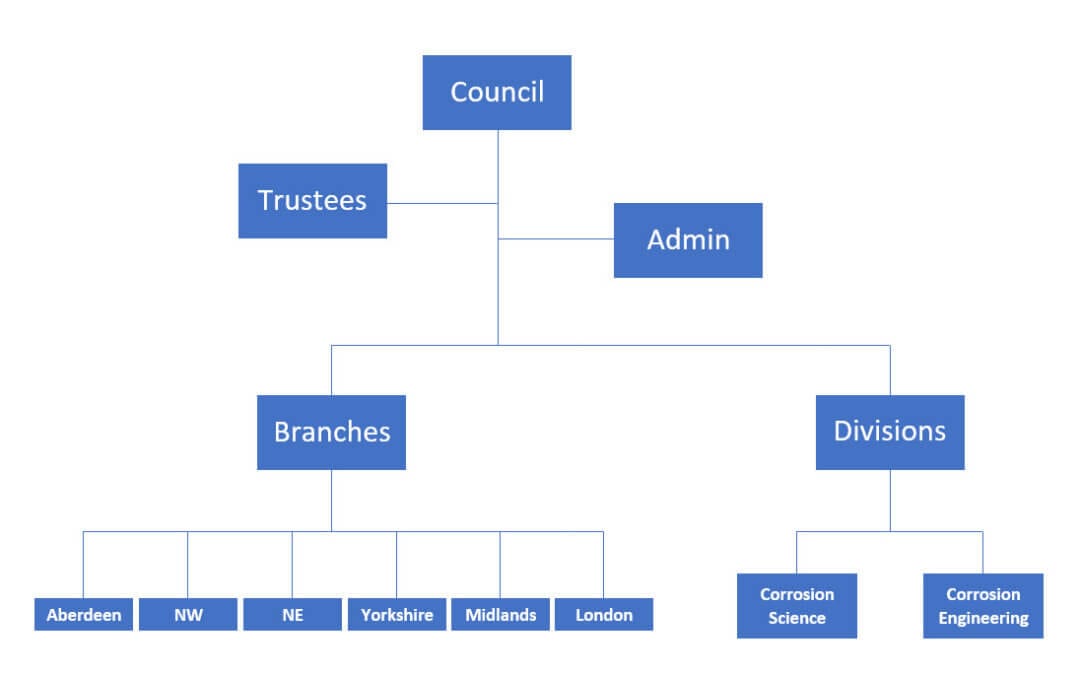
Here’s an overview of how ICorr functions.

The Council of the Institute of Corrosion

Our Council is like the Board of Directors of a large company. It is the Institute’s highest decision-making body, and every branch, division, and committee report to the Council. The Council is made up of the following members:

  • The five trustees/directors
  • Branch and Division Chairs
  • Committee Chairs
  • The Chair of Young ICorr
  • The Technical Editor of Corrosion Management magazine
  • Various co-opted members

The Trustees of the Institute of Corrosion

There are five trustees, and these form the ‘committee’ that oversees the routine running of the Institute between Council meetings. The trustees are the following Institute of Corrosion members:

  • The President
  • The Vice President
  • The Immediate Past President
  • The Honorary Secretary
  • The Honorary Treasurer

Our Head Office

Our head office, Corrosion House, is where all the admin work is conducted. Located in Northampton, the staff of three here work tirelessly to ensure that every t is crossed and i dotted across every aspect of the running of ICorr.

Beneath the Council, our structure allows information and operations to flow freely in all directions as follows:

The Branches of the Institute of Corrosion

The six regional branches let us reach deep into the heart of the corrosion community in the UK:

  • Aberdeen
  • London
  • Midlands
  • Northeast
  • Northwest
  • Yorkshire

The work they do and the networking opportunities they present to our members is vital. They have a great deal of autonomy, and run various events that include:

  • Seminars/webinars
  • Technical workshops
  • Social events

Every event and interaction within our branches is a networking opportunity, and a chance for members to learn and share ideas, experience, and best practices.

The Two Divisions of the Institute of Corrosion

Though depicted on the organisational structure chart as a single leg of our not-for-profit organisation, the two divisions really stretch across every part of ICorr. Their reach is in everything we do:

The Corrosion Engineering Division (CED)

Made up of five Working Groups, the CED also runs a Working Day and Symposium. The Working Groups are:

  • Nuclear Corrosion
  • Coatings
  • Cathodic Protection
  • All Energy
  • Corrosion in Concrete

The Corrosion Science Division

This division consists of representatives from the corrosion research community – primarily academia and research – and runs the annual Corrosion Science Symposium.

Young ICorr

While the experience of senior corrosion professionals is crucial in our industry and to the Institute, equally vital are the younger engineers and scientists who are entering and progressing in their careers in corrosion prevention.

Young ICorr is a vibrant and forward-looking group, through which many initiatives and early-career networks are formed, and from which we believe corrosion industry leaders of tomorrow will develop.

The Committees of the Institute of Corrosion

Finally, to the committees ─ without which the Institute of Corrosion could not function effectively. This is where much of the day-to-day work is managed. These teams meet up when needed, collaborate with other teams, and ensure that actions agreed are carried out.

The Awards Committee

Responsible for overseeing the portfolio of ICorr awards, and for the nomination of ICorr members for external awards. The recognition of excellence both internally and externally helps us to demonstrate the authority with which the Institute operates and the professionalism, knowledge, and expertise of our members.

The Building Management Committee

This committee is responsible for the maintenance and upkeep of our Head Office, Corrosion House in Northampton. They may not get their hands dirty with building work, but without them we might not have a home!

The Course Approval Board

The education of the corrosion community, at whatever stage of their individual careers, is crucial to the future of our industry, and, indeed, the future of our world – when corrosion control is ignored it can be catastrophic.

The Digital Strategy Committee

In our digital world, it is easier to connect, build networks, and share expertise than ever before. However, to do this effectively, it is essential to develop and follow strategy that aligns with the goals of the Institute. This is the remit of the Digital Strategy Committee.

The Membership Development Committee

The real strength of the Institute lies in its membership. The broader and deeper our membership is, the more we can offer and provide to them and the global corrosion community.

The Membership Development Committee is responsible for initiatives to increase our membership and highlight the benefits of membership.

The Professional Assessment Committee (PAC)

While the Membership Development Committee is responsible for driving membership applications, it is the PAC that handles membership and upgrade applications.

Correx Limited

Though we are a not-for-profit organisation, our commercial activities are key to our present and future sustainability. However, it is also crucial that we keep the operation of these at arm’s length. To ensure this is the case, we registered Correx Limited in 2003.

It is Correx that organises all of our commercial activities, and especially the administration of ICATS (Industrial Coating Applicators Training Scheme). ICATS is mandated by the Highways Agency and Network Rail for all coating applicators – and it is also a requirement for many other major structure owners including Oil Companies, Power Generators, and Infrastructure Owners.

In future articles, we plan to explore each element of the organisational structure of the Institute of Corrosion, to help all our members and the wider corrosion community to have a greater understanding of all the moving parts of the Institute and the tremendous amount of work that goes on behind the scenes. If you’re interested in getting involved in any of these activities, please get in touch with us!

In the meantime, to learn more about membership of the Institute of Corrosion, please check out our membership page to learn how to become a member and immediately begin to enjoy the many benefits of membership of the Institute of Corrosion.

Online Classes vs Classroom Learning: Which Is Best for Corrosion Professionals?

Online Classes vs Classroom Learning: Which Is Best for Corrosion Professionals?

Tips to Help You Choose the Best Corrosion Course

Gaining corrosion-specific qualifications could help you to propel your career to the next level. However, selecting what courses will help you achieve your professional career goals can be challenging. One of the questions you’ll need to answer is, how best do I gain my next corrosion qualification – online learning vs classroom learning?

In this article, we discuss the advantages and disadvantages of online classes vs classroom learning for corrosion professionals.

Online learning vs traditional learning: what’s the difference?

Learning online and learning in the classroom sound like very different beasts, and they are.

When you learn virtually, you must manage your time effectively and be highly self-motivated. The onus is on you to compete tasks and keep the momentum of learning going.

In the classroom, you’ll have the guiding hand of the lecturer, trainer, or teacher to help and motivate you. You’ll also have others to bounce off and engage with ─ which makes for a more relaxed learning experience.

Despite these differences, there are also many similarities between corrosion training provided online and that delivered in the classroom. For example, you will benefit from the same theoretical and practical learning, and the qualification you receive will be the same and regarded equally by prospective employers and industry bodies like ICorr.

The advantages and disadvantages of classroom learning

Usually, classroom learning for corrosion professionals is provided in specialized facilities – like ICorr’s Cathodic Protection Training & Examination Centre in Telford, where training in cathodic protection is delivered by ICorr and the Corrosion Protection Association (CPA), orArgyll Ruane’s corrosion courses that are delivered in their dedicated classroom facility in Sheffield. This isn’t the only benefit, however.

Advantages of learning in a classroom include:

  • The physical contact between trainers and learners. It’s easy to ask questions and to learn from questions asked by others.
  • There can be a healthy competitive element in the classroom setting, and this can help to keep you motivated.
  • You’ll also get to forge new professional relationships with other corrosion professionals ─ a great way to extend your network.
  • Classroom learning helps to keep you disciplined in your approach.
  • Because you’re away from home and work, your focus is not disturbed either during learning hours or when you are doing your ‘homework’ in your temporary accommodation.

What’s there not to like about classroom learning? These disadvantages should be considered when making your choice of learning options:

  • You will need to pay for your travel and accommodation, as well as meals.
  • If you don’t attend a classroom session, you miss it completely.
  • The courses are usually more expensive, because there is a whole layer of infrastructure to pay for.
  • They are time-bound. You must adhere to a strict schedule, irrespective of other commitments.
  • If you are self-employed, you won’t be earning while you are learning.

The advantages and disadvantages of online learning

You can take online lessons anywhere there is internet access. In your home, your office, or even while commuting by train. Other advantages include:

  • You are not bound by time or location. There may be a specified ‘complete by’ date, but online lessons offer the flexibility to view them at anytime and anywhere.
  • You work at your own pace, without the stricter, time-bound approach of classroom learning, meaning you can fit your course in to suit the demands of your professional and personal life.
  • No loss of earnings while learning, and you save on travel time.
  • It’s more cost-effective – courses are generally cheaper, and you don’t have the added expense of accommodation and meals to consider.
  • You may have the opportunity to meet corrosion professionals online, and these could be from anywhere in the world – a great way to extend your professional network globally.

While these advantages are very tempting, you should also think about the following disadvantages of eLearning:

  • It can be challenging to stay motivated – you must be self-disciplined and have good time management skills.
  • eLearning requires you to be technologically adept, and able to use the latest communication technology ─ and what if you lose your data or connection?
  • A lack of social interaction means you don’t benefit from other students in quite the same way as you do in the classroom.

Which corrosion course is best for you? Online learning vs classroom

Once you know which qualification is best for you at any given stage in your career, and you are ready to achieve your next career goals, you’ll need to decide which training platform best suits your needs:  online learning or classroom learning. Here are a few questions that will help you make the right decision:

What’s my ability to learn?

Think about the time it will take you to complete the course. Do you have the time available to spend a few days in the classroom? If you do, do these coincide with the course dates?

You’ll also need to consider if you have the technology to take an online course and if you have the right technology available to you.

Thirdly, how is your motivation and self-discipline? When you take a class-based corrosion course, you are held to account by the course tutor and those around you. Do you perform better in this learning situation, or do you learn more effectively when left to your own devices?

Finally, can you attend the classes from a logistics point of view? Do you drive? Will train times be prohibitive? Is the distance prohibitive? Can you be away from home overnight?

What is my socialisation preference?

If you are learning by traditional methods, you’ll be surrounded by like-minded individuals. Are you the type of person who thrives in this atmosphere?

Perhaps you are more introverted, and don’t care to ask questions in front of other people.

Do you want to take lunch breaks as opportunities for focused study, or could these impromptu group sessions help you embed the learning you’ve received?

We’re not all social creatures, and we don’t all learn equally well in the classroom. If this sounds like you, eLearning could be the way to go.

How much will the course cost – is it cost-effective for me?

The last question you should ask is whether attendance of class-based learning will be cost-effective. There are many things to consider here:

  • How much does the course cost?
  • Will you need to take unpaid time off work?
  • Can the cost of the course be subsidized, by your employer or other source?
  • Upon completion, what impact will this have on your earnings potential in the future?

Qualifications in corrosion engineering and corrosion sciences, and job-related corrosion specializations, are an investment in yourself and your career.

For advice on which course would be best for you, and to learn what corrosion training, course, and qualifications are available through ICorr, please email us at admin@icorr.org with the subject line ‘Interested in ICorr corrosion training’. Tell us what you would like to know, and we’ll answer your questions by return email.

Chris Lynch: Worthy Recipient of the Paul McIntyre Award 2022

Chris Lynch: Worthy Recipient of the Paul McIntyre Award 2022

Giving Back in Corrosion Engineering

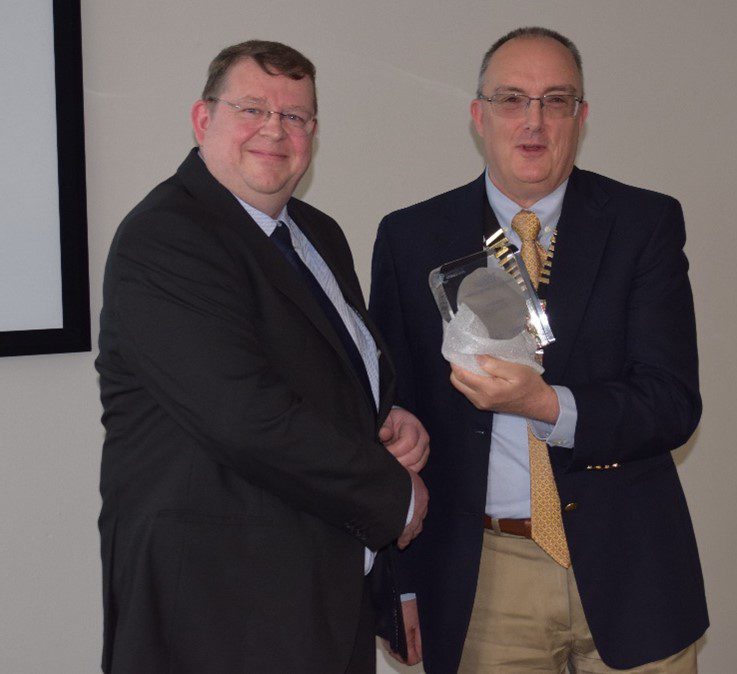
First awarded in 2017, the Paul McIntyre Award is our premier award in the field of corrosion engineering. It is presented to a senior corrosion engineer by the President of the Institute of Corrosion at the Corrosion Engineering Division’s Working Day and Symposium.

In addition to the recipient being a senior engineer, the criteria includes that he or she is a leading practitioner in his or her field who has advanced European collaboration and the development of international standards.

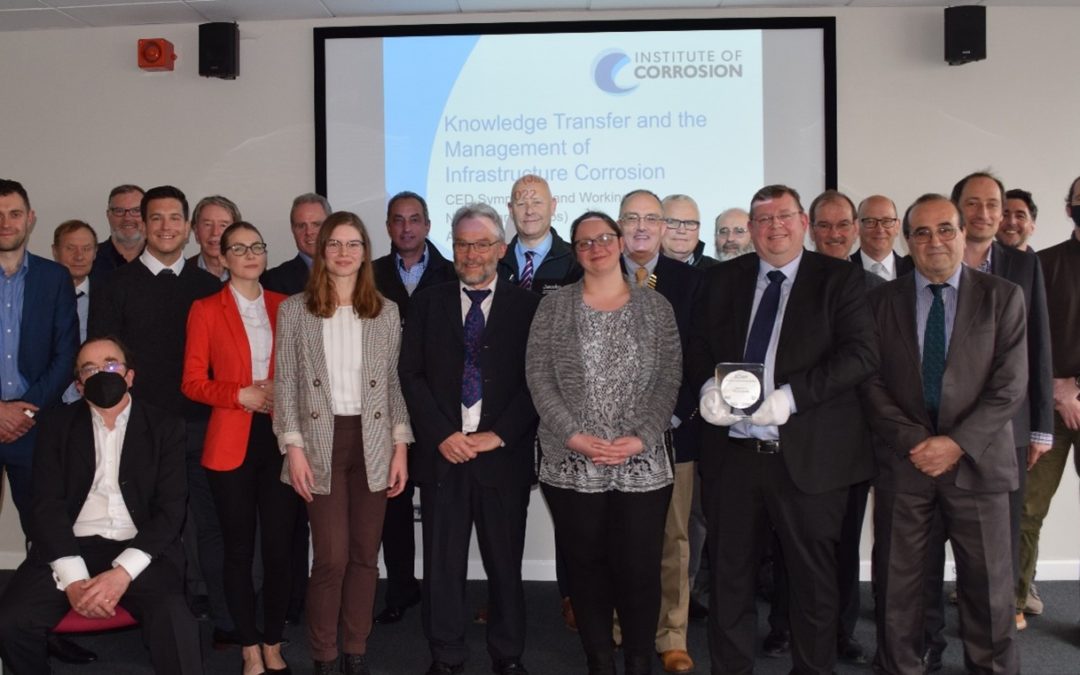
This year, we returned to an in-person Working Day held at the National Railway Museum in York. It certainly proved to be a Working Day and Symposium to Remember, especially for Chris Lynch, who received the Paul McIntyre Award at the end of the morning’s session.

Paul McIntyre – an inspiration to those who follow

Dr Paul McIntyre was determined, invariably polite and accommodating, and had an endearing, dry sense of humour. His career spanned industry, asset management, and editorial work, as well as working on standardisation within the industry.

After graduating from the University of Newcastle-upon-Tyne, Paul spent the initial stages of his career in industry. He moved south in 1978, to join the Central Electricity Research Laboratories in Leatherhead. As Group Leader, he spearheaded studies into stress corrosion, localised corrosion, and corrosion fatigue in conventional and nuclear power plants.

Later in his career, Paul became involved in asset management and remaining life assessment of components, including the development of remedial methodologies such as reliability, availability, and maintenance (RAM) and reliability centred maintenance (RCM).

Between 1996 and 2006, he was the editor of the British Corrosion Journal, though editorial work was not his only foray into the written word in the corrosion industry. Paul authored around 60 published papers and over 200 technical reports.

Paul was never one to rest on his laurels, and thrived on demanding work. If he wasn’t at work, he was deliberating, or brainstorming, or advising. Between 2004 and 2010, he worked as consultant in the Electrochemistry and Corrosion group at NPL. He put his insight and engineering experience to work in producing critical analysis of a wide range of failure investigations including fracture of wind turbine bolts and corrosion pitting in desalination plants, as well as providing informed corrosion control guidance to industry.

Paul also had nearly 30 years of participation in corrosion standardisation as a member of BSI and ISO committees. This included time served as Chair of ISO/NFE 8 Corrosion of metals and alloys, and UK representative on the equivalent ISO committee TC 156 and within that being secretary of WG 2 Stress Corrosion Cracking and member of WG 7 Accelerated Corrosion Tests.

He made an immense contribution as Scientific Secretary of the EFC.

He was also on the Council of the Institute of Corrosion from the early 2000s, specialising in standards work and pan-European activities.

In 2003 Paul was awarded the T. B. Marsden Prize of IOM3 for his considerable achievements in promoting standards, education, and publishing in corrosion and materials. In citation for the award, the Chair of ISO TC 156 said, “Paul has provided more input into the development of ISO standards in the corrosion field than any other individual”.

Unfortunately, Paul was diagnosed with secondary liver cancer in 2012, and, despite his spirit and fight, he sadly passed away in 2012.

The Paul McIntyre Award is a befitting celebration in his memory, and an inspiration to all those who follow him.

Chris Lynch

Chris Lynch graduated from the University of Leeds in 1990.

He began his working career as a junior corrosion engineer at Aberdeen Corrosion Engineers Limited, and remained in the north of Scotland for more than 10 years. Extensive travel took him into Europe and the Middle East, while working onshore and offshore.

Employed by Corrpro Companies Europe Limited in 2005, he is now Senior Engineering Manager and responsible for cathodic protection engineering, site services, and the power unit design personnel.

Like Paul McIntyre, Chris is dedicated to his work and an avid learner. He also believes it is important to give back to the industry he loves and that has rewarded him well.

Also like Paul McIntyre, Chris has served on many committees and with industry bodies. He is Chair of a BSI committee, and has presented training and development courses. He has an international outlook, and thrives on exchange of information with his peers from around the globe. A Chartered Engineer, his rollcall includes:

  • Working on numerous training committees
  • Course presenter of ICorr training schemes
  • Currently a member of the Cathodic Protection Governing Body (CPGB)
  • Level 4 CP Specialist of buried and marine structures and internal surfaces
  • Fellow of the Institute of Corrosion
  • Chair of GEL/603 which is the British Standards Institute (BSI) committee for Cathodic Protection
  • Works on various Working Group activities for ISO and CEN
  • Member of CEOCOR
  • Member of the Marine Corrosion Forum

In accepting the Paul McIntyre Award, Chris said:

I would like to thank those who have voted for me to receive the Paul McIntyre Award for 2022. This is a great honour for me.

“I would like to dedicate it to all the people who have contributed to my success, many of whom I have met whilst doing the work that Paul himself did tirelessly and for so many years himself.

“It is wonderful that my work with GEL/603 and with ISO and CEN standards committees and working groups has been recognised with this award. The work is so varied and with communities such as CEOCOR, the approach is unique and informal.

“To be honest, it is not work at all. It is fun.

“There is much to be gained in international standards work and I have built up friendships with peers and experts across Europe and the wider world. I have gained so much more than can be taught on courses or read in presentations, papers, or visiting exhibitions.

“I believe we all have something to share. Perhaps an experience we have had that is unique or a set of interesting data we have gathered; or a job that went wrong that others would benefit from in hindsight.”

The similarities between Dr Paul McIntyre and Chris Lynch are uncanny. A worthy recipient of our most prestigious corrosion engineering award.

To learn more about the Institute of Corrosion Awards, click here.

To discover how you can become a member of the Institute of Corrosion, and ways in which membership can help develop your career, or how you can give back to the industry by sharing your knowledge and experience with those who are developing theirs, please contact us.

Corrosion Engineering: A Working Day to Remember

Corrosion Engineering: A Working Day to Remember

5 Talks, 4 Working Group Sessions, 1 Prestigious Award, and a New Chair… Phew!

The corrosion engineering community was able to get together and do what they do best at the Institute of Corrosion’s Corrosion Engineering Division (CED) Working Day and Symposium in April. Discuss latest trends, share knowledge, and brainstorm ideas and concepts.

Held at the magnificent National Railway Museum in York, this was the latest in a series of CED Working Days that offer delegates exceptional networking opportunities – as well as a chance to visit the museum.

A welcome to introduce a sad farewell

Nick Smart, Chair of CED, welcomed the delegates to the event and introduced the speakers. This was the last Working Day and Symposium that Nick has introduced, as, after 15 years of excellent service as the CED Chair, he is stepping down.

Nick’s shoes will be challenging to fill, and the meeting showed their appreciation for his unstinting efforts and contribution throughout his years at the helm. A sad but celebratory farewell, and a warm welcome to the incoming Chair.

Introducing the Corrosion Engineering Division’s new Chair

Before the main proceedings began, Nick Smart introduced the delegates to the CED’s new Chair, Danny Burkle.

While Nick will be a hard act to follow, we’re incredibly lucky to have Danny taking over the steering of the CED.

A business development engineer, Danny’s prime responsibilities in his role at LBBC Baskerville include developing business strategy, business, and product range for innovative corrosion testing autoclaves to simulate realistic field environments within several high-pressure and high-temperature applications and industries.

His Doctorate in mechanical engineering, which he completed at the University of Leeds, focused on corrosion mechanisms involved in carbon dioxide corrosion, and protecting carbon steel assets against corrosion by forming natural corrosion products. The industry-focused research, sponsored by BP, was based on real-life engineering problems.

With both academic and industry experience, Danny’s role as CED Chair could help to forge closer relationships between research and industry.

Knowledge transfer in five presentations

Through the day, delegates were treated to five presentations around this year’s theme of ‘Knowledge Transfer and the Management of Infrastructure Corrosion and Management’:

1.     Hot dip galvanizing for specification and use in infrastructure projects

Presented by Desmond Makepeace of the Galvanisers Association, this talk began by describing the galvanising process, with reference to the appropriate standard EN ISO 1461.

Desmond discussed a variety of defects, which of these can be tolerated, and factors affecting the quality of galvanising, including coating thickness, renovation, adhesion, joining-bolting, duplex systems, maintenance, venting of hollow sections, and overlapping sections. He also discussed how the atmosphere affects corrosion of galvanised structures.

2.     Best management practices to transfer knowledge to ensure integrity assurance optimisation for oil and gas production

One of the highlights of the Working Day, this Young ICorr talk was given by Izabela Gajewska. Izabela was a member of the winning team of the 2020 cohort of the Institute of Corrosion’s Young Engineer Programme (YEP) (which you can read about in our article ‘A case study for all young corrosion engineers – it could be you’).

Izabela discussed the nature of knowledge transfer, and the best practices to ensure this happens effectively and successfully – such as planning, work experience, mentoring, specialised training, attending conferences, and so on. She spoke about creating an effective mentoring strategy, delivery of training, and the value of external training courses in areas including coating, passive fire protection, cathodic protection, and risk assessments.

3.     The consequences of climate change for corrosion

Chris Atkins of Mott MacDonald gave a thought leadership talk, discussing his ideas around climate change and corrosion. For example, can we rely on historically established corrosion rates as emissions of carbon dioxide are increasing? An ensuing reduction in the pH of natural waters could make them more aggressive to concrete, though it may reduce the corrosion rate of galvanised steel.

Temperature increases reduce the dissolved oxygen content in water, but Chris demonstrated how this temperature increase does not automatically produce an increase in corrosion rates – and a reduction in carbon dioxide levels from today’s elevated levels is likely to reduce atmospheric corrosivity.

The real issue? As far as Chris is aware, no one is taking a global view of the effect of climate change on corrosion, and this leads Chris to ask one last question: is this an opportunity for the Institute of Corrosion to take a leading role?

4.     Academia and industry: How can we advance corrosion science and engineering together?

“Academics want to publish. Companies want to make money.”

Old thinking.

Richard Barker of Leeds University addressed this in a thought-provoking talk that pointed to research around this topic, as well as opportunities and challenges that exist for academia and commercial operations to collaborate more effectively.

While academia has the time and resource to produce new knowledge which can be used commercially, barriers that exist include complexity of communication to share knowledge and the complexity of initiating and continuing collaboration.

Perhaps the biggest challenge is trust. Industry must trust scientists, but the complex and ever-changing nature of large bodies of academic research makes this challenging for many businesses. However, we are seeing that some companies are developing strategies to identify and reach out to research groups for collaborative projects – and creating collaborative success.

The conclusion? Yes, there are challenges that exist, but these can be overcome with the correct approach from both sides. If we can do this, then there are significant benefits to be accessed from greater collaboration between academia and industry.

5.     Radioactive waste disposal – where corrosion science meets corrosion engineering

In the first presentation of the afternoon session, Nick Smart gave his last CED Working Day and Symposium presentation as Chair.

Nick discussed the three levels of radioactive waste, and discussed the various research that supports the corrosion engineering and safety assessment aspects of radioactive waste management.

Describing corrosion issues that exist (such as atmospheric external corrosion of stainless steel waste containers during interim storage, the corrosion behaviour of waste uranium, aluminium and Magnox after encapsulation in cement, and the long-term corrosion of waste containers after disposal in deep geological repositories), he pointed out that the UK’s total nuclear waste inventory would fill Wembley Stadium.

Nick discussed the two main concepts for geological disposal of high-level waste, and the challenges that exist within diverse global geological environments – key environmental considerations when disposing of radioactive waste underground include oxygen concentration, chloride and sulphide concentrations, radiation levels and microbial activity.

Nick outlined the analytical techniques that are used to characterise the corrosion behaviour and corrosion rates of candidate waste container materials in long-term in situ experiments conducted under representative conditions, and how such studies can be supported by comparison with the corrosion of natural analogues, such as archaeological artefacts like the Anglo-Saxon Coppergate Helmet currently exhibited in the Yorkshire Museum.

The session concluded with a short talk by Stuart Bond from AMPP. He discussed the development of revised standards being conducted by AMPP (a merger between SSPC/NACE was rolled out in January 2021).

The Working Group Meetings

At the end of the talks, delegates had an opportunity to visit the National Railway Museum and attend Working Group Meetings. This year the following groups held sessions:

·       Nuclear Corrosion Group

Chaired by Nick Smart, the Nuclear Corrosion Group met to discuss a wide range of corrosion issues arising during the storage of nuclear waste. These included assessment of pitting corrosion in stainless steel during storage in atmospheric conditions, the effects of microbial corrosion on cast iron under damp conditions, and the potential for galvanic corrosion of stainless steel in contact with graphite in cementitious environments.

·       Coatings Group

There was plenty to discuss in this group, chaired by Phillip Watkinson. This included:

  • The impending review of the Coatings Technical Information Documents (CTID), created in 2016-17
  • The transfer of NACE Coatings Standards to AMPP
  • A suggestion by Douglas Mills that EIS measurements (ISO 12944) be reviewed
  • Phillip Watkinson tabled that two Paints and Varnishes Standards (BS EN ISO 4628-1:2003 and 4628-2:2003) should also be reviewed

It was agreed that an interim meeting would be held ahead of next year’s CED Working Day.

·       Cathodic Protection Group

Acting Chair Chris Lynch directed discussion around subsea CP systems and performance of flush fit aluminium deep sea anodes on complex piping systems. This included current distribution, current density, anode installation methodology and expected performance along with coatings, anode corrosion products, and calcareous deposits.

·       All Energy Group

Chaired by Steve Paterson, all those present contributed to a positive discussion about the purpose of the group, which has been formed by adding renewables to the previous Oil and Gas Group. Items covered included:

  • Production of documents
  • Mentoring of Young ICorr members
  • Information exchange via networking
  • Engagement with other organisations like AMPP

After an update with regards to standards, it was agreed that another meeting would be held in October.

The Paul McIntyre Award

As is customary at the CED Working Day and Symposium, before the group broke for lunch, the President presented the Paul McIntyre Award.

This year’s recipient of this prestigious award, the premier engineering award of the Institute of Corrosion, was Chris Lynch, who has worked tirelessly for many years and made many outstanding contributions to many aspects of corrosion engineering. You can read more about the award and Chris’s contributions in our article ‘Chris Lynch – Recipient of the Paul McIntyre Award 2022’.

Don’t miss out on the benefits of the CED

The CED is a driving force within the corrosion industry. It shares news, views, and learning to the Institute’s membership, via several channels, including:

Chairs of individual Working Groups liaise with counterparts at other corresponding Working Groups in international bodies. The Working Groups also provide a mechanism for members to collaborate effectively; for example, by jointly preparing documents that are of immediate and practical use to them in their field of activity. Such documents are downloadable within the Members Area of the ICorr website.

If you are not already a member of the Institute of Corrosion, check out our membership page to learn how to become a member and immediately begin to enjoy the many benefits of membership of the Institute of Corrosion.

A Case Study for All Young Corrosion Engineers – It Could Be You

A Case Study for All Young Corrosion Engineers – It Could Be You

Rewards, Awards, and Benefits of Participating in the Young Engineer Programme

Here’s a case study for all young corrosion engineers:

Do what you love to do. Receive grade A mentorship in the process. Develop your learning and understanding, and make new connections to deepen your professional network. Oh, and win a fully expensed trip to the 5-day AMPP Annual Conference & Expo in the USA.

Too good to be true? Not for the winning team of the 2020 cohort of the Institute of Corrosion’s Young Engineer Programme (YEP).

What is the Young Engineer Programme?

The YEP is specifically designed for engineers at the early stage of their careers in the corrosion industry. A series of lectures are presented, and the group is divided into teams and challenged to present solutions to a real-life case study.

The lectures cover subject areas including:

  • Basic corrosion
  • Welding
  • Materials
  • Coatings
  • Painting, fire protection and linings
  • Cathodic protection
  • Chemical treatments
  • Presentation skills

These lectures are designed to provide the theoretical and practical guidance needed to complete the case study. To aid progress toward their goal, each team is allocated a mentor with relevant and recognised industry expertise and experience.

There was a total of 30 young engineers enrolled in the 2020 cohort, all able to take advantage of this immensely valuable (and free) course. The YEP enrolled engineers divided into seven teams of between three and five for the case study.

The mentors were:

  • Andrew Sturgeon, Manager Materials Engineering at Genesis Energies, London
  • Chris Googan, Materials & Corrosion Engineer at Anticorrosion Engineering Limited
  • Charles Barraclough, Materials and Welding Engineer
  • Tasos Kostrivas PhD, ΕMBA, MSc, FIMMM
  • David Shaw, Lead QC coating/insulation/PFP Saipem
  • Rob Doggett, Materials and Welding Engineer at Fluor
  • John Davies, Consultant QA Engineer at Fulkrum Technical Services

Throughout the programme, guests included Bill Hedges, Gareth Hinds, Steve Paterson, Danny Burkle, and Caroline Allanach and the Steering Group; Trevor Osborne, Alan Denny, Anthony Setiadi, and David Mobbs.

The case study – the challenge

The case study that the teams were asked to review and present their findings centred around a titanium pipe corrosion failure at an onshore glycol desalination plant, in which was found several leaks. The desalination plant is used to periodically remove the salts from glycol which is used for hydrate and corrosion control in gas pipelines from three offshore fields.

Particularly challenging in this case study is that the high-grade titanium spool would be expected to resist any form of corrosion in this service. After being given the complete case study, the teams were tasked to include the following in their submissions:

  • Propose credible root causes for the observed defects and describe the potential failure scenarios
  • Explain how you would perform a corrosion risk assessment to determine if the plant is safe to operate
  • Identify what mitigation options could be applied to prolong the service life of this section of the desalination plant
  • Propose alternative materials of construction for replacement pipe spools and describe the basis for the selection
  • Describe what other factors should be considered in your assessment and propose possible longer-term solution(s)

The case study – presentation and judging

The teams presented their case studies to a panel of judges (Sadegh Parvizi, Chris Williams, and John Boran) on 12th November 2020. Each 20-minute presentation was followed by five minutes allotted for questioning. While no team was allowed into the presentation meeting before their time, they were permitted to remain in the meeting to hear subsequent teams present.

The presentations began at 5pm after registration and introductions. Would presenting first be best? To get your presentation completed and then relax to watch others? Or maybe presenting last would be more advantageous – with extra time to do those last-minute preparations and practice? Or would each team feel the added pressure of more eyes on them as the evening progressed?

When the final presentation had been made, the presentation session was called to a close. During a 20-minute break in proceedings, the judges deliberated, cogitated, and digested the tremendous presentations they had been served in seven courses (sorry, we couldn’t resist pinching from Lloyd Grossman’s Master Chef catchphrase!).

To be honest, there was very little to choose between the case study tasks completed. Each team’s findings had terrific merit – a testament to their mentorship, the lectures they had attended, and the collaborative capability of each team.

The deciding factor came down to presentation: the clarity and precision with which the winning team delivered its findings and answered the challenging questions posed by the judges.

And the winning team… Drum roll…

Team number four, mentored by Tasos Kostrivas, and comprising:

  • Ryan Cobbs, civil engineer at Mott MacDonald
  • Izabela Gajewska, corrosion engineer at Intertek
  • Harry Wright, corrosion engineer at Element
  • Praveena Nkumaran, mechanical engineer at Worley Parsons
  • Lemoine Vincent, welding engineer at Saipem

The grand prize – the fully expensed trip to the AMPP Annual Conference & Expo 2022

Because of Covid, the delivery of the grand prize was unavoidably delayed by a year. Nevertheless, the winning team – unfortunately minus Praveena who was unable to attend – set out off for San Antonio in Texas for the AMPP Annual Conference & Expo in March 2022.

For many, this is a once-in-a-lifetime event. For only a select few young engineers, their attendance is fully expensed, courtesy of YEP sponsor BP.

This event is the largest of its kind in the corrosion world. There are more than 500 technical paper presentations, almost 500 exhibitors, opportunities to gain credits toward career development, and the chance to hear from some of the best corrosion professionals on the planet – as well as meet and connect with peers from around the globe.

And it wasn’t only these four young engineers who attended the conference and expo in San Antonio. Thanks to the sponsorship of Pipeline Induction Heat, James McGladdery (National Nuclear Laboratory) and Benjamin Lee (SGN) were selected to join the AMPP Leadership Course for their performance during the programme.

The YEP experience through the winners’ eyes

Winning at anything isn’t a cake walk. It takes hard work, effort, and determination. It takes learning and enthusiasm. How does YEP stand up to scrutiny from the inside?

Here’s what Izabela Gajewska said about her experience:

“Taking part in 2020 Young Engineer Programme was an amazing experience and a great opportunity for networking. All lectures were interesting and very educational. I got an opportunity to learn more about areas of the industry that I am not involved a lot in my daily job including welding, fire protection, and chemical treatments.

“It was a great experience to work on the case study with colleagues from different companies and industry branches. The ideas and a views of all team members were equally valuable, enhanced creativity, and were essential to solve the case study and prepare the final presentation. I enjoyed collaboration and brainstorming very much.

“During solving the case study I had to motivate myself to look through many valuable research papers and technical books recommended by my team colleagues and our mentor, Tasos Kostrivas. I had also a chance to see different approaches to solve corrosion issues thanks to the diversity of the industries in my team. Apart from this, I feel that I have improved my planning and communication skills, teamwork, did some good networking, and made new friends.

“I also was delighted to take part in the 2022 Annual Conference by NACE/AMPP (Association for Materials Protection and Performance) in San Antonio, Texas and celebrate winning the Young Engineer Programme 2020 along with my team colleagues Vincent Lemoine, Ryan Cobbs, Harry Wright.

“One of my team colleagues, Praveena Nanthakumaran was not able to attend. Fortunately, she will be able to attend the next NACE/AMPP conference in Denver next year, and celebrate her well-deserved trip to the conference in the United States.

“For me, the highlight of the NACE/AMPP conference was the EMERGing Leaders Bash which included recognition and celebration, acknowledging the accomplishments of 2022 scholarship and award recipients including my winning team and two other colleagues accepted for the NACE/AMPP Leadership Programme:  James McGladdery and Ben Lee. It was an honour to be a part of this amazing and inspiring evening.”

To the present – a case study to whet the appetite

The 2022 YEP cohort have another real-life case study to become immersed in. This year’s candidates will be presenting in Aberdeen (held here for the first time, and aptly so). They have been asked to provide a corrosion risk assessment of a platform in the North Sea for a client who is planning to acquire the asset. But:

  • Corrosion on the platform has been poorly managed during the past 15 years, resulting in several hydrocarbon leaks
  • The teams must determine and present solutions to extend the life of the platform for another 10 years, making the exercise a real challenge
  • They must also identify materials selection for a new pipeline

A challenging, real-life case study that will help all the young engineers involved improve their learning and prove their competence. A fantastic addition to any CV.

To the future – it’s time to start thinking about pre-enrolment for YEP

Demand for places in the Institute of Corrosion’s Young Engineer Programme is always high. Benefitting from lectures given by some of the industry’s brightest minds, offering the chance to network and collaborate with some of the industry’s upcoming stars, and the opportunity to be rewarded with an incredible, fully expensed experience, it is not difficult to understand why.

If you are at an early stage of your career in the corrosion industry and would welcome extra experience to set you up for the future, please contact the Institute of Corrosion. We would be pleased to answer your questions and provide details of how you may pre-enrol for our next YEP cohort.

Don’t forget, also, to follow the Institute of Corrosion on our LinkedIn page – where we post regularly to keep the corrosion community updated.

If you’re not already, why not become a member of the Institute of Corrosion? We have many different membership options, including free student membership.