The April branch meeting was joint with The Welding Institute, and Dr Patrick Lydon, IACS Corrosion Engineering, gave a presentation on “The Corrosion and Safety Hazards Associated with AC and DC Interference on Onshore Pipelines”. This was a hybrid meeting, with 23 attendees in person, and 20 online, approximately half of these from oversees.
Pat explained that one of the main concerns associated with AC, and also DC, stray current interference on pipelines is that it can in certain circumstances result in high rates of corrosion, even if a pipeline system has fully effective levels of cathodic protection (CP).
In the case of AC corrosion, the highest reported rate of corrosion in the UK was 2.45mm/yr and that resulted in through-wall corrosion and loss of containment within 2.5 years of the pipeline construction.
A situation was described where a powerline operator had changed the electrical configuration on a power cable system routed close to a pipeline, whilst maintenance work on the cable system was being carried out. This resulted in a sudden increase in AC voltage on the pipeline from 2V to about 20V which resulted in an increase in the AC corrosion rate on the pipeline from 0.02mm/yr to 4.0mm/yr.
Pat pointed out that it is not only higher rates of corrosion that pipeline operators should be concerned about but also the electrical safety risks to personnel working on pipelines from short term and long-term AC interference. AC voltages can be induced on pipelines from low frequency inductive coupling between buried and above ground pipelines, where they are routed in close proximity to high voltage powerlines.
Historically pipeline designers did not consider the proximity to electrical substations and powerline pylons when selecting a pipeline route. Thus, in the event of a ‘phase to earth fault’ on the electrical systems there could be an enhanced touch potential risk to personnel working on a pipeline from the resultant ground potential rise (GPR) effects during short term interference events. The fault currents can result in high localised voltage gradients, which can transfer potentially fatal touch voltages to pipelines, presenting a safety risk to personnel working on a pipeline system.
Pat then pointed out that the standard that addresses the touch potential limits is BS EN 50443 “Effects of electromagnetic interference on pipelines caused by high voltage AC electric traction systems and/or high voltage AC. power supply systems”. However, the voltages specified in this standard are in excess of those adopted in other countries and in other industries. The limits stated in BS EN 50443 only apply to electrically instructed personnel, and for a specified footwear insulation resistance, which may not be achievable when working on a pipeline. It was pointed out that current guidance is to use an alternative to this standard to specify maximum touch potential limits.
Examples of pipeline damage due to lightning or an arc strike, where loss of containment has occurred where shown. Lightning damage can result in through wall perforation in a relatively short time period. Figure 2 shows an example of a high voltage surge damage to 3-layer polyethylene coated pipeline.
An example of the damage that an arc strike from a 400kV power cable onto a buried gas main was also given. The arc strike occurred because a fire had occurred in a wooded area underneath the powerlines.
The fire changed the dielectric strength of the air and resulted in an arc which hit a pipeline and caused the damage shown on Figure 3.
The basic safety guidance for work on pipelines located within the vicinity of overhead and buried powerlines was discussed, and information provided on recommended safe practices when working near HV power cables, together with details on plant and personnel separation and clearance distances.
It was pointed out that when pipelines are strung out above ground for welding, close to HV overhead power cables, there is the risk of inductive and capacitive coupling creating relatively high AC voltages on the pipeline sections, which can affect welding operations but also create a touch potential risk. To mitigate this risk, each end of the above ground pipeline section should be earthed.
The presentation included the factors that pipeline operators and designers need to consider when assessing and mitigating the risks from electrical interference on pipelines which relate, not just to touch potential risks, but also the ignition risks from pipework or cables carrying electrical current.
Pat also explained that pipeline operators often isolate the pipeline CP system before performing welding operations to ensure that when pipelines are cut, there is no spark potential risk from the CP current. However, the magnitude of the AC current flowing in a pipeline where it is routed close to powerlines can be at least an order of magnitude greater than the DC current and can result in an incendive ignition risk when pipework is cut.
It is important that not just the DC current, but AC current flowing in a pipeline, is considered. This is because switching off a CP system may not remove all ignition sources. It is important to ensure a solid bond is in place before pipework is cut or removed. There should also be sufficient slack cable in the bond to allow for pipe movement when a pipe is cut, which could otherwise result in cable detachment.
Surge protection on pipelines was also discussed and information provided on how surge protection on cross country pipelines may compromise plant earthing systems. DC decoupling devices e.g polarisation cell replacements (PCR)s can facilitate the flow of AC current through earth cables within above ground installations (AGI)s and compromise the specific earthing arrangements in AGIs.
The presentation concluded with examples of situations where DC stray current corrosion has occurred due to incorrect welding operations. High rates of corrosion were observed within a relatively short time.
There was a lively question and answer session, and Pat was then thanked for his excellent presentation and presented with a pen on behalf of London Branch, and a paperweight from TWI.
The next branch technical evening will be on 13th October, and details of the speaker/topic will be given in the summer magazine, and also on the ICorr website.
Figure 1, Typical AC corrosion on FBE coated pipeline.
Figure 2, Lightning Strike on 3-Layer Polyethylene Coated Pipeline.
Figure 3, Damage to pipeline caused by arc strike.
Argyll Ruane have been delivering corrosion and coatings inspection courses accredited by ICorr for over 20 years.
Over the past few years, they have been expanding their international network of strategic partnerships to enable them to offer these ICorr courses globally.
By forming partnerships with key organisations, Argyll Ruane are now able to deliver these courses within Europe, the Middle East, Australia, India, China, Malaysia, Indonesia, Libya, Egypt and the USA. Their approved training Partners include, HTS Consultants, Alfa Egypt, RSA Academy, Leptis Ltd, Indonesian Institute of NDT, ICE-International Consultant Engineers, and TÜV Rheinland, who are all dedicated to supporting students with their ICorr training. Many, such as Leptis Ltd in Libya, have made significant investments into providing state-of the-art training facilities for students to enjoy.
Moreover, Argyll Ruane are working with a number of consultants to facilitate the delivery of these UK and overseas ICorr courses, including Kevin Graham, Simon Hope, Jane Lomas, Alex Garner, David Stowers, and Sherman Spear, who each bring a significant level of experience and breadth of knowledge of the corrosion and coatings inspection industry.
Courses that are available across these locations include ICorr Level 1, 2 and 3 Protective Coatings Inspector, Insulation Inspector, and Level 2 and 3 Passive Fire Protection (PFP) Epoxy Coating Inspector. Additionally, ICorr Level 2 Passive Fire Protection (PFP) Epoxy Coating Inspector, PCI Transition courses and Recertification examinations are available online. Upcoming course dates can be found on the website, and the diary page of the magazine.
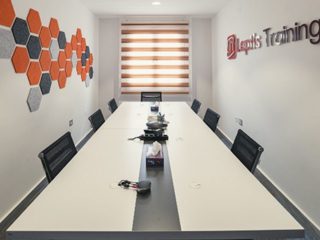
Leptis Ltd have invested in new training facilities for the delivery of ICorr courses in Tripoli, Libya.
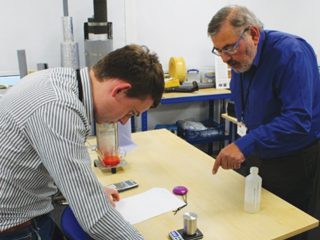
Simon Hope, who has over 45 years’ experience in the corrosion and coatings inspection industry, passing on his knowledge to a student on a Level 2 Protective Coatings course at Argyll Ruane training facility in Sheffield.
The Young ICorr committee held their most recent meeting via teleconference at the end of April to develop a clear strategy for the coming year, as well as to establish sub-committees to focus on events/meetings, the Young Engineer Programme, a dedicated mentoring programme, and the establishment of an annual Young ICorr award.
In addition to this, for the very first time, Young ICorr had a strong presence at the annual CED working day held at the York Railway Museum on 27 April 2022. Izabela Gajewska (Intertek) represented Young ICorr as a speaker giving a talk on “Best Management Practices to Transfer Knowledge to Ensure Integrity Assurance Optimization for Oil and Gas Production”. Izabela’s talk was very welcomed by the CED attendees and initiated a number of discussions around integrating the early-stage career members into ICorr. (Editor: I hope to publish an article based on this presentation in the next issue of Corrosion Management).
In addition to this restructuring of the Young ICorr committee responsibilities as mentioned above, James McGladdery, the Young ICorr vice chair, will step up as joint chair with Danny Burkle, which will help to split the responsibility for the growth of the section whilst Danny transitions into his new position as chair of CED, taking over from Nick Smart. This transition will allow for a continued presence of Young ICorr in the ICorr Corrosion Engineering and Corrosion Science divisions. To become part of the Young ICorr community, or for more information about what they do, and how they can help you, contact, James McGladdery or Danny Burkle on James.McGladdery@uknnl.com and d.burkle@lbbcbaskerville.co.uk, respectively.
Follow Young ICorr on LinkedIn to ensure you do not miss out on future events:
The 63rd CSS will be an in person joint meeting with Electrochem2022 taking place at the John McIntyre Conference Centre near Holyrood Park in Edinburgh, between the 5th and 6th September 2022.
The CSS is the annual meeting for students and researchers working in all areas of Corrosion Science and Engineering. The symposium is an ideal opportunity for early career researchers in corrosion to
discuss their work, share ideas and, above all enjoy themselves in a stimulating/friendly environment.
The meeting website is, www.rsc.org/events/detail/74101/electrochem-2022, and is open for abstract submissions, with a deadline of the 8th July 2022.
The CSD committee is also looking for Galloway award submissions (see, www.icorr.org/icorr-awards/). The award simply requires students to send a copy of a submitted or published paper (journal or conference proceedings) from the previous 12 months.
As noted on page 6, this year’s recipient of the Paul McIntyre award is Chris Lynch.
Chris Lynch is currently employed by Corrpro Companies Europe Limited as their Senior Engineering Manager. He is responsible for the Cathodic Protection Engineering, Site Services and the Power Unit Design personnel, and has been in this role for the last 8 years.
He graduated from The University of Leeds in 1990 and started working as a Junior Corrosion Engineer for Aberdeen Corrosion Engineers Limited, and stayed in the North of Scotland for over 10 years whilst travelling extensively as an ‘engineer in-learning’ taking him across Europe and the Middle East working both onshore and offshore. He now specialises in Cathodic Protection. In 2005 he returned to Teesside to work for his current employer as a Senior Projects Engineer and has worked through the ranks to his present position.
“I believe in working hard with honestly and integrity and have been fortunate to have worked on some excellent Projects with competent people. I am constantly learning and have a continual appetite to understand more and more in my field and the wider Corrosion Industry. I think it is important to put a little back into the industry that has served me so well and have taken the opportunity to do so which has rewarded me in so many ways. Throughout my career I have championed and supported the Institute of Corrosion. I have worked on the numerous training committees and as a course presenter of the ICorr CP training scheme since the mid 1990’s and continue this voluntarily to this day as a current member of the Cathodic Protection Governing Body (CPGB). I am a Level 4 CP Specialist of buried and marine structures and internal surfaces, a Fellow of the Institute of Corrosion and a Chartered Engineer”, stated Chris.
He holds the position of Chair of GEL/603 which is the British Standards Institute (BSI) committee for Cathodic Protection and works on numerous Working Group activities for ISO and CEN. He is a member of several professional bodies including CEOCOR and the Marine Corrosion Forum, and reportedly he has thrived on the open exchange of experience and learning between his peers, particularly those from overseas.
Chris continued “I would like to thank those who have voted for me to receive the Paul McIntyre Award for 2022. This is a great honour for me. I would like to dedicate it to all the people who have contributed to my success, many of whom I have met whilst doing the work that Paul himself did tirelessly and for so many years himself. It is wonderful that my work with GEL/603 and with ISO and CEN standards committees and working groups has been recognised with this award. The work is so varied and with communities such as CEOCOR, the approach is unique and informal. To be honest, it is not work at all. It is fun. There is much to be gained in international standards work and I have built up friendships with peers and experts across Europe and the wider world. I have gained so much more than can be taught on courses or read in presentations, papers or visiting exhibitions. I believe we all have something to share. Perhaps an experience we have had that is unique or a set of interesting data we have gathered, a job that went wrong that others would benefit from in hindsight.
A more detailed version of this report can be found on the Institute website.
We use cookies to optimize our website and our service.
Functional
Always active
The technical storage or access is strictly necessary for the legitimate purpose of enabling the use of a specific service explicitly requested by the subscriber or user, or for the sole purpose of carrying out the transmission of a communication over an electronic communications network.
Preferences
The technical storage or access is necessary for the legitimate purpose of storing preferences that are not requested by the subscriber or user.
Statistics
The technical storage or access that is used exclusively for statistical purposes.The technical storage or access that is used exclusively for anonymous statistical purposes. Without a subpoena, voluntary compliance on the part of your Internet Service Provider, or additional records from a third party, information stored or retrieved for this purpose alone cannot usually be used to identify you.
Marketing
The technical storage or access is required to create user profiles to send advertising, or to track the user on a website or across several websites for similar marketing purposes.