It’s impossible for me to open this column without mentioning the ongoing coronavirus outbreak. The situation is unprecedented in the history of the Institute and is clearly going to dominate the activities and priorities of our members for many months. We have put in place policies, working arrangements and contingency plans where possible but of course there is still a lot of uncertainty. Our main priority is the wellbeing and safety of our members, officers and staff and our thoughts go out to all those who have been affected in any way. I trust that you are all are all following the official government guidelines and looking after each other where possible.
It has been a very difficult time for everyone and the Institute is no exception. Cancellations have hit local branch and division events, committee meetings and training courses. However, it has been great to see our tight knit community rally round and show a positive spirit in the face of adversity. This makes me very proud and I would like to commend you all for your kindness and solidarity!
In other news, now that the rebranding of the Institute has been completed attention has turned to our Digital Strategy, which is racing ahead under the guidance of Bill Hedges and David Horrocks. You will have noticed the weekly blogs that we have been publishing on our website and sharing on our social media platforms. These have been enormously successful in driving traffic to our website and raising awareness of who we are and what we do. We are keen to build on this in the coming months and I would strongly encourage you all to share the blogs as widely as possible, comment on them and stimulate discussion to maximise their impact. We are also planning to hold more of our events online going forward, which should enable us all to stay connected in these challenging circumstances
We are always striving to improve the quality of service we provide to our members and a recent useful addition has been the facility for free download of papers from every EuroCorr conference since 2004, which can now be found in the Members Area of the ICorr website. Credit goes to the eagle eye of Brian Wyatt, who spotted on the EFC website that Member Societies are entitled to this facility. If you are aware of any other benefits that we should be offering to our members, or would like to make any suggestions, please let us know.
One significant change at Corrosion House in the past few weeks has been the retirement of Gwynneth Moore. I would like to thank Gwynneth sincerely for the outstanding job she has done over the past few years, particularly in keeping on top of membership administration, which is by no means an easy task. In fact, such was her dedication to the Institute that she postponed her planned retirement at the end of 2019 to cover a temporary staff shortage in the office, which was very much appreciated by Denise and the Trustees. Her proof reading skills will also be sorely missed. We wish Gwynneth all the best in her retirement – although I wouldn’t be surprised to see her helping out in the office again from time to time!
As one chapter closes another one begins and I am pleased to announce the two latest additions to our office team; Dorota Maliszewska and Rebecca Hurst. I’m sure you will join me in offering them a very warm welcome to the Institute.
Please keep an eye on the Institute of Corrosion website for updates on our response to the ongoing coronavirus situation. Stay safe and look after each other.
This is a new regular column where readers can submit generic (not specific project) questions relating to corrosion protection, to be answered by corrosion experts.This month, the questions relate to zinc rich coatings and the problems of monitoring CP on pipelines affected by induced AC
Question:
With the advent of high quality three layer polyolefin pipeline coatings and liquid or heat shrink field joint coatings having similar corrosion barrier characteristics, current densities for Cathodic Protection (CP) have been greatly reduced.These coated pipelines when in the presence of high voltage overhead power transmission systems tend to experience high induced a.c. voltages as well the possibility of phase to ground faults, which can create aground potential rise and damage the coating and pipe steel.To provide personnel safety and to protect pipeline integrity induced a.c. and fault a.c. mitigation is required.When such mitigation measures are installed they often take the form of electrical grounding using liner electrodes of zinc or copper connected to the pipeline via d.c. decouplers, where these decouplers proliferate due to the design requirements they can adversely affect the operators’ ability to undertake close interval potential surveys (CIPS) due to capacitor discharge. This discharge supports what should be the IR free potential during the rectifier off cycle thereby providing erroneous and misleading results.
Given this issue what can be done to ensure the pipeline is correctly protected and can the situation be controlled such that CIPS may be carried out, and if not what are the alternative technologies which will prove assurance that protection has been attained? AN
Answer:
Decouplers on well-coated pipelines can affect off potential readings during CIPS testing. The engineer measuring the results may witness irregular off potential waveforms at or near to where decouplers are installed. Most notably, the off values will be excessively and un-characteristically negative, and where there are multiple decouplers, the effect can be magnified and difficult to ameliorate.It could be incorrectly concluded that the pipeline was well protected, however it is known that such off potential values are in error. In some cases, such polarized values are not actually possible on a protected pipeline and instead of having a clean on/off potential waveform it is observed that the off potential is supported at a much more negative value.
In the past several tests have been undertaken on well coated pipelines to improve the response during the IR cycle including, capturing the reading later in the cycle, setting the on/off interruption cycle for longer periods or removing the decouplers from the system.These measures were not in all cases successful, and in the latter case, removing the decoupler can result in an unsafe situation as the induced voltage could rise above the 15V ac safe level established by NACE SP-0177 2014.
Given that disconnecting the decouplers in the presence of induced and fault a.c. is a high-risk strategy from a personnel and livestock perspective other methods of providing IR free potential measurements need to be relied upon.Such measurements can be provided by means of coupons using a magnet and a reed switch, to provide potential measurements which can be relied upon to provide an indication of present and ongoing protection. IR free coupons represent a low-cost option for obtaining polarized potentials because they avoid measurement errors due to current flow in the soil and are independent of the pipeline readings and the effects of decoupler capacitor discharge. Coupons may be used for any application where an independent reading is required.In addition, CIPS is not the only method in which pipeline integrity can be established as a DCVG survey may be carried.DCVG is an important and reliable survey method in pipeline construction and in the past has provided an accurate method of locating and recording the severity of line pipe coating defects which expose bare steel. Where indications have been located with DCVG they can be exposed and any damage repaired. DCVG provides a tool which allows the greater majority of coating defects to be located, excavated and repaired thereby limiting the CP current demand and improving pipeline protection.TCO
Readers can submit questions for possible inclusion in this column.Please email the editor on, brianpce@aol.com
This is a new regular column where readers can submit generic (not specific project) questions relating to corrosion protection, to be answered by corrosion experts.This month, the questions relate to zinc rich coatings and the problems of monitoring CP on pipelines affected by induced AC
Question:
Zinc-rich primers are commonly used for the protection of structures exposed to severe environments.The level of zinc dust is classified by the weight of zinc in the dried film, and most standards and specifications require at least > 77% to meet the performance demands. In conventional zinc-rich epoxy primers the high levels of zinc are achieved by adding large amounts of zinc dust particles into an epoxy matrix and the dispersion of this is critical to ensure electrical continuity and hence galvanic protection of steel.
I have heard of zinc epoxy primers on the market with considerably lower zinc levels (as low as 31% by weight). Do these primers still provide good galvanic corrosion protection and maintain good adhesion and mechanical properties of the dried film ? PF
Answer:
Corrosion protection paints using metallic zinc dust as a protective pigment have been used successfully for many decades.Zinc levels in coatings are classified by various standards bodies; common examples being:
• ISO 12944 = “zinc rich” >80% (Zinc dust on dry film)
• BS5493= “zinc rich” >95% (Zinc dust on weight of pigment)
• BS4652= “zinc rich” >85% (Zinc metal on dry film)
• SSPC Paint 20 Specification
Type 1 – Inorganic zinc rich paints (Zinc silicates)
Type 2 – Organic zinc rich paints (Epoxy or other organic binders)
• “zinc rich” Level 1, ≥85% (Zinc dust on weight of dry film)
• “zinc rich” Level 2, ≥77% to <85% (Zinc dust on weight of dry film)
• “Reduced zinc” Level 3, ≥65% to <77%(Zinc dust on weight of dry film)
Metallic zinc can protect ferrous substrates via several mechanisms:
• Galvanic protection – Fundamental physical chemistry dictates that if two different metals are in intimate electrical conductive contact, the more reactive metal will form the anode in a corrosion cell and preferentially dissolve to protect the less reactive cathodic species. As zinc sits above mild steel (principal component being iron) in the electrochemical series then metallic zinc in contact with steel will react preferentially, and sacrificially, to protect the steel. In the case of zinc rich primers, the paint is formulated with a very high pigment to binder ratio (close to or even at the critical PVC) such that metallic zinc particles are in intimate contact with each other within the dry film and with the steel substrate at their interface. For a galvanic mechanism to work properly, it is important that the substrate is blast cleaned to a high standard, (typically minimum Sa2½ ISO 8501-1), with enough surface profile to give a good mechanical key. The zinc salts formed as a result of the dissolution of the zinc dust at the anode of the corrosion cell can build up and plug the gap in the coating thereby providing a self-healing effect which can close off the corrosion cell and give a longer-term barrier protection. For true metal-to-metal contact within the coating, typically a level of at least 77% zinc on dry film would be specified. These primers can be designated “Zinc Rich”.
• Barrier effect – On exposure to the atmosphere the zinc metal will react to form zinc salts on a localised basis within the dry film which will plug any porosity within the coating and provide excellent barrier protection.
• Local effect on pH – The zinc salts formed at a corrosion site, in addition to providing a physical barrier to protect the substrate, are inherently alkaline in nature thereby raising the pH at the corrosion site. High pH conditions do not favour the electrochemical corrosion mechanism and therefore the rate of corrosion is suppressed.
Protective primers can be formulated using lower levels of zinc dust than those defined as “zinc rich”. These products must be carefully formulated –as with zinc rich primers these are typically at a high pigment to binder ratio, using a suitable combination of filler pigments so that the zinc dust particles are not totally encapsulated by the binder and therefore still available to react with the external environment. In the case of these reduced zinc primers, there is insufficient zinc to give true galvanic protection or extensive zinc salt formation and plugging of large corrosion cells, as in extremely corrosive environments such as offshore and marine. These products can however provide effective protection in less demanding environments by means of their barrier and pH buffering mechanisms as described above.
There is no official minimum level of zinc in a reduced zinc primer, although the performance levels will need to be carefully assessed to meet the appropriate specification requirements. Very thin film (~15µ dft) inorganic weldable primers are used on a widespread basis in production of steel stock. These will require very low levels of zinc (sometimes around 15%) in order to meet the required low levels of zinc fumes generated by subsequent welding processes. These products are only designed for temporary protection prior to fabrication.
Formulation of an effective zinc rich or reduced zinc primer requires a high degree of effort (or luck!) on the part of the formulator – It is not just a case of putting in a high loading of zinc and hoping for the best. The higher the zinc loading, then various factors such as poor application properties, weak, powdery film, poor adhesion and importantly, higher cost will have to be considered. A good zinc rich or reduced zinc primer will provide the correct balance of performance in the designated environment, good spray characteristics, good film properties, compatibility with subsequent coats of paint, all for an acceptable price – Not an easy task! MM
To act as the first point of contact for technical enquiries received by the National Corrosion Service (NCS)
To refer each enquiry to an appropriate technical expert based on their expertise, availability and track record of addressing enquiries to the satisfaction of the customer
To resolve each enquiry in a professional and timely manner
To maintain and update a database of available technical experts across a range of corrosion-related disciplines
To keep an auditable record of the number of enquiries received, the manner of their resolution and their final outcome
To liaise with colleagues within ICorr to promote the NCS through appropriate channels and where possible seek to highlight successful case studies
Requirements
Professional experience (preferably at senior level) in the practice of corrosion management and control
Experience in fielding technical enquiries from industry
Prior knowledge of where to access technical expertise across a range of corrosion-related disciplines
Availability on a part-time basis (typically less than one day per week)
Working knowledge of Institute of Corrosion activities would be advantageous
This series of features in Corrosion Management intends to highlight industry wide engineering experiences, practical opinions and guidance to allow improved awareness for the wider public, and focused advice to practicing technologists.The series is prepared by ICorr Fellows who have made significant contributions to the field of corrosion management with superlative past industry involvements.The first contribution in this series is “ Metallic Materials Optimisation in Hydrocarbon Production Systems”, by Bijan Kermani, FICorr.
Metallic Materials Optimisation in Hydrocarbon Production Systems
Hydrocarbon producing facilities are potentially subject to both external and internal corrosion threats: in the case of the former, from hostile and geographically remote operating environments, and in the latter from the presence of wet produced fluids and acid gases. Both of these threats continue to impact materials selection, engineering design and through life integrity management.Selection and optimisation of appropriate materials, which can tolerate given production scenarios together with effective whole life corrosion management, remain key operational challenges and underpin successful hydrocarbon production, economy, safety and security. Correct choice of materials and their optimisation in such systems at the design stage is therefore an essential element of an effective corrosion management programme to achieve high reliability and trouble-free operation. The choice is governed by a number of principal parameters including adequate mechanical properties, corrosion performance, joining integrity, availability and cost.
This Fellow’s Corner gives an outline of a materials optimisation strategy by combining a number of these key ingredients.It takes advantage of materials with proven track record while describing attributes essential for such a holistic approach.It focuses on internal corrosion by produced and injected fluids as the principal criteria in materials selection.While descriptive, a basic of knowledge of materials and corrosion is nevertheless, highly advisable so that a fit for service solutions is achieved.
Amongst the parameters outlined above, two elements are elaborated further.
i. Corrosion Threats: given the conditions associated with hydrocarbon production and that of gas/water injection, internal corrosion must always be seen as a potential risk.The risk becomes real once an aqueous phase is present and able to contact the material, providing a ready electrolyte for the corrosion reaction to occur.The need to reliably handle wet hydrocarbons arises from the increasing number of fields where significant levels of CO2 and H2S are present under more arduous operating conditions.In addition, the growth in the need for increased production which invariably entails water and/or gas injection to maintain reservoir pressure and/or enhance recovery can introduce O2 and the potential for microbiological activity which presents a different type of corrosion threat.
While most classical forms of corrosion are encountered in hydrocarbon production, the principal types where the majority of failures occur remains limited.The most prevalent types of damage encountered include metal-loss corrosion and localised corrosion manifested in the presence of CO2 (sweet corrosion) and H2S (sour corrosion) dissolved in the produced fluids and by the presence of dissolved oxygen in water injection systems.These three types of corrosion threat should be addressed specifically in the material optimisation process when assessing corrosion risk. In addition, the potential risk of environmental induced cracking needs to be addressed effectively.
ii. Metallic Materials: The oil and gas industry sectors continue to lean heavily on the use of carbon and low alloy steels (CLAS) which are readily available in the volumes required and able to meet many of the mechanical, structural, fabrication and cost requirements.The technology is well developed and for many applications these materials represent an economical choice.However, the inherent corrosion resistance of CLASs is relatively low. Consequently, their successful application invariably requires combination with one or more whole-life forms of corrosion mitigation against both internal and external exposure conditions.
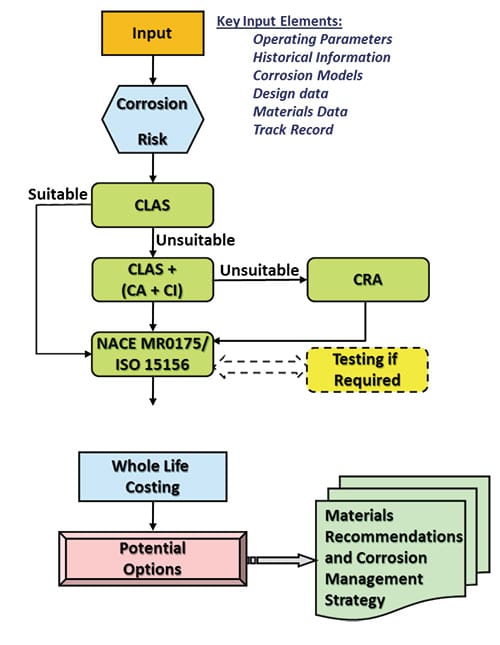
A materials optimisation strategy requires an integration of all the above key parameters to allow the selection of the most suitable, safe and economical material option and corrosion control procedure.The parameters in such a strategy should take advantage of two key elements of trusted/proven methods reflecting past experience as well innovative solutions. Considering the above elements, the methodology described here has adopted a stepwise process by first exploring the feasibility of using CLAS followed by its use in combination with corrosion inhibition (CI) and/or a corrosion allowance (CA). If this approach is not feasible, then corrosion resistant alloys (CRAs) need to be considered, all based on whole-life costing.
Governed by system corrosivity and the feasibility of corrosion mitigation measures, materials are selected accordingly. It is important to note that while CLASs are chosen primarily according to their general and localised metal loss corrosion resistance, with adequate resistance to different types of H2S induced cracking, CRAs are normally selected primarily based on their resistance to environmental induced cracking.This latter threat includes sulphide stress cracking and chloride stress corrosion cracking or a combination thereof, as affected by the operating temperatures and conditions.The exception for CRAs is under extreme conditions – typically a combination of high temperature, low pH, high CO2 and H2S – where general corrosion may also, or exclusively, have to be considered in the overall selection strategy.
The simple overall approach to the optimisation strategy, shown in the figure, captures these necessary steps in finalising the materials choice. This simplified roadmap includes several key elements taking on board and incorporating (i) corrosion risk evaluation, (ii) operating conditions, (iii) corrosivity assessment, (iv) erosion velocity, (v) window of application of individual alloy, and last but no least (vi) whole life costing of potential materials options and corrosion mitigation methods. The simple methodology is based on utilisation of past successes and lessons learnt in effective use of CLASs and integration of key parameters to allow the selection of the most suitable, safe and economical material option and corrosion control measures.
The roadmap follows a methodical route to highlighting options and the most appropriate and cost effective materials, and outperforms similar models through the unique integration of key parameters.The strategy is applicable to optimisation of materials for all applications including downhole completions, surface and transportation facilities.
A distinction should be made here between materials used for subsurface (wells), where welding and CA may not be applicable, in contrast to materials for above surface facilities (subsea, topside or transportation) where corrosion mitigation in the form of CI deployment, or CA, become feasible.
Throughout the process, in the absence of reliable data, a methodical approach to performance evaluation needs to be put in place and be implemented.This provides a flexible structure to allow realistic testing to enable input of complementary data to provide further confidence on their application.
Mitigating corrosion of embedded rebar is a perennial problem for reinforced concrete structures, requiring preventative maintenance and repair. Topical corrosion inhibiting treatments require a clean, properly prepared surface area to work as intended, however according to the company, Cortec’s new MCI®-2020 Gel is designed to work when proper surface preparation cannot be achieved, or is economically undesirable, by delivering its “Migrating Corrosion Inhibitor”™ technology directly to the depth of reinforcement.
The gel is an injectable corrosion inh ibitor that provides a robust dose of corrosion protection directly where it is most needed. Once inside the concrete, the inhibitor can also move laterally through the concrete along the embedded reinforcement via liquid and vapour diffusion.The corrosion inhibitor molecules deposit on metal surfaces, forming a molecular layer that acts as a barrier to corrosive elements such as chlorides and from carbonation.
It is considered a mixed inhibitor that protects against corrosion at both the anodic and cathodic areas of a corrosion cell. Unlike some of its competitors, it does not contain secondary amines or nitrites, which together can form carcinogenic nitrosamines.It is also non-flammable and non-combustible, and can be used in almost any concrete repair or maintenance application, concluded the company.
We use cookies to optimize our website and our service.
Functional
Always active
The technical storage or access is strictly necessary for the legitimate purpose of enabling the use of a specific service explicitly requested by the subscriber or user, or for the sole purpose of carrying out the transmission of a communication over an electronic communications network.
Preferences
The technical storage or access is necessary for the legitimate purpose of storing preferences that are not requested by the subscriber or user.
Statistics
The technical storage or access that is used exclusively for statistical purposes.The technical storage or access that is used exclusively for anonymous statistical purposes. Without a subpoena, voluntary compliance on the part of your Internet Service Provider, or additional records from a third party, information stored or retrieved for this purpose alone cannot usually be used to identify you.
Marketing
The technical storage or access is required to create user profiles to send advertising, or to track the user on a website or across several websites for similar marketing purposes.