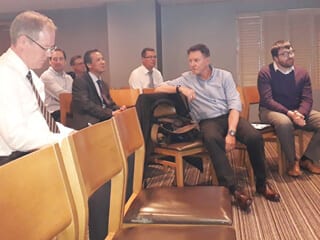
The March meeting was an industrial event at ICR, Bridge of Don, with group presentations and demonstrations of three of ICR’s core business activities.
ICR have specialised tooling and trained engineers, who deal with the insertion and retrieval of corrosion monitoring coupons in live pipeline valve stations (Online Retrievals).
Pre-installed fittings on the pipes allow threaded plugs which carry the mounted coupons to be inserted into the pipe.
This is carried out using either mechanical or hydraulic, telescopic portable tooling which can introduce, through the valve gate, fresh coupons of prepared carbon steel which then sit within the line for the study period.Recovery of the coupons allows for weight loss assessment and corrosion pattern studies, which can be used to evaluate the corrosive nature of the fluid and help to provide remedial measures, such as chemical injection solutions.
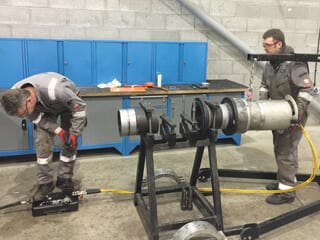
ICR also offers on-site weldless, flange to pipe connections which are carried out using a hydraulic colleted + ram system. The flanges to be fitted to the pipe have an annular groove in the inside into which the wall of the pipe can be expanded using tooling inserted inside the pipe end. The hydraulic ram contains a split collet which expands inside the pipe and forces a ring of the pipe wall into the flange grove. This provides a weldless metal to metal gas tight seal which is dressed each end with sealant to prevent water ingress to the junction. This can be performed on pipe to flange connections in any remote situation with 3” to 15” pipes.
A full demonstration of the operation was performed on 10” pipe using the hydraulic compressor and ram, and sectioned flanges were offered to the audience as proof of the integrity and bond.
Finally, a presentation was made on engineering repair solutions for pipe work and structural beam strengthening.These composite repairs use glass and carbon fibre cloth which is soaked in epoxy and then systematically wrapped around surface-prepared pipes, T-junctions elbows or structural beam sections, to cover and reinforce damaged or thinned areas of pipe or steelwork. The wrapping fibre used has a woven nature and anisotropic strength. Once wrapped, a compression bandage is added and within 24 hrs, the epoxy laden fibre will reach its full cured strength. The wrap system is ideal for situations were emergency or temporary repairs are required, but is often suitable for longer term fix until major maintenance programmes are permissible. ICR are also able to wrap pipes under service and low pressure which are leaking. A flanged threaded plate is fitted into the leak and a hose added to divert the leaking fluid while the pipe and edge of the plate are wrapped in the composite. Once the wrap has cured, the threaded plate can be fitted with a blanking plug to reseal the pipe.
At the close of the industrial visit, the Chairman, Dr Yunnan Gao, presented ICR with a certificate of appreciation. Further industrial visits are planned for September 2019 (NCIMB Microbial Laboratories) and March 2020 (Oceaneering NDT).
The April event was the annual joint meeting with the MCF (Marine Corrosion Forum) where the branch were very
pleased to welcome Scaled Solutions Ltd of Edinburgh, to talk on their recent R&D findings into the performance and optimization of corrosion inhibitors, including those for demanding HP (12,000 psi) / HT (300 C) operations.
(The Scottish Government recently recognised Scaled Solutions’ contribution to Research and Development through the provision of a £2.2M grant award in June 2017, to support R&D in several key areas for the Oil and Gas Production industry. This award, together with significant further investment by Scaled Solutions themselves of £3M, should bring significant cost-saving and corrosion prevention benefits to O&G operations).
It is well known that during qualification of a corrosion inhibitor, it is extremely important to carry out laboratory-based assessments that are prudently representative. However in practice, there are many variables that can contribute to the corrosive nature of a system and it is often costly and time consuming to accurately reproduce all the different field conditions. Because of this, investigations are normally carried out using an iterative screening programme, starting with simple tests, followed by product deselection and then further more complex tests.The simplified screening tests then determine the preferred products and dose rates which can pass to the next stage of testing.It is therefore vital that these initial screening tests are carried out in an appropriate a manner as possible.
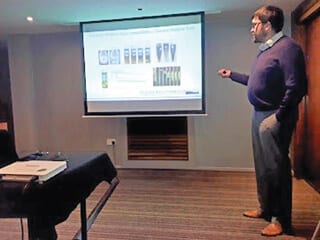
Hunter Thomson explained how Scaled Solutions’ ongoing research into seemingly small changes to test methodologies and conditions in these preliminary screening tests, can significantly influence the outcome of screening studies.A range of corrosion inhibitors based on common chemistries have been formulated by them to test these effects more precisely, and their extensive results to date have illustrated the controlling effect of aspects such as pre-corrosion, the impact of the brine chemistry, inhibitor composition, as well as the effectiveness of partitioning for different chemicals, on the performance and relative performance of different products.
Hunter highlighted how relatively small changes in the methodology adopted, can lead to considerable differences in the observed performance, ranking, and outcome of the
pre-screening of corrosion inhibitor chemicals, and that thorough understanding and careful design of corrosion inhibitor screening programmes are essential to eliminating possible errors and test artefacts.
This most interesting presentation generated many questions and proposals for future work, covering topics such as effects of intermittent chemical injection, surface area and scaling.
At the close of the meeting, the chair presented Hunter Thomson with a certificate of appreciation.
Looking further ahead, the branch will be hosting its annual full-day Corrosion Awareness course on 27th August 2019, (via key sponsor Rosen), comprising of a number of lectures/presentations focusing on microbiologically influenced corrosion (MIC) in pipeline systems. This year’s programme will include talks by ROSEN specialists and other visiting speakers, on their MIC Experiences from global operations covering, sampling, analysis, monitoring of pipelines for mic damage, chemical mitigation / cleaning strategies, and finally inspection, modelling and monitoring approaches.
Most certainly this event will provide a very comprehensive introduction to this very significant and often troublesome area of Corrosion Control/Prevention, and the provisional programme can be found on the Institute website.
Full details of future ICorr Aberdeen events can be found on the diary page of the magazine and on the website, or by contacting: ICorrABZ@gmail.com, and all past branch presentations can also be found on: https://sites.google.com/site/icorrabz/resource-center
The Institute of Corrosion is running meetings of both the Corrosion Science Division (CSD) and the Corrosion Engineering Division (CED) as part of the Electrochem 2019 conference, which is being held from 26-28 August at Strathclyde University, as follows:
1. The Corrosion Science Symposium will include presentations on the electrochemical aspects of corrosion science and will cover state of the art developments in fundamental corrosion science. Presentations will be given in on Tuesday 27th and Wednesday 28th August. This symposium will include presentation of the U.R. Evans award to the 2019 winner, Tetsuo Shoji.
2. The Corrosion Engineering Day will take place on Wednesday 28th August only. In the morning there will be a series of invited lectures from experienced practitioners on the theme of ‘Electrochemical Corrosion Monitoring in Industrial Applications’. This symposium will include presentation of the Paul McIntyre award to the 2019 winner, Steve Paterson. In the afternoon CED working group meetings will take place (Coatings, Oil and Gas, Nuclear, CP, Corrosion in Concrete). A day rate option is available on the registration page for people attending the CED meeting only. Attendance at the working group meetings only is free of charge. Please email Nick Smart (nick.smart@woodplc.com) to indicate which working group meeting(s) you plan to attend.
This year the annual working day of the Corrosion Engineering Division (CED) will take place during the Electrochem 2019 meeting, being held at the University of Strathclyde’s Technology Innovation Centre in Glasgow, Monday 26th – Wednesday 28th August.The CED meeting will be held on the 28th August, and it will be integrated with the Corrosion Science Symposium, organised by the Institute’s Corrosion Science Division.
The programme for the CED part of the meeting will include invited lectures on the theme of ‘Industrial Applications of Electrochemical Corrosion Monitoring’, which will be presented during the morning.Full details of the CED lectures will be published on the conference web site in June 2019, and in the next issue of CM. The lectures will be followed by the presentation of the Paul McIntyre award
to this year’s winner, who will be announced in a few weeks’ time.
In the afternoon there will be an opportunity to join the CED working group meetings.The current working groups are:
nCathodic protection
nNuclear
nCoatings
nOil and gas
nCorrosion in Concrete
The Electrochem 2019 annual meeting is organised by the Electrochemistry, and Electroanalytical and Sensors, Interest Groups of the RSC, and the Society of Chemistry and Industry (SCI). The 2019 meeting will be the 25th anniversary of Electrochem and it will include the 60th Corrosion Science Symposium. Details of the meeting and registration are available at https://www.strath.ac.uk/engineering/chemicalprocessengineering/electrochem2019/.
Attendees are welcome to join any of the parallel sessions that will be running during the meeting.
We are pleased to announce the updated ICATS website has been launched. The address remains the same, http://www.icats-training.org/, but it is more user friendly and works much better with phones and tablets.
As you will be aware ICorr has moved to new offices at Corrosion House, 5 St Peters Gardens, Marefair, Northampton, NN1 1SX.This new facility includes state of the art training facilities where most of our courses will now be presented.
As previously announced, ICATS has also introducing the new ICATS Managers/Engineers Industrial Coating Awareness course. This is a structured training module for managers, engineers, specifiers, and anyone that would benefit from an understanding of coating application.
The module covers:
Health and Safety in industrial painting
Preparation standards
Blasting and abrasives
Mechanical and manual preparation
Other surface preparation methods
Painting specification
Toolbox talks
Paint technology
Galvanic series
Convertible and non-convertible Coatings
Over-painting existing paint systems
Paint manufacturers
Paint failures
QC and QA
The Industrial Coating Applicator (ICA) faces many issues within industrial coatings, and it is recognised that this role can be misunderstood, leading to a potentially dangerous situation, or misinterpretation, and an expectation of what can or can’t be achieved.
These are one-day classroom-based presentations, and the first one is planned for 4th July in Northampton.
The next Supervisor course will be on 2nd and 3rd July, and will also be held in Northampton. Please contact the office, correx@icorr.org, phone 01604 438222, or check the ICATS website http://www.icats-training.org/ for dates and details of all courses.
ICorr/Argyll Ruane has entered into an agreement with PFPNet, the industry body for Hydrocarbon Fire Protection, with a member base of owners/operators, major applicators, and the engineering community, to develop a PFP training course, the contents of which will be developed by PFPNet, working with ICorr, and will be delivered by Argyll Ruane, with the first module is planned to be delivered by the end of this year.
This first course is intended for owners’ inspectors, who are required to inspect PFP coatings, but in addition, other courses are planned, which will include module planned to be delivered for other types of PFP systems, as well as other disciplines within the PFP industry, for example, modules that will supplement professional engineering qualifications, and improve understanding about how PFP should be engineered, specified and installed.
Training will be provided by qualified individuals, and an important part of the overall programme is accreditation of the course, along with qualification of the individuals who successfully complete the training.
A PFPNet conference is planned to be held in Manchester on 5th and 6th June, and there will be a presentation about this new course from Argyll Ruane.
Welcome to the latest edition of Corrosion Management. I have had a lot of positive feedback on the magazine from members recently, particularly regarding the quality of the technical articles, so congratulations to our Editor Brian Goldie on the improvements he has been making. He assures me there is more to come!
This is an exciting time for the Institute, with the recent move to the new Corrosion House at 5 St Peters Gardens in Northampton. Our dedicated office team of Denise, Gwynneth and Sue are now safely installed in the building and the final touches are being made to the furnishings under the watchful eye of Trevor Osborne. On the evening of Thursday 6th June we held a Grand Opening event to celebrate the move to our new home, and all members were warmly invited to attend.
I’m also delighted to announce that Bill Hedges has agreed to take up the vacant position of Vice President of the Institute, subject to a formal vote at the next Council meeting. Bill has been prominent in London Branch activities for many years now, most notably in the development of the Young Engineers Programme, and he brings a wealth of experience and insight from his role as Chief Engineer – Materials at BP. I’m excited about the contribution he can make, and the higher profile he will be able to bring to the Institute during his Presidency.
We have a number of important initiatives coming to the boil at the moment, including a new agreement for provision of ICorr training courses worldwide, a complete overhaul of the Institute brand, a position paper on recruitment and retention of student members, and a proposal for a discounted subscription scheme for retired members. You will be hearing more details about these over the coming months.
In other news, I would like to congratulate one of our members, Liane Smith, who has recently been elected an Honorary Fellow of the European Federation of Corrosion (EFC). This is a significant honour and recognises her impressive contribution to the establishment and continued success of EFC Working Party 13 – Corrosion in Oil & Gas Production. Liane will receive her award at the next EuroCorr conference, which will be held in Seville in September.
Finally, I was privileged to be invited to present the President’s talk at the London branch meeting at Imperial College in March. I chose to discuss the future of the Institute and how we might formulate a longer term strategy to adapt to external drivers, such as the transition to low carbon energy, the digital revolution, the growing generational gap and the UK Industrial Strategy. I was very encouraged by the level of audience engagement throughout the discussion and picked up a lot of great ideas from the members who were there. I plan to repeat the process at the other five branches over the rest of the year and would encourage you all to attend your local branch if you can. Your input is very important to the future of the Institute!
We use cookies to optimize our website and our service.
Functional
Always active
The technical storage or access is strictly necessary for the legitimate purpose of enabling the use of a specific service explicitly requested by the subscriber or user, or for the sole purpose of carrying out the transmission of a communication over an electronic communications network.
Preferences
The technical storage or access is necessary for the legitimate purpose of storing preferences that are not requested by the subscriber or user.
Statistics
The technical storage or access that is used exclusively for statistical purposes.The technical storage or access that is used exclusively for anonymous statistical purposes. Without a subpoena, voluntary compliance on the part of your Internet Service Provider, or additional records from a third party, information stored or retrieved for this purpose alone cannot usually be used to identify you.
Marketing
The technical storage or access is required to create user profiles to send advertising, or to track the user on a website or across several websites for similar marketing purposes.