CEng, IEng and EngTech Members registered or Members hoping to register with the Engineering Council
At present, due to the demise of the Society of Environmental Engineers (SEE), ICorr are not able to register Members with the Engineering Council. A new Registration Agreement with an alternative Engineering Council Licenced Member is being sought to enable ICorr to again be able to provide this service to members.
We will announce here and in Corrosion Management magazine as soon as this service is again available.
This does not affect existing ICorr registrants, who will continue to be registered with the Engineering Council throughout the transition period.
Dear BrianWe are pleased to advise that the funding band for the Material Science Technologist Degree Apprenticeship has been approved. Click here to view the final funding band decision letter.
The apprenticeship is now ready for delivery and details are available on The Institute for Apprenticeships and Technical Education website.
Employers who are interested in having individuals trained on this apprenticeship should contact the universities who have participated in the trailblazer group about its availability and delivery dates. The universities are:
Staffordshire University
The University of Sheffield
Manchester Metropolitan University
Queen Mary University of London
University of Birmingham
University of Derby
Sheffield Hallam University.
We would like to thank everyone involved for all their hard work and support in developing the Material Science Technologist Degree Apprenticeship.
Sir Gerry Berragan, Chief Executive of the Institute for Apprenticeships and Technical Education, has expressed his thanks to all of those involved in the trailblazer group. A copy of the letter can be found here.
If you would like any further information, please do not hesitate to contact us.
The Institute of Corrosion is currently undergoing a rebranding exercise. We are working closely with MD Design Studio and SquareOne who are looking at all aspects of the brand, including a new logo.
Please click on the link below to take a look at the introductory slides which contain extracts from the brand concept presentation and provide a background to the project. You can then see the 3 shortlisted concepts and then answer the 9 multiple choice questions that follow to help us make an informed decision on which design to continue developing.
Your feedback will form an integral part of the project and we welcome as many of you to respond as possible by 14th August 2019.
The survey has now ended, thank you for your feedback
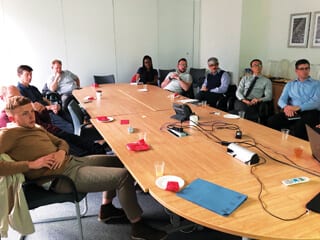
The January meeting was joint with TWI, when Neil Gallon & Michael Young of Rosen presented a talk on Preferential Weld Corrosion (PWC).
This was the first of its type in the North East aimed at creating some synergy between ICorr and TWI.A good crowd over 20+ came to hear the presentation which went into in detail about the differences and complexity of welds in pipelines, and the possibility of galvanic corrosion causing the metal adjacent to the weld being consumed. The heat affected zone (HAZ) can be attacked preferentially to the weld because of changes in morphology and differing galvanic potentials. Potential issues are very difficult to diagnose and therefore a lot of work has been done to understand the effect of adding corrosion inhibitors, for example when they are added to water injection/production pipes to protect the base metal, however this can also cause issues as they do not protect the weld. In these cases the weld can become anodic and preferential weld corrosion can occur.
One very interesting question was asked about the potential ‘double whammy’ of PWC and CUI occurring at the same time. It was confirmed that this could potentially occur if the insulation system was damaged allowing water to enter the system and causing electrolytes to leach from the insulation and gather at the weld.In summary the evening was great success and this type of joint meeting will be used again.
This report was inadvertently published under the Midland Branch in the last issue.
The May meeting was a very interesting presentation on the future of ICorr, by the President, with lots of input and discussions from the branch members.Whilst the meeting was well attended there is always room for more, especially during a presentation by the institute’s President. The role of the Institute in the day to day corporate environment was discussed, with many far reaching improvements being tabled by Gareth.
In September, the branch is hosting a half day event on the Severn Valley Steam Railway, with tours of the engine house and a ride out on a private ICorr carriage, with food and drinks provided. The event is open to all branch sponsoring companies initially as it is being held to thank them for supportingMidlands branch, but tickets will be available to purchase for individuals. This promises to be a great networking event, and more details will be available in
due course.
The branch AGM was held in March, which was followed by the “President’s talk”. The chairman, Paul Brook, reviewed the activities of the branch over the past year and noted that we had had excellent presentations. The Treasurer, Jim Glynn, announced that again our finances were in good shape, and that surplus monies will be returned to head office.Paul then asked if any members wanted to join the committee, and confirmed that existing members were happy to serve for another year. Paul also informed the meeting that the branch is close to completing a venue move from Imperial College, Kensington to the AR offices in Bird Cage Walk, Westminster.This should be a great home for London branch future technical talks, which will restart following the summer recess in October, on the second Thursday of the month as usual. More details will be available on Institute web site in due course.
Gareth Hinds then presented his views onthe future of the Institute, and discussed ways we could adapt to changes, including environmental challenges, the rise of digital communications, and how to encourage more young engineers to join the Institute, and how to support them. This generated a lot of discussion and interesting suggestions.
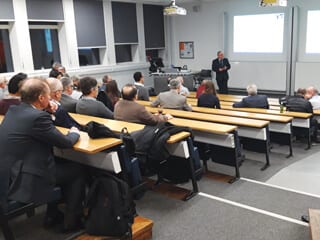
The April meeting, the last of this season, was joint with The Welding Institute, and was given by Alan Denney of TWI, on the subject of “High tensile steel bolts and nuts: hydrogen embrittlement and failure in corrosive environments.’
Alan started by talking about the failure of threaded components used as shear connectors for earthquake resistance on the San Francisco Oakland Bay Bridge, which has been well documented in the technical press in the USA. These galvanised rods (in ASTM A354 grade BD steel) were pre-installed in 2008 in the supporting piers to the bridge superstructure which are above the water level. The superstructure was assembled and in 2013 the rod connectors were pre-tensioned hydraulically to 70% of UTS. A number of these suffered brittle failure, the published cause of which was that the rods failed due to hydrogen embrittlement arising from stress corrosion cracking.
Alan then proceeded to explain the conditions required for stress corrosion cracking, namely a combination of a susceptible material, a source of the hydrogen,and tensile strength above a threshold value. He explained that the hydrogen could be either from internal sources in manufacture, or from an external source. The potential sources in manufacturing include hydrogen retained from steelmaking or hydrogen resulting from pickling of the components prior to coating. The external source would result from corrosion, the hydrogen being generated by the cathodic reaction. He explained that failures can occur in nuts as well as the bolts or threaded rods, and that in galvanized components the zinc acts as a barrier to the outward diffusion of any trapped hydrogen.
Failures of structural bolts have a long history. Alan mentioned that his first encounter with bolts failing from hydrogen embrittlement was in the 1970s on a television transmission tower, with failures occurring in V grade and Y grade bolts on cold nights; the bolts being found on the ground in the morning, and his most recent experience of a failure was a few weeks before this talk. Apart from in transmission towers, such failures have also occurred in the recent past on prestigious building structures, and in offshore wind turbine towers. Recent occurrences known to Alan have been in large diameter high tensile bolts, generally in bolt grades 10.9 and above. He explained that there was a relationship with hardness of the fasteners (both bolt and nut), and covered recommendations in standards such as those published by DNV-GL for offshore wind turbine structures, which limit the highest strength grade to 10.9. He discussed the typical crack morphologies associated with hydrogen embrittlement and how the fracture surface could be ‘read’.
Alan then discussed some of the metallurgical aspects in bolt and nut materials and the recommendations and findings of work carried out by the Deutscher Schraubenverband (DSV) in relation to the desirable elements in the composition, and their proposed limits on chemical composition. He presented some findings from DSV on the failure thresholds in 10.9 bolts under ASTM F1624 test conditions with different coating types and then finished by summarising the findings:
nThere is a risk of stress corrosion cracking with the use of fasteners with a UTS > 1000 N/mm2 in a corrosive or marine environment.
nThe much-quoted guideline of 380 Hv as the threshold for stress corrosion cracking is not conservative, notably when there is a risk of external corrosion, even during temporary conditions.
nControls which will improve their performance in marginal situations can be put in place for the bolt materials, their heat treatment and metallurgical controls, their coating systems and application, and their quality control and testing requirements .
However the main means of avoidance of SCC is to control the environment.
There was a lively question and answer session, with interesting contributions from the audience and the meeting was closed with a vote of thanks and a presentation to the speaker.
We use cookies to optimize our website and our service.
Functional
Always active
The technical storage or access is strictly necessary for the legitimate purpose of enabling the use of a specific service explicitly requested by the subscriber or user, or for the sole purpose of carrying out the transmission of a communication over an electronic communications network.
Preferences
The technical storage or access is necessary for the legitimate purpose of storing preferences that are not requested by the subscriber or user.
Statistics
The technical storage or access that is used exclusively for statistical purposes.The technical storage or access that is used exclusively for anonymous statistical purposes. Without a subpoena, voluntary compliance on the part of your Internet Service Provider, or additional records from a third party, information stored or retrieved for this purpose alone cannot usually be used to identify you.
Marketing
The technical storage or access is required to create user profiles to send advertising, or to track the user on a website or across several websites for similar marketing purposes.