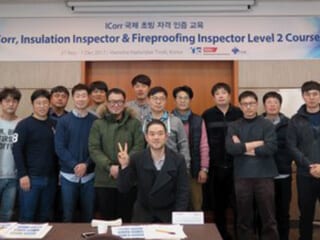
An increase in demand for ICorr certification courses is leading to an increase in international delivery of the Paint Inspector, Fireproofing and Insulation Inspector and Cathodic Protection Technician courses, and recently, ICorr trainer Nigel Peterson-White delivered Fireproofing and Insulation Inspector Level 2 courses to 18 delegates in Busan, South Korea. The high calibre attendees came from multinational organisations such as Samsung, Daewoo and Hyundai, and working in industries such as shipping, marine and oil and gas.
Delegates completed 5 days of training and examinations covering the inspection of common types of passive fire protection as well as both thermal (hot and cold) insulation and acoustic insulation.
This training was arranged in conjunction with the Corrosion Science Society of Korea (CCSK). The CCSK is a technical society devoted exclusively to scientific and technical activities relating to corrosion and corrosion prevention.
Full details of all training and Qualification courses available, and dates of these, can be found on the Institute website.
The 2018 CED working day meeting will be held at the Birchwood Park Conference Centre, Warrington, on Tuesday 24 April 2018 on the subject of ‘Atmospheric Corrosion in Industrial Applications’. An information and registration leaflet is included in this issue of Corrosion Management.Exhibition space will be available for hire.
The Coatings Working group has prepared a series of guidance documents on the following topics:
• Inspection and testing of coatings
• Organic coating application methods
• Surface Preparation methods for coating application
• Paint: a definition and generic organic coating types
• Thermal metal spray coatings
• On-site and off-site application of intumescent fire and corrosion protection coatings for steel structures
These documents are now available through the members’ area of the Institute’s web site.If you have any comments on them please send them to admin@icorr.org
The AGM was held in November in Birmingham after a very successful half-day technical meeting, and my thanks go to Midland Branch for once again organising these events in such a wonderful location.Hence it has now been over 12 months since John kindly passed the chain of office over to me, and the time has flown by.I am not sure if that is because of the fun I have been having or how busy we have been!
During the year the ICORR and CORREX teams have continued to work hard on our behalf in our temporary home in Barrett House, and Trevor Osborne is continuing to search for a property which we can purchase to give us a more permanent home.However in the meantime, the lease on Barrett House has been extended until July 2018.
During 2017 we ran the first “Fundamentals of Corrosion” and “Marine CP 2” courses both of which generated a lot of interest, and we will run a number of these courses again this year. Part of our development plan for 2018 is the introduction of new courses to complement our existing portfolio and to meet the market and membership needs.There are plenty of opportunities on the horizon for further increases in corrosion-related activity both in the UK and overseas, particularly in the field of training.
The Route to Chartership Initiative has been a major piece of work this past year and we are now in the process of running the first pilot. If this appeals to any of you, please contact David Mobbs via head office.
As you will see later in the magazine, ICorr, through Correx Ltd, is hosting the CEOCOR Congress in May 2018 at the Crowne Plaza in Stratford-on-Avon.The congress programme is being prepared by CEOCOR and ICorr will host the event, and have already obtained sponsorship and arranged a supporting exhibition and an accompanying person’s programme
Individual membership of the Institute is up from last year and our Professional Members also continue to grow.Our student members have also grown, but we are seeing a decline in ‘Young Engineers’, which reflects the smaller number of graduate recruits in many of the Engineering Houses.However, during 2018 we will once again be running a Young Engineers course aimed at supporting and encouraging young graduates to flourish in the corrosion industry, and I attended the first evening session which was kindly hosted by CB&I in Paddington.
The level of volunteering within the Institute, which keeps it operating efficiently is very impressive, much of which is not publicised. However the pressure of day jobs is making volunteer work more difficult and ICorr is finding that it needs to pay for some of the tasks that need to be completed on its behalf if we are to continue to grow, as a result we have now appointed a part time Business Development Manager, David Mobbs, who started with us on 1st February.
Finally, It is with great pride that I get to visit our branches and see the strong and active organisation we are, and I hope to continue this in 2018, and thanks go to all the members who give us their time for these local events.
WELCOME to our 173 new members and 13 Sustaining Company Members who joined the Institute in 2017.
TOGETHER WITH THE CONGRATULATIONS of the Institute to all the following members who have attained Professional Status in 2017.
Technician
David A Wilson Keith M Wagner James A Ahern Rahul Albert Stephenson Chandresh Ellathuvalappil Nilesh Panchal David Kerr Allen McGee Thomas D Lamb
Professional
Rajasekaran Karthikeyan Alistair Crichton Christian A Lewis Maria Arul Antony R Simeon Nnamdi Okara Ajay Kumar Ricardo Filipe Benjamin J Fellows Neil J Munro Asad Ali Stewart W Gilchrist Steven Brierley Christopher J Everett Amr El-Sayed Saleh Hussein Shan Mohan Castelino Adaikkalam Chidambaram Robert W Burrows Mohammad Hosseini Stephen F Tate Ankit Trivedi Mark A Gough Peter H Smithson Ahmed Asad Naveed Ul-Hassnan Marc Childs William J Smith Mudjat Savran Kamran Anjum Thomas Whittleton Azaz Mohammad Yunus Memon Muhammad Hussain Kausar Fatima Saifee Shady Abdelsalam Abdelhamid Hassan Nikhil Paliwal Anthony Davidson
Fellow
Edward J Boran Lee Wilson Mohsen Mazraeh Amit Kumar Jane P Lomas Zia H Chaudhary Muhammad Arsalan Khan Sherwani Mobeen Hassan Robert W Flannery James A Seton Muhammad Ejaz Graeme Jones Royden de Souza Robert J K Wood William Reid Varghese Chakko Nettikaden
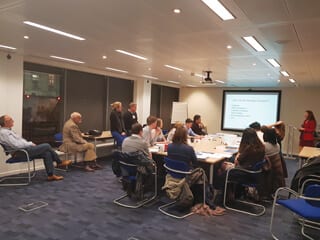
The first presentation of The Young Engineers Program (YEP) also start at CB&I in London with an excellent presentation on the Basics of Corrosion by Jane Lomas. The event was opened by Bill hedges of BP and continues through the year with 9 modules including a Case Study which the delegates will present back at the London Branch meeting in November 2018.
The discussion was all encompassing but dealt with the basics of corrosion from first principals;
Basic Principles
Anodic and Cathodic Areas
What Controls Corrosion rates
Corrosive Environments
Common Types of Corrosion
Pitting
Crevice attack
Galvanic corrosion
Stray current corrosion
Stress corrosion cracking
Microbially induced corrosion
The group enjoyed a networking session after the meeting at a local restaurant courtesy of The Institute of Corrosion.
The next YEP meeting will be Welding and NDT Techniques to be presented by Alan Denney on Wednesday 21st February at CB&I in London.
We are extremely grateful to Jane Lomas and Sadegh Parvizi at CB&I and all the other members of ICorr that give up their time freely to assist our Young Engineers with their career development
For complete article of the newsletter please click link below;
This presentation introduced and explain the benefits of Stress Monitoring in Pipeline Integrity Management. The technique is the only inspection technique that can simultaneously map the lateral position and depth of cover of the pipeline whilst also providing comprehensive defect detection. Moreover, it provides additional deliverables that anticipate the increasing demand of pipeline regulatory authorities such as the location of casings and wrinkle bends.
Hamed talked the audience through the benefits of using this method which is developing to be known as silver bullet of pipeline integrity as it is the only method of measuring stress in pipeline wall. He explained the physical principles of the method that is also capable of measuring the depth of cover, lateral position and detecting welded joints. Specifications of this innovative method was detailed in terms of achieved performance in field trials which took loads of interests among audience. Loads of case studies were explained by the speaker to display the advantages of this the technique over traditional inspection methods in special cases. The technique which also is named Stress Concentration Tomography is able to assess condition of buried pipelines remotely without any dependency to a specific type of defect, manufacturing size, construction configuration or operating condition that will save a considerable amount of time, effort and budget while it will also provide an accurate 3-dimensional mapping of pipe and surrounding objects.”
For full article of the newsletter please click link below;
We use cookies to optimize our website and our service.
Functional
Always active
The technical storage or access is strictly necessary for the legitimate purpose of enabling the use of a specific service explicitly requested by the subscriber or user, or for the sole purpose of carrying out the transmission of a communication over an electronic communications network.
Preferences
The technical storage or access is necessary for the legitimate purpose of storing preferences that are not requested by the subscriber or user.
Statistics
The technical storage or access that is used exclusively for statistical purposes.The technical storage or access that is used exclusively for anonymous statistical purposes. Without a subpoena, voluntary compliance on the part of your Internet Service Provider, or additional records from a third party, information stored or retrieved for this purpose alone cannot usually be used to identify you.
Marketing
The technical storage or access is required to create user profiles to send advertising, or to track the user on a website or across several websites for similar marketing purposes.