



Prestigious Engineer Training for Young Engineers

Prestigious Engineer Training for Young Engineers

What engineer training is best for young engineers?

Despite the UK government pushing engineering as a career choice in 2018 (the ‘Year of Engineering’), apprenticeship starts fell by 2.5% in engineering and manufacturing technologies between 2017/18 and 2018/19 (House of Commons Library Apprenticeship Statistics). That’s bad news in a sector that is suffering from a skills shortage, and in which it is estimated that 203,000 people with Level 3+ engineering skills will be required each year to 2024 to keep pace with demand.

To combat the skills shortage in UK engineering, it is incumbent on the industry to ensure that young engineers have access to the very best engineer training opportunities. Here at the Institute of Corrosion we are committed to professional development and training, with a particular focus on our early career members.

In this article, you’ll learn more about one of the most prestigious training initiatives for young engineers – the Young Engineer Programme (YEP).

Investing in the future
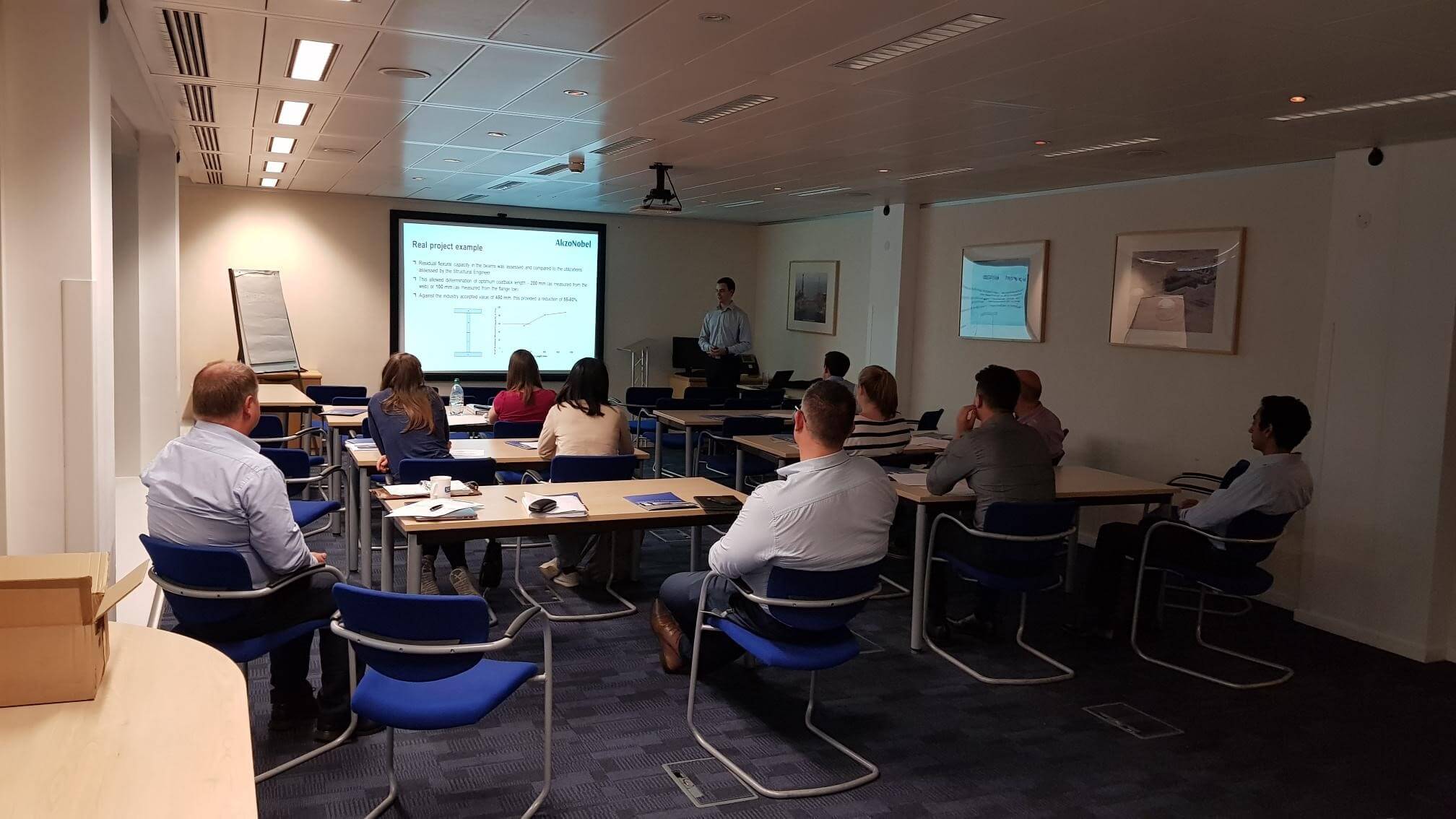
young engineer training in classroomAt the back end of 2018, Argyll Ruane noted that ICorr are investing in the future with initiatives that focus on attracting the younger people from our community. It noted the success of Young ICorr, the redevelopment of inspector training, and the new engineer training programmes such as ‘Fundamentals of Corrosion.

The Young Engineer Programme is pivotal in the development of young engineers.

What is the Young Engineer Programme?

Designed for the engineer who has been practicing in industry for a few years but wishes to develop their skills and knowledge more broadly, the Young Engineer Programme is an 11-month programme run every two years.

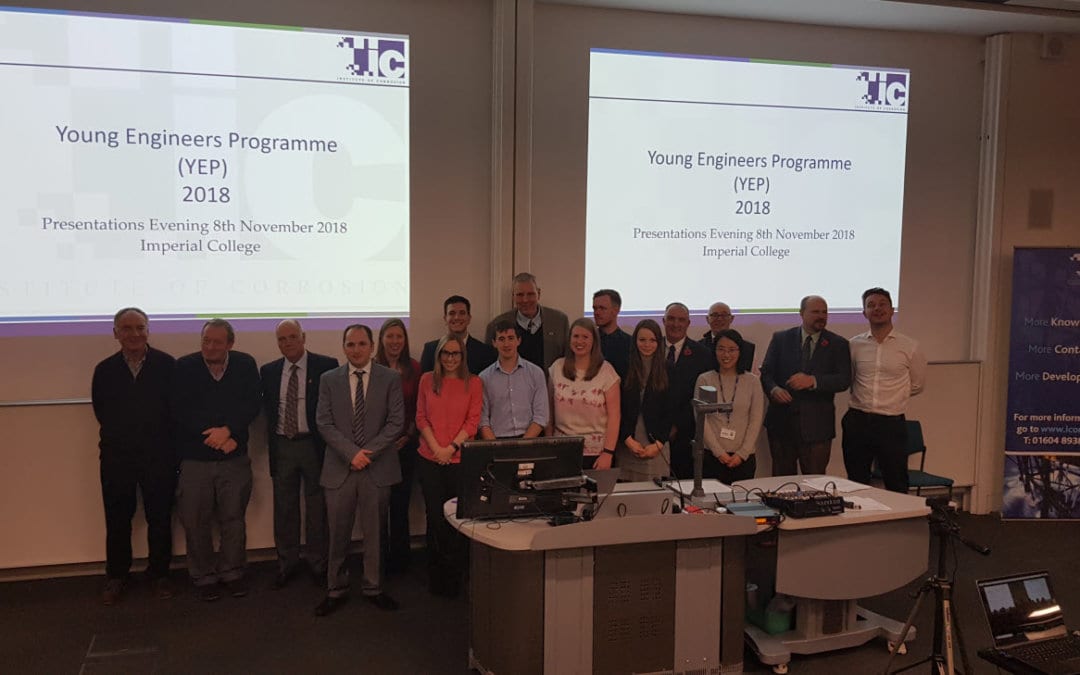
The 2018 programme reached its climax in November 2018, when teams presented to a judging panel, with the winning team crowned and given its reward – a trip to the NACE Corrosion Conference & Expo 2019.

How could the Young Engineer Programme benefit you?

The Young Engineer Programme provides a threefold process of learning:

  1. Delegates receive a series of lectures from industry experts in a range of subjects. This helps them broaden their own knowledge outside their own specific area of industry.
  2. Delegates then work in ‘project teams’ of four. The objective is to collaborate to discuss a real-world corrosion case study provided by an industry partner and come up with a practical engineering solution.
  3. The teams make a presentation of their findings to a panel of ICorr judges and the winning team gets to attend the NACE Corrosion Conference the following year.

In this way, delegates broaden their knowledge, improve their collaborative and project management skills, and develop their communication skills.

Other benefits of becoming a delegate on the Young Engineer Programme include expansion of your professional network and, of course, a major plus on your CV.

You receive mentoring throughout the Young Engineer Programme

mentoring for young engineersWith the group of young engineers split into teams of four, each team is assigned a dedicated mentor. It is the mentor’s job to ensure that their team stays on track and works as a team. The mentor will make sure that the team answers the questions raised by the case study.

As a delegate, you and your team will meet face-to-face with your mentor during the May to November period of the programme. You’ll also meet with your mentor on Skype, and the mentor can ask the author of the case study any questions that your team may have.

What do delegates say about engineer training during the Young Engineer Programme?

Word gets out when engineer training does what it says on the tin – and then some. Responses from 2018 delegates included:

This programme has altered the way I think about my work and how I carry it out.

I hadn’t realised the value of ICorr and I will go back to work on Monday and encourage them to engage.

A senior engineer in the ICorr fraternity said:

This is probably the most important function in the UK Corrosion calendar, it’s truly fantastic.

How do you join the Young Engineer Programme?

The Young Engineer Programme runs every two years. We open the programme to applicants in the September of the year before the programme starts and email our entire membership about the programme prior to this. We also send personal emails to the engineering community.

The programme has exploded in popularity. In 2018, there were 12 delegates in three teams of four who presented their findings on the case study. The current crop numbers eight teams of four. We expect programme applicant numbers to increase further next time round.

To ensure you learn of the next Young Engineer Programme at the earliest opportunity, we recommend that you become a member of the Institute of Corrosion. There are several grades of membership.

The Young Engineer Programme – a summary

As a ‘cradle to grave’ organisation, we support our members with engineer training throughout their career, from apprenticeship to Chartered Engineer status. Young ICorr (aimed at young professionals aged 35 and under) has an expanding membership base, supported by ICorr initiatives such as our free student membership.

The Young Engineer Programme is an invaluable addition to our training initiatives, helping you to expand your knowledge and network, improve your competencies and capabilities, and add prestigious training and development experience to your CV.

To learn more about the Young Engineer Programme, visit our YEP pages or email the Institute of Corrosion at admin@icorr.org.

Winner of the Photo Competition

Winner of the Photo Competition

As has already been announced, the Institute has a new image and this will involve rebranding of the website, stationery, documentation and marketing material, and of course this magazine.  To help with this new image, the Institute launched a photo competition to find images that are people-focused and celebrate the people that make ICorr, or capture a wide range of activities, such as people networking, working on-site, people in labs, people inspecting, or people achieving accreditations and awards, rather than tired-looking images of rusty components previously used. The designers were looking for uplifting photos of pristine, gleaming infrastructure to emphasise that our members get things right!

The winning photo of an under-deck inspection on an offshore wind turbine jacket, picked by a panel of ICorr judges, was submitted by Simon Dunn, Dangle Ltd, and is featured on the cover of this issue of the magazine.  It will also feature on the landing page backdrop of the rebranded website.

Unlocking and Managing the Effects of Corrosion

Unlocking and Managing the Effects of Corrosion

Fundamentals of Corrosion Explained

The effects of corrosion include the ultimate destruction of possessions and products (if the product is left untreated) and a real but hidden financial cost. That cost of corrosion is passed onto consumers and businesses – and it’s colossal.

A two-year study by NACE put the corrosion cost at $2.5 trillion each year, or around 3% of global GDP. The study also estimated that implementing best practices in corrosion prevention could result in as much as $875 billion in savings. Imagine the positive effect that releasing this cash could have on world economic growth.

In this article, we briefly discuss the fundamentals of corrosion – the who, what and how of corrosion management.

Who is affected by the effects of corrosion?

There is not a single life on this planet that is not affected by corrosion. Of course, those in developed countries suffer a greater direct impact, but corroded metals seep into the earth, rivers, seas and air. As do chemicals and other hazardous materials which escape because of corrosion in pipes and tanks. Eventually this pollution goes global.

Even more serious than the cost of corrosion is the impact it has on our safety. The effects of corrosion of steel reinforcing bars in concrete can lead to collapse of buildings, bridges and roads. Corrosion of components in planes, trains and automobiles can have disastrous consequences.

Energy and utility companies are in a constant battle against corrosion, with the effects of corrosion causing disruption and cost from drilling platforms to domestic pipelines.

Corrosion causes financial costs, health and safety issues, and loss of life. It’s unsightly and depletes the world’s natural resources.

At the forefront of corrosion prevention are engineers, paint inspectors, designers, technicians and scientists. Engineers in civil, mechanical and naval fields are continually assessing potential or actual corrosion and incorporating anti-corrosion measures into their projects and work strategies.

What are the mechanisms of corrosion?

Classification of the type of corrosion present is commonly made on one of the following three factors:

  1. The nature of the corrosion (immersed or atmospheric)
  2. The mechanism of the corrosion (electrochemical or chemical reactions)
  3. The appearance of the corrosion (uniform or localised)

There are many techniques and tools that are used to help in the detection and classification of corrosion. Eight common forms of wet corrosion can be identified by their appearance:

  1. Uniform corrosion (when the entire surface is corroding at the same rate)
  2. Pitting corrosion (small holes in the metal)
  3. Crevice corrosion (corrosion that occurs in the gap between two adjoining surfaces)
  4. Galvanic corrosion (corrosion of one metal preferentially to another with which it is in electrical contact)
  5. Erosion corrosion, including cavitation and fretting (degradation of a metal due to the relative motion of a corrosive fluid)
  6. Intergranular corrosion (localised corrosion along the grain boundaries of a metal while the bulk of the grains remain unaffected)
  7. Dealloying (occurring in certain alloy metals, in which the alloy metal loses its reactive element and retains the corrosion resistant element)
  8. Environmentally assisted cracking, such as stress corrosion (cracking caused by tensile stress in a corrosive environment)

To identify some of these types of corrosion, you may need to use advanced techniques such as optical or electron microscopy.

How can you manage corrosion?

There are five principal strategies in corrosion prevention:

1.      Selection of materials

Some metals are highly resistant to corrosion (such as gold and platinum), while others have a low resistance to corrosion (like sodium and magnesium).

By using appropriate metals (or alloys) for specific use and environment, engineers can increase the life of products. Their cost is obviously a very important factor in this decision.

2.      Inhibitors

Some chemicals act to inhibit corrosion. These include silicates, phosphates, nitrites, and organic amines. Inhibitors are generally preferred in closed systems where the presence of the inhibitor can be more easily maintained (for example in heating and cooling systems towers).

3.      Coating

Coating isolates the metal from the corrosive environment surrounding it. The coating may be metallic (for example, tin-plated steel). They may also work like galvanised steel in which the coating corrodes in preference to the metal beneath. Coatings are commonly non-metallic, such as paint, and may be either organic or inorganic.

4.      Cathodic protection

Cathodic protection works by applying an external electrical current so that the corrosion reaction takes place on a separate surface to the metal to be protected, with electrons forced to flow to the metal that is to be protected.

5.      Design

Designing products and structures to eliminate or minimise the potential for corrosion helps to reduce maintenance and repair costs and time; for example, by designing structures with fewer crevices in which corrosion often develops.

Obtain Professional Membership of ICorr with ‘Fundamentals of Corrosion’ training

For all who want to expand their career opportunities or wish to expand or refresh their knowledge of corrosion, the Institute of Corrosion offers the five-day Fundamentals of Corrosion for Engineers Course. Successful completion of the course is required to obtain Professional Membership of the Institute of Corrosion if you don’t have either formal qualifications in corrosion or relevant experience.

The interactive course takes place in a classroom format. During the first four days, your time will be occupied by talks and practical sessions. On the last day, there is a short review and an examination. In the course, you will learn:

  • Basic corrosion science and corrosion mechanisms
  • The electrochemical series and its practical uses
  • Corrosion prevention and management methods
  • The basics of cathodic protection
  • Surface preparation challenges, paints and coatings
  • Corrosion and environmental conditions
  • The basics of material selection and design
  • The basics of corrosion testing and monitoring

Presented by Dr Jane Lomas, a corrosion and coatings engineer with more than 30 years corrosion experience, and guest presenter Dr Les Callow, a metallurgist and corrosion engineer with more than 40 years of corrosion experience across multiple industries, this course redefines training standards in fundamentals of corrosion.

For more information and dates of upcoming Fundamentals of Corrosion courses, click here.   Places on this course are strictly limited to 10 people.

William Michael (Bill) Cox (14 Apr 1950 – 3 Dec 2019)

William Michael (Bill) Cox (14 Apr 1950 – 3 Dec 2019)

William Michael (Bill) Cox (14 Apr 1950 – 3 Dec 2019)

I first met Bill shortly after I joined the UMIST Corrosion and Protection Centre in 1983. I had been interested in corrosion sensors for detection of hydrogen, and had several discussions with him about the feasibility of the various available corrosion detection methods (mine was useless!). He always focussed on the argument that there was no point knowing whether corrosion was happening unless you also were prepared to intervene to manage the corrosion process. However, at the time industry was more interested in repair after failure rather than management of the processes leading to failure. Of course, being 10-15 years’ ahead of the game Bill was exactly right and over his career he became one of the leading figures in risk and asset management of plant where corrosion is generally the dominant failure process.

Born in Keithley in Yorkshire, Bill was a boy soprano and chorister, he played the piano and the guitar, he was a keen motorcyclist and owner of a vintage BMW K100RS, a very devoted family man, and a serial speeder in either of his two elderly Audis.  He completed his undergraduate studies in metallurgy on a sandwich course at the University of Aston in Birmingham in 1975 during which time he met the ‘girl’ who was later to become his wife.  On completion of the programme he went to work at the copper-nickel smelter in Selebi Phikwe in Botswana.  He loved working with hot metal and the problem solving involved with developing the plant in harsh working conditions.   

In 1978 he moved back to the UK to study for an MSc in Corrosion Science and Engineering at the University of Manchester Institute of Science and Technology (UMIST) and in the same year married Anna. After completing his MSc he stayed on to undertake a PhD with John Dawson on “Acid Dewpoint Corrosion”, a problem that was beginning to become of significant commercial concern particularly in power generation and steam-raising plant. Graduating in 1981, he linked up with the Corrosion and Protection Centre Industrial Service (CAPCIS) to develop expertise in, and to market, the on-line electrochemically based corrosion monitoring methods that he had pioneered during his PhD. Working with John Dawson, Steve Turgoose, Graham Wood and Howard Stott from the academic side and, from CAPCIS and industry, with Dave Geary, Dave Eden, Jim Palmer, Bob Eden, Karel Hladky, Les Woolf, Dave Farrell, Paul Bottomley, Barry Meadowcroft, Kevin Lawson, Wai Him, Wai Yeung Mok, and many others. He rapidly developed a significant business based on electrochemical noise instrumentation and sensors that enabled tight process control to be introduced to minimise the conditions leading to corrosion damage. This business eventually become Capcis-March Ltd., for which Bill was managing and operations director – one of the first successful companies to be spun out of UMIST. After 16 years at Manchester he left to found Corrosion Management Ltd, promoting his expertise in the application of advanced corrosion monitoring with risk-based inspection and risk based maintenance technologies for the process industries, as well as general failure investigation and litigation work. His client base was worldwide with projects in Europe, North America and Pacific East Asia.

A strong supporter of ICorr (as Member of Council and of the Training and Certification Board for 20 years and President from 1996-98), IOM3 (as Member of Council from 1993-2003), BINDT (as member of the PCN Certification Board) and NACE (as both Member and Chair of its International Relations Strategy Operations Committee) and was a Fellow of all of these Institutions, the last being a singular Honour. As well as attending (and organising) many conferences, seminars and publishing more than 32 papers, Bill also found time to act as Technical Advisory Editor for Anti-Corrosion Methods and Materials for over 10 years, significantly increasing the journal’s profile.

Well known for his eponymous number plate “B111 COX”, acquired after a nudge from Les Woolf, Bill directly launched and influenced the careers of many people now in senior positions in the corrosion industry. He was always generous with his time and was ever willing to provide advice and mentoring to anyone who asked. Creditably, he always did what he said he would do with energy and enthusiasm, he was straight talking and importantly also straight doing. He is a huge loss and we shall all miss him. The corrosion community has lost one of its great characters.

Bill is survived by his wife Anna and daughter Ella.

With thanks to former colleagues, friends and family who corrected the detail and supplied anecdotes too numerous to mention.

© Stuart Lyon, Corrosion@Manchester, Dept. of Materials, University of Manchester.  Licenced under CC-BY-NC

Midland Branch AGM

Following a very successful half day event and AGM in 2019, the branch plans to start 2020 with a meeting at the end of Feb (date and venue to be confirmed), with Prafull Sharma from corrosion radar presenting ‘Corrosion Under Insulation online monitoring with Electro-Magnetic Guided Radar (EMGR)’. CUI is a big issue for the corrosion industry therefore any innovative monitoring system will be very beneficial in the goal to mitigate corrosion. It is therefore likely to be a well-attended meeting.

For any branch queries, please contact Bill Whittaker, bwhittaker@cathodicengineering.co.uk, or Paul Segers, paul.segers@segcorr.com