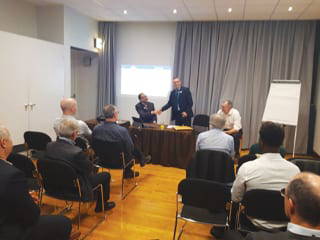
The 2019 branch luncheon proved to be another great success, as the audience was bowled over by an enthralling guest appearance from legendary cricket commentator Henry Blofeld OBE. The unmistakable voice of the Test Match Special, regaled the crowd at the Royal Overseas League in Mayfair with stories from his 45-year career behind the mic, and his two books, which he happily signed for guests after the lunch.
Before the 170 guests settled in the Hall of India and Pakistan for the afternoon, the branch team of diligent raffle sellers had time to mingle and raise an approximate £1,650, which will help fund the future branch series of evening lectures. The contribution from Henry was greatly appreciated, as was the involvement of the event’s sponsors, which this year included Winn and Coles, DuraPol, Corrosion Integrity Management, Correx, and CTS.
The annual event also gave guests the opportunity to reflect on those that the industry lost this year, and in particular the passing of Bill Cox. Tributes to him were led by Institute President Gareth Hinds, who gave a superb account of the excellent work that Bill had done for the Institute during many years of service, which culminated in a rousing applause that Bill would have undoubtedly appreciated.
Preparation has already begun for the 2020 Luncheon, as well as a possible summer ball in London 2021, which will celebrate the 25th anniversary of the of the change of name of the Institute from the British Association of Corrosion Engineers (BACE) in 1966 to the Institute of Corrosion Science & Technology , which was the forerunner of the current Institute of Corrosion.
The first meeting of the branch on Wednesday 8th January had 40 attendees and started with an introduction to the new branding concepts for the Institute, which will be launched in February this year, given by Marc Desmeules, who gave a fascinating insight into the process behind designing a new logo which was the start of the rebranding exercise.
The main technical meeting followed which was a panel discussion on the complexities of internal linings, the selection variables and the link to design standards. The first presentation was from Dr Nasa Miskin from DuraPol who gave a presentation on “Corrosion Prevention in Acid Gas Treating Units”, an extremely difficult and complex environment for any lining system. This was followed by a presentation from Simon Daly of Hempel on “Internal Linings; Selection Variables and Link to Design Standards” which culminated in a discussion on the requirements for the new ISO standard for the internal lining of process vessels.
Both presentations are available to view on the Institute of Corrosion website. It was a successful evening and fantastic to see both the young engineers and branch members in discussion over refreshments afterwards.
The March meeting will be the branch AGM, followed bythe chairman’s talk. Please note the date, Tuesday 10th March.
The Institute of Corrosion continues to follow the official UK government guidelines on how to mitigate the spread of coronavirus (COVID-19).
Our major priority is the safety and welfare of our members, officers and staff. Our main office at Corrosion House is open, with appropriate social distancing and safety measures in place for our staff and visitors.
Our training course providers will provide regular updates via their websites.
We appreciate the patience and support of our members in these challenging circumstances.
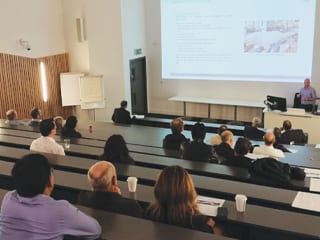
The branch held its 4th event of the 2019/2020 session at its usual venue, RGU, with a presentation on “The Application of bismuth based alloys to address Oilfield challenges” by, Paul Carragher (BiSN), Lance Underwood (BiSN) and Angus MacLeod (BP).
This was a highly successful joint presentation with IOM3 – The Institute of Materials, Metals and Mining, which has recently celebrated its 150 year anniversary. The BiSN speakers discussed in detail their Wel-Lok sealing technology which utilises a unique combination of a thermite powered chemical heater and a bismuth based alloy to deliver an efficient down hole sealing capability, using standard oilfield deployment methods.
The thermite heater provides the energy to melt the bismuth alloy in situ, allowing the heavy liquid alloy to flow by gravity to the desired location. As the bismuth alloy cools, it expands on solidification to provide a seal. Paul Carragher started BiSN in 2010 with the insight to develop new and innovative sealing solutions for the oil & gas industry, and explained the use of bismuth in downhole sealing applications
Lance Underwood, Principal Engineer at BiSN Oil Tools, who has has over 30 years of experience in the industry, then provided further insights into the development of new technologies for plugs for oil wells, covering materials selection, downhole corrosion control and long-term corrosion testing programmes. He illustrated some of the rigorous testing requirements for downhole oilfield tools including bits, mud-motors, turbo-drills, under-reamers, hammers, and laser drilling.
Angus MacLeod (Senior Intervention Engineer with BP), with 22 years Oil and Gas industry experience, then followed this up with some actual case histories from BP operations worldwide, where this technology has been applied offshore, to shut off water production in open-hole gravel pack completions, as well as the work being done to qualify the alloys, as a permanent well abandonment material. In his current role, Angus is responsible for developing new welltechnology as part of BP’s Upstream Technology Group, primarily focussed on “Life of Well Surveillance” and “Plug & Abandonment”. The event generated a huge level of interest and many questions were asked, which can be found, together with the answers, on the branch website.
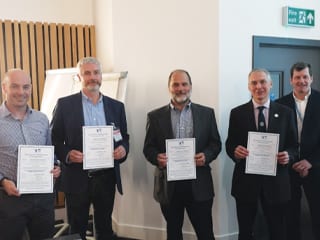
At the close of the meeting, the branch chairman, presented all speakers with a Certificate of Appreciation from the branch.
Full details of future branch events can be found on the diary page of this magazine and on the website, or by contacting: ICorrABZ@gmail.com.
Copies of the majority of past branch presentations can be found at: https://sites.google.com/site/icorrabz/resource-center and a photo gallery for these events is at, https://sites.google.com/site/icorrabz/event-gallery
Particular attention is drawn to the 2020 Corrosion Awareness Day to be held on Tuesday 25thAugust at, Petrofac Training Centre, Forties Road, Montrose, Angus, DD10 9ET. The day will include several practical demonstrations with teaching, this year themed on fabrication and external corrosion management.Further Details about this can be obtained from the branch Chair: Stephen Tate, email: Stephen.Tate@external.total.com
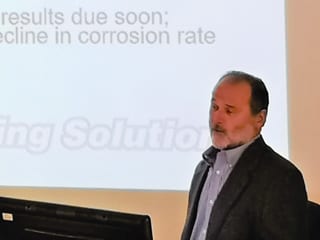
Angus MacLeod highlighted the many practical applications for this new Downhole Sealing Technology.
The Aberdeen Chair Stephen Tate, presented all speakers with Certificates of Appreciation.
Access the Benefits of CEng with Mentorship and Guidance
As your engineering career progresses, a step you’ll want to take is to register as a Chartered Engineer. This professional registration offers many benefits, including industry recognition and higher earning potential.
In this article, we explore the key benefits of Chartered Engineer (CEng) status and walk you through the registration route for members of the Institute of Corrosion.
What are the benefits of registering as a Chartered Engineer?
Being a Chartered Engineer shows that you have the skill set, knowledge, experience and expertise to do what Chartered Engineers do:
“Develop solutions to engineering problems using new or existing technologies, through innovation, creativity and change and/or they may have technical accountability for complex systems with significant levels of risk.”
With a significant upgrade in the recognition of your technical expertise, your CEng status demonstrates that you are committed to continuous professional development to meet evolving needs. This prestigious title offers some real tangible benefits, including:
· You improve your career prospects
Chartered Engineer status is likely to help improve your career prospects among a wider audience of employers.
· You improve your earning potential
According to the 2019 Salary Survey by The Engineer, professionally registered engineers earn substantially more than their non-registered colleagues – almost 25% more. The mean salary for registered engineers is £55,968 versus £45,809 for non-registered engineers.
The salary differential is particularly pronounced in telecoms, utilities and electronics (with an average £18,000 gap) and energy/renewables, and nuclear (with a difference of £13,000). Based on these findings, over 20 years your greater earning potential as a Chartered Engineer might be worth more than £250,000 (and that’s based only on the average difference in salaries).
· Your competence is internationally recognised
The UK standards under which CEng is registered are recognised around the world. You’ll take your improved employability and earning potential with you wherever you travel for work.
· You increase your professional network
As a Chartered Engineer, you become a recognised expert in your field. Should you wish, and with membership of a professional body such as the Institute of Corrosion, this can lead to participation in professional working groups, campaigns, reports, and a wider and deeper professional network.
As a CEng, you become classified as an ‘appropriate person’ under the UK Passport list of occupations. This means that you can certify and countersign applications when documented evidence of identity is required (such as passports and bank accounts).
How do you become a Chartered Engineer?
There are several routes to registration as a Chartered Engineer, based upon your qualifications and experience. Whichever route is most appropriate, you will be assessed across five competence statements:
Knowledge and understanding
Application to practice
Technical and commercial leadership
Interpersonal skills commitment
Personal commitment
Within these competencies you will also be assessed on other elements that include:
Send your application to: The Secretary of the Engineering Council Registration Committee, Institute of Corrosion, Corrosion House, 5 St Peters Gardens, Marefair, Northampton, NN1 1SX, United Kingdom.
Your professional membership status of the Institute of Corrosion is confirmed, and your application is assessed for acceptability and completeness.
Once confirmed as complete, your application is submitted to the next Society of Operations Engineers (SOE) Membership and Standards Committee meeting for review.
The SOE advises the Institute of Corrosion of your most appropriate registrant grade and route and any additional information required.
You will be requested to attend a Professional Review Interview (PRI).
If successful, you will be informed and then invoiced by the Institute of Corrosion for the the Engineering Council UK (ECUK) one-off registration fee and annual registration fee.
Your name is added to the SOE’s register and the SOE informs ECUK who will add you to the register and issue your certificate. Only then can you use your post-nominal CEng.
As part of our commitment to our members, we have established a mentoring programme designed to help ensure that you have the necessary education and experience for registration as a Chartered Engineer. We’ll provide guidance with the assessment of your competency in the field of corrosion engineering, examining your core technical competencies against expected minimum levels for CEng status.
We’ll help you develop a programme that accelerates you to your goal of becoming a Chartered Engineer. This programme may include recommended training and/or conference involvement. We’ll also assist you to complete the application form and we can provide guidance before your PRI.
For more information about the mentoring programme, email the Institute of Corrosion at admin@icorr.org. Or, if you would prefer to speak to us, call us on + 44 (0) 1604 438222.
Start your Chartered Engineer journey today
As a registered Chartered Engineer your competence and capability will be recognised around the world. You are likely to receive a higher salary, and operate within an elite professional network.
Whatever your qualifications and experience, there is a route to CEng. Professional members of the Institute of Corrosion are in an enviable position, with unrivalled mentorship and guidance available – just part of our commitment to our members.
To learn more about the competency standards, visit UKSPEC.
A word from our President
In the latest issue of Corrosion Management, the bi-monthly magazine of the Institute of Corrosion, ICorr President Gareth Hinds says:
“I’m delighted to say that we have signed an agreement with the Society of Operations Engineers allowing them to take over the registration of our CEng, IEng, and EngTech members with the Engineering Council. Huge thanks are due to David Harvey and Bill Hedges for their efforts in securing this seamless transition from the now defunct Society of Environmental Engineers. If you had been holding off submitting an application while this was being sorted, now is the time!”
To enquire about becoming a Chartered Engineer via professional membership of the Institute of Corrosion, email us at admin@icorr.org.
Hodge Clemco Ltd is a UK based manufacturer and supplier of blast cleaning machines, surface preparation equipment and abrasives. They have two manufacturing sites in Sheffield for both equipment and abrasives, and an extensive distribution and stockist network. Hodge Clemco’s wide manufacturing and service capability includes; portable blast machines, expendable and recyclable abrasives, plastic and Envirasponge media and equipment, blast room installations, grit recycling systems, bespoke engineered solutions, blast cabinets, PPE and spares, servicing and training.
Incorporated in 1959, Hodge Clemco have developed into a market leader in the surface finishing industry. Their products are used every day in many prestigious installations for the Ministry of Defence, Lockheed Martin, BAE, BP, Shell and Rolls Royce, to name but a few. Part of the 110-year-old Samuel Hodge Group, Hodge Clemco is part of a diverse engineering group which includes Techniquip, Victor Marine and RLBS.
We use cookies to optimize our website and our service.
Functional
Always active
The technical storage or access is strictly necessary for the legitimate purpose of enabling the use of a specific service explicitly requested by the subscriber or user, or for the sole purpose of carrying out the transmission of a communication over an electronic communications network.
Preferences
The technical storage or access is necessary for the legitimate purpose of storing preferences that are not requested by the subscriber or user.
Statistics
The technical storage or access that is used exclusively for statistical purposes.The technical storage or access that is used exclusively for anonymous statistical purposes. Without a subpoena, voluntary compliance on the part of your Internet Service Provider, or additional records from a third party, information stored or retrieved for this purpose alone cannot usually be used to identify you.
Marketing
The technical storage or access is required to create user profiles to send advertising, or to track the user on a website or across several websites for similar marketing purposes.