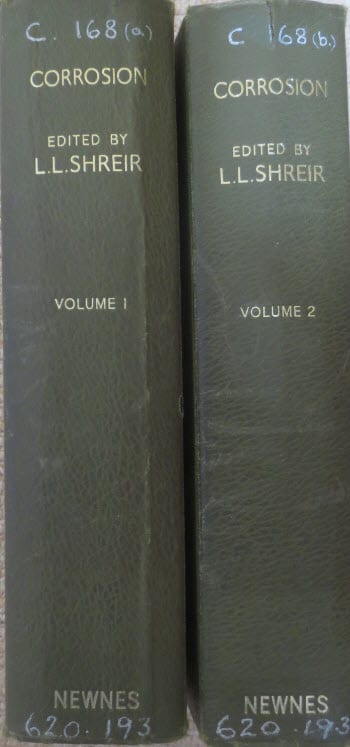
The Institute of Corrosion now have publications available for you to acquire Free of Charge upon requests, but postage will be charged of £5/edition within the UK. Some of the publication are quite old and may be out of print but it would be useful for research purposes etc.
The List of Corrosion and Corrosion Related Science and Technology book available are as follow;
Title
Author
Publisher
ISBN No./Other
Date
Corrosion Volumes 1 and 2
L L Shrier
George Newnes
–
1965
Corrosion Guide 2nd Edition
Erich Rabald
USA
Library of Congress Catalogue No.6719853
1968 Rare book Well used condition
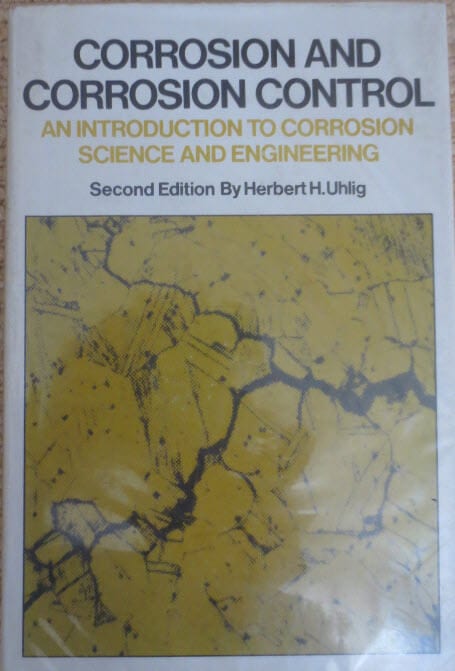
Corrosion & Control 2nd edition Introduction to Corrosion Science and Engineering
H H Uhlig
USA
0-471-85941-299-7
1971
Corrosion and Protection of Metals
4 papers Institute of Metals
Iliffe Press
–
1964
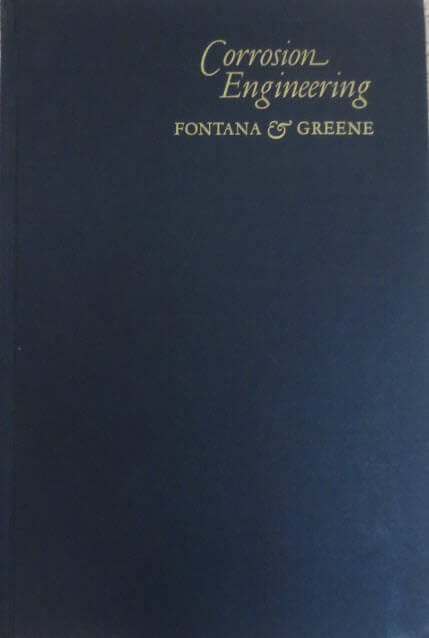
Corrosion Engineering
Fontana and Greene
McGraw Hill
Library of Congress Catalogue No.
67-19901 21460
1967
An Engineers Approach to Corrosion
C.F.Trigg
Pitman and Sons Ltd.
–
1952
Protective Painting of Iron and Steel Structures
1st and 2nd Editions
Fancutt and Hudson
Chapman and Hall
–
1957
1968
The complete list of publication can be found on https://www.icorr.org/souces-of-information/
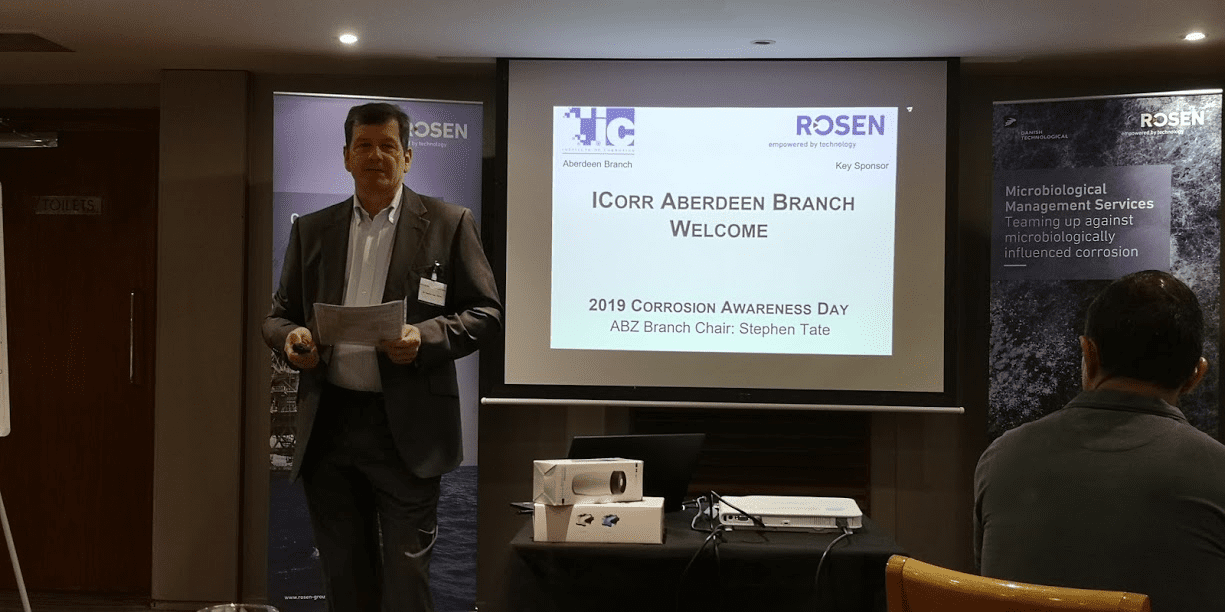
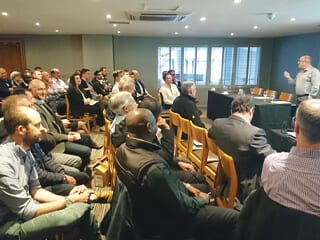
The New Aberdeen Chair Stephen Tate welcomed attendees to its Annual Corrosion Awareness Event
The Aberdeen Branch opened its 2019-2020 session on 27/08/2019, with 2 linked events on MIC – Microbiologically Induced Corrosion.
Its well-attended Annual Corrosion Awareness Day (CAD) had a full day teaching programme on MIC Risks, Mitigations, Modelling and Bacterial Analysis, complimented by an evening visit the following week, to NCIMB Laboratories in Bucksburn and the National Collection of Industrial, Food and Marine Bacteria.
The CAD Event featured some excellent talks by ICR – Dr Carol Devine, the DTI – Danish Technological Institute – Dr Laura Tiano and Dr Lone Tang, from Shell – Mabel Ntim and from Key Sponsor ROSEN – Dr Ian Laing, Dr Daniel Sandana and Steven Loftus, (CAD Co-ordinator).
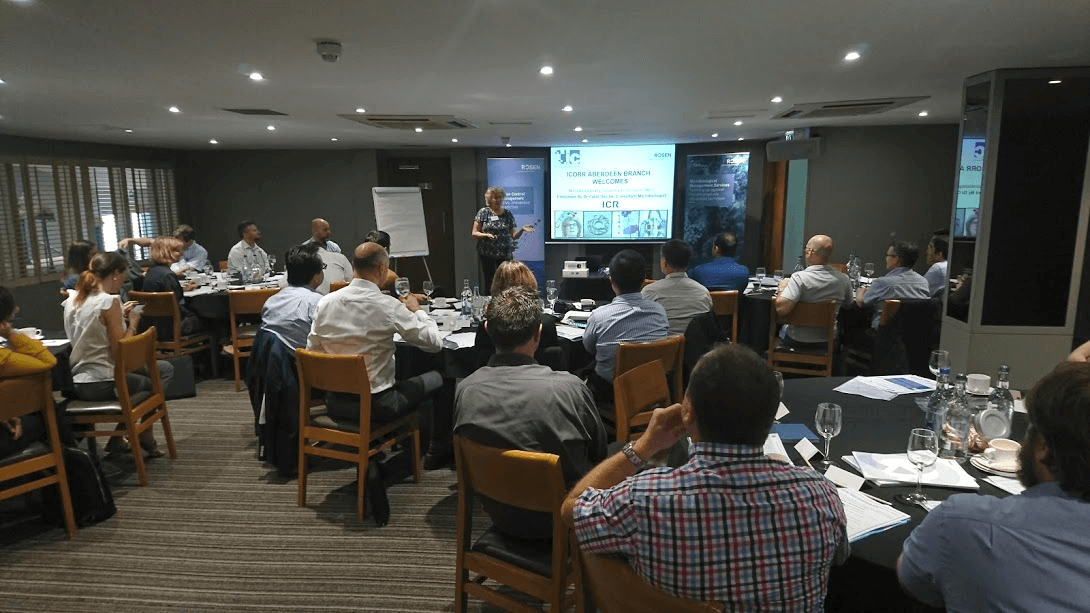
Dr Carol Devine opened the Teaching Programme with a fascinating insight into her career as a Microbiologist entitled “My Life in MIC”
Microbiologically influenced corrosion can have a major impact on operators’ CAPEX, OPEX and cause severe environmental damage.
A key aim of the CAD Workshop was therefore to improve understanding of complex MIC processes, detection of microbiological activity in Pipeline systems and management of MIC in the Pipeline Industry in particular, which has seen many Pipelines lost due to Internal Corrosion in the North Sea Sector.
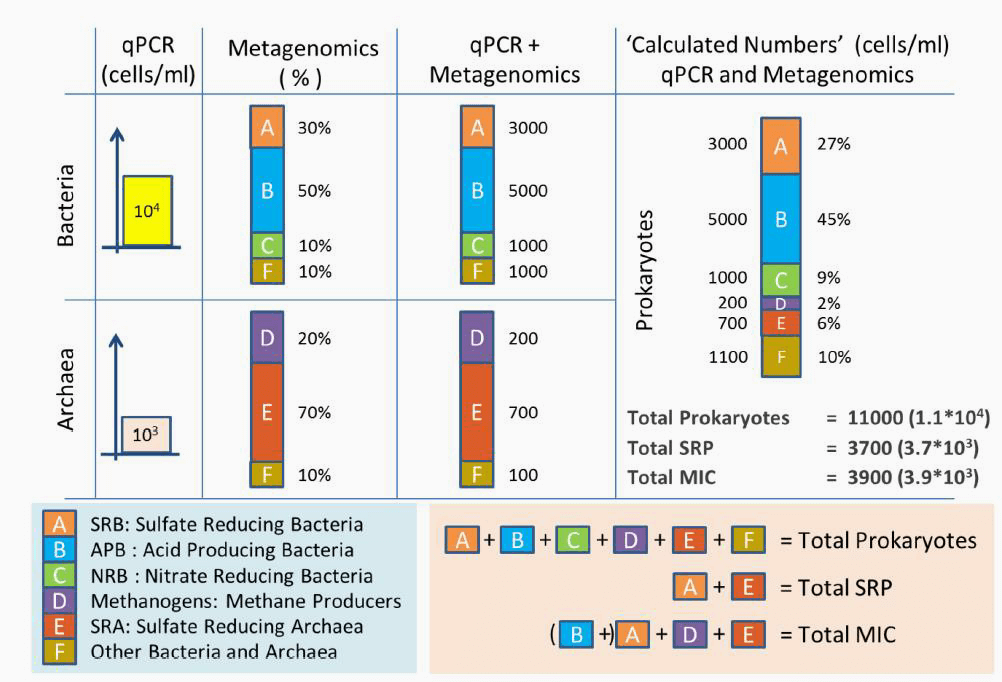
Many Analytical techniques were discussed in detail, including qPCR (molecular) analysis, traditional culture based MPN (most probable number), NGS, (next-generation sequencing which has revolutionized biological sciences), Metagenomics, (the study of genetic material recovered directly from environmental samples), along with Pipeline In-Line Inspection Tools, (deploying a wide range of NDT methods), Internal Cleaning, Chemical Treatment and MIC Modelling Tools for corrosion rate determination.
A lively discussion followed with many valuable viewpoints expressed and with great inputs from the 4 participating Microbiologists.
It was emphasized to all CAD delegates, the need for an integrated approach to microbial monitoring, combining data from multiple techniques, together with taking a fully holistic approach to Pipeline Integrity Management.
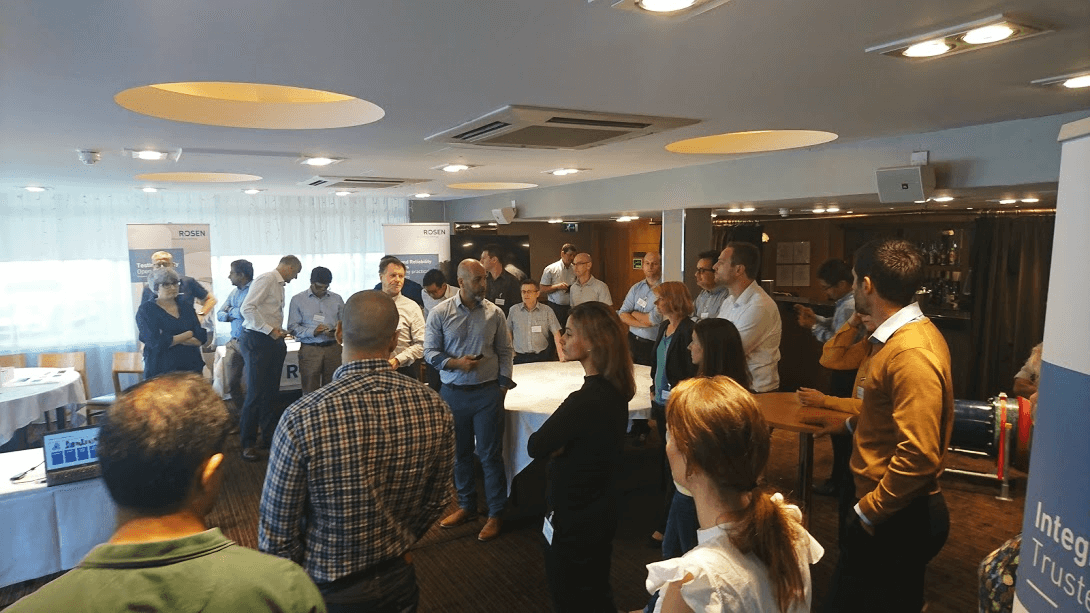
Dr Ian Laing, Principal Corrosion Engineer of ROSEN discussed MIC Modelling / MIC Management and the vast range of specialist tools available for Cleaning and Intelligent Pigging
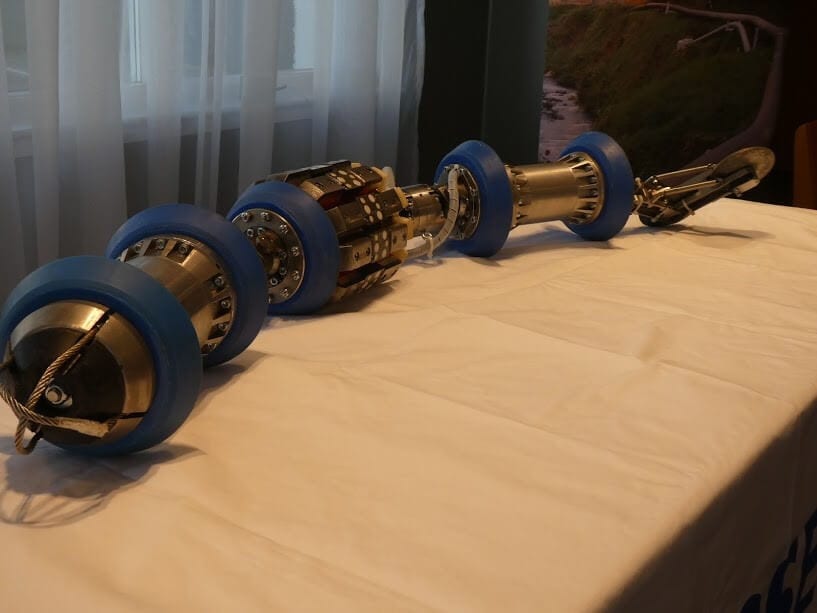
Advanced Intelligent Pigging and Cleaning Tools on Display from ROSEN – Key Event Sponsor
The NCIMB Event of 03/09/19, built on the previously weeks discussions, with a most informative Event led by Dr Daniel Swan who was previously Head of Platforms and Pipelines, (now the Genomics Pipelines Group) at the Earlham Institute in Norwich, (formerly The Genome Analysis Centre – TGAC).
NCIMB have 68 year’s experience of preserving, storing, distributing, analysing and exploiting micro-organisms and are the only privately owned, publicly viewable collection of bacteria in the UK.
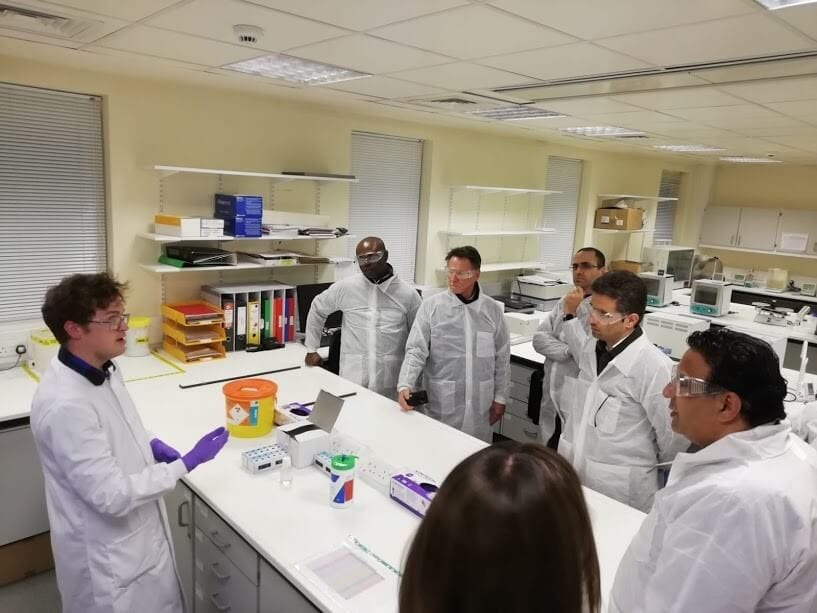
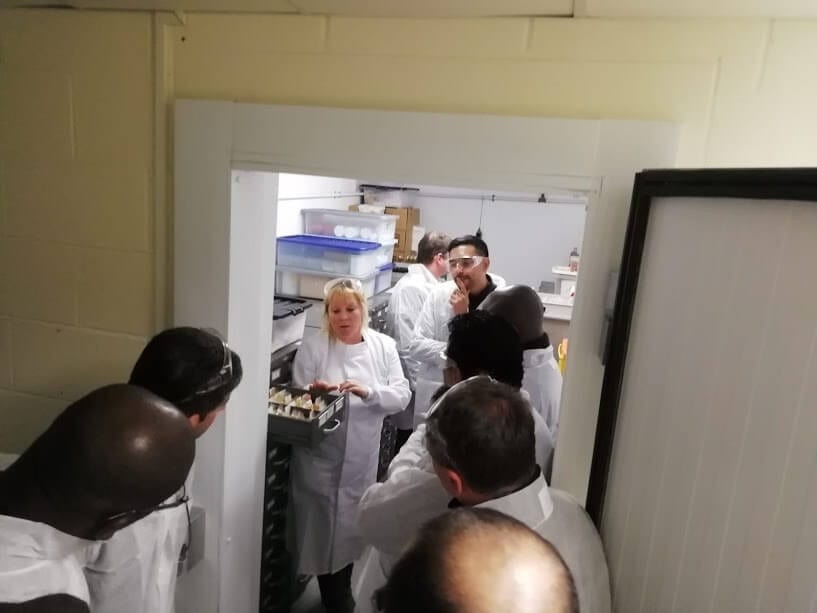
A very comprehensive tour of the NCIMB Laboratories followed Daniel’s presentation and recommendations for effective Bacterial Monitoring Strategies, with everyone kitted out in protective clothing to view a wide range of practical demonstrations of Bacterial Sampling. Archiving and Determination.
Kyle Sim (Laboratory Assistant) of NCIMB explains the MPN Bacterial Sampling, Serial Dilution and Bacterial Counts to ICorr Attendees
A peek inside the NCIMB Vault – National Collection of Industrial Food and Marine Bacteria: with Samantha Law (Culture Collection Curator)
An example of collaboration between different Bacterial Data Sources and Counts that provides a more effective summary of Bacterial Contamination Status, (by Dr Daniel Swan).
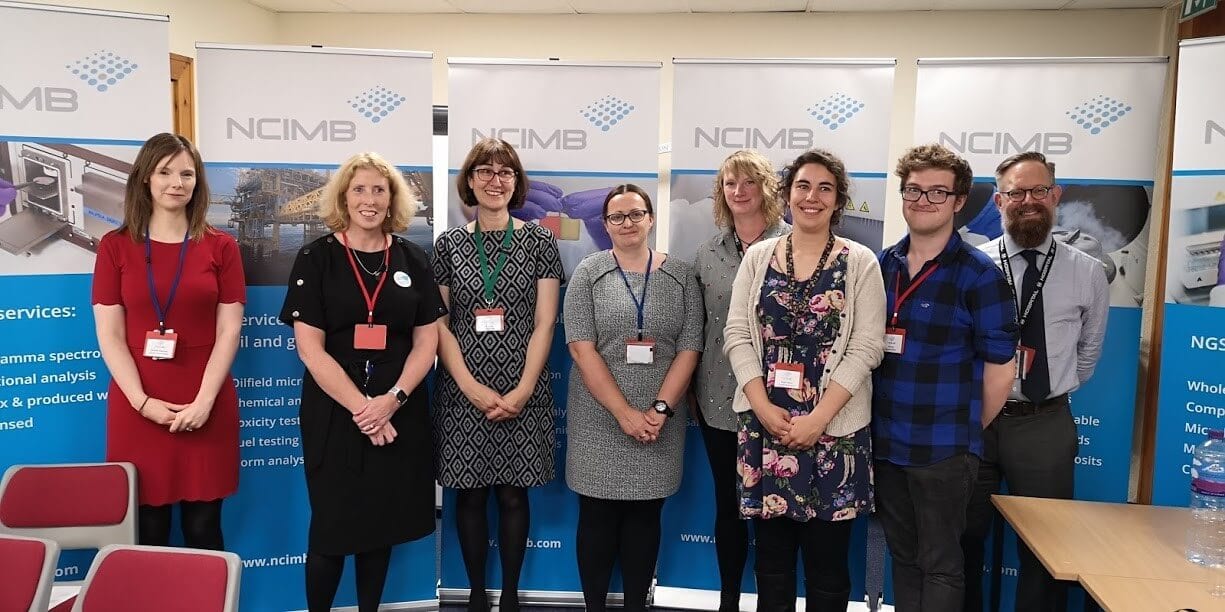
The NCIMB Laboratories Team from L to R, Michelle Robertson (Analytical Services Manager), Dr Carol Phillips (CEO), Sheila Batchelor (Marketing Manager), Vikki Mitchell (Identification Services Manager), Julie Mackinnon (Senior Molecular Scientist), Maggie Bayliss (Inbound Sales Exec), Kyle Sim (Laboratory Assistant) and Dr Daniel Swan (NGS Services Manager)
This most interesting Industrial Visit to NCIMB, (the first of 2 in the 2019-2020 programme), generated very many questions, so many in fact the Event overran by nearly 90 minutes !
At the close of both Meetings, the new Aberdeen Chair, Mr Stephen Tate presented all speakers and organisers with Certificates of Appreciation from the Branch.
Looking ahead, the ICorr Aberdeen Branch will be hosting its annual joint event with TWI – The Welding Institute on 24/09/19 at RGU, which will discuss in detail Environmentally Related Cracking. This talk will cover the topic of SCC on Offshore assets with emphasis on Weldments and HISC issues.
Full details of future ICorr Aberdeen events can be found on the diary page of the magazine and on the website, or by contacting: ICorrABZ@gmail.com
Further photos of both Events may be found on the Aberdeen Branch Gallery:
The next meeting of the branch is a joint meeting with Society of Chemical Industry (SCI), being held at the SCI offices, 14/15 Belgrave Square, London, on 26 September at 17.30. The theme of the evening is “Offshore Energy and Telegraph Cables” and will be chaired by John O’Shea, Hon Life Fellow, ICorr.
Dr Fred Parrett, SCI London Group, will present the story of the first transatlantic telegraph cable, the story of how it happened and the personalities involved. The second presentation will be by Trevor Osborne, a Past President of ICorr, who will discuss the problems which occurred with the installation of offshore wind farm towers, and how, what should have been an easy transition from the early offshore oil and gas platforms, often was not.
Places are limited, so register your interest at http://bit.ly/Offshore_Energy, or email conferences@soci.org
The branch is still looking for a new home for the 19/20 evening meetings, and full details will be emailed to regular branch attendees, and posted on the Institute website once the venue is known.
Just to remind readers, on Thursday 26th Sept, the branch will be hosting a half day networking event for sustaining members, with a steam train ride, tour of the railway engine house and buffet lunch, at the Severn Valley Steam railway. The cost of attending for sustaining members is covered by the branch, please contact Bill Whittaker, bwhittaker@cathodicengineering.co.uk, to reserve your place ASAP.
The 2019 Institute AGM will again be held in Birmingham. The date is 31st October and this is earlier than normal to avoid clashing with the London branch Xmas Luncheon. A large event is planned with many interesting and technical papers being presented prior to the AGM. Full event details will be sent to all members via email, however please add this date to your diary.
The branch have secured continued commitments from all their existing 2018/2019 members and in addition have elected a new committee member, Mr. Jonathan Segynola (Corrosion Technical Authority of CNR)
At the AGM held on 28th May 2019, Stephen Tate and Nigel Owen, were elected Chair and Vice Chair respectively for the 20198/2020 session.
The successful May technical event was jointly organised between ICorr and NACE, and had 49 enthusiastic attendees from across industry and 3 very knowledgeable speakers.
Scott Maidman – Global Deployment Manager of Air Liquide, commenced proceedings with a detailed talk on the merits of Dry Ice Blast Cleaning, as an alternative method of surface preparation. This technique has been designed specifically for use in fabric maintenance in the Oil and Gas industry and similar applications, offering an alternative means of surface preparation and removal of coatings and corrosion. Further development of the equipment has allowed surface profiling through the addition of common abrasives to the dry ice flow. Its additional benefits include a reduced carbon footprint, less waste and post-blast clean up, when compared to other commonly used methods.
Graeme Kennedy – Manager Oil & Gas Downstream UK & Ireland for International Paint, continued with a complimentary talk on Cyclic Corrosion Testing on Surfaces that have been prepared by Dry Ice Blasting. International Paint collaborated with Dry Ice Global and NACE Aberdeen section to investigate the comparative performance of surface tolerant coatings systems when applied to corroded steel surfaces prepared by Dry Ice Blasting, with injected garnet abrasive. International Paint provided pre-rusted carbon steel panels which were blast cleaned and coated with two proprietary coatings systems and then allowed to cure prior to testing. These coated panels were then exposed to ISO12944-9: 2018 (formerly ISO20340 Performance requirements for protective paint systems for offshore and related structures) cyclic corrosion testing, as used in NORSOK M501, Edition 6. The coated panels were all scribed to expose the metal surface and tested for 25 cycles /4200 hours /6 months of alternate UV/condensation, salt spray and freeze to -20°C. The presentation considered the performance of common surface tolerant coatings systems applied over this method of surface preparation, and assessed the corrosion creep from the scribe, and adhesion values, as an indication of performance in the field.
Kennedy of International Paint, in an informative presentation entitled – Cyclic Corrosion Testing on Surfaces Prepared by Dry Ice Blasting.
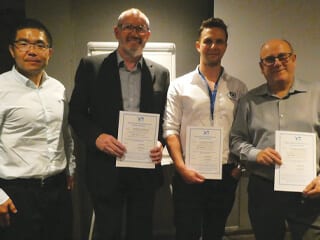
Out-going chair Dr Yunnan Gao presents Certificates of Appreciation to the event Speakers – Simon Daly, Scott Maidman, and Graeme Kennedy.
Simon Daly – Oil & Gas Segment Manager, Hempel A/S, rounded off a very informative evening with a final presentation entitled ‘Evaluating the Effect of Surface Preparation Standard on Zinc Rich Epoxy Primers’. The presentation focussed on work carried out over an 18 month period with a view to creating consistent reproducible test panels for use in the evaluation of protective coating systems for corrosive environments. Additionally he presented a draft evaluation methodology for combining coating’s application characteristics and long term performance. Simon explained that historically, zinc rich primers have been associated with use as a primary means of corrosion protection on offshore assets at the new construction stage. His presentation investigated the risks and benefits of adopting zinc rich epoxy technology for the far more demanding maintenance phase, by considering/comparing different zinc systems under a variety of sub optimal surface preparation conditions, and the impact upon performance, the effect of the number of coating layers and coating type on system tolerance to salt contamination, a suitable means of providing consistently prepared test panels to recognized standards, other than commonly applied SA 2.5, and a test methodology for ensuring consistent levels of salt contamination prior to application and evaluation of coating performance.
This most interesting series of presentations generated many questions and proposals for future testing programmes.
The branch have secured a continued agreement from the Robert Gordon University (RGU) for use of their main Lecture Theatre (N242), as its venue the 2019/2020 evening events free of charge, and an excellent programme has now been compiled, which will be featured on the Institute website and circulated to all branch sponsors and companion institutes.
Looking ahead, the branch will be hosting its annual full-day Corrosion Awareness (CAD) course on 27th August 2019, (via key sponsor Rosen UK, at the Palm Court hotel), comprising of a number of lectures / presentations focusing on microbiologically influenced corrosion (MIC) in pipeline systems. This year’s CAD programme will include talks by ROSEN specialists and other visiting speakers, on their MIC experiences from global operations covering – Sampling, Analysis, Monitoring of Pipelines for MIC damage, Chemical Mitigation / Cleaning Strategies and finally Inspection, Modelling and Monitoring approaches. Most certainly this event will provide a very comprehensive introduction, to this very significant and often troublesome area of Corrosion Control / Prevention.
Finally, It is with deep sadness that the Aberdeen committee have to report the loss of Alan Foxton, a past ICorr and TWI presenter, and Richard Waud, a valued and regular ICorr attendee, on the 9th and 10th July respectively. Our thoughts are with all their families, friends and colleagues.
As usual, full details of future branch events can be found on the diary page of the magazine and on the website, or by contacting: ICorrABZ@gmail.com
“Born on the 4th of July” – not many of us can claim that, and even fewer are buried on the same date, but that was Joe Nugent. Joe died on the 26th June, aged 91, having outlived beloved wife Patty by just a few months.
As a very green young lad back in the eighties, employed by Leighs Paints to look after technical sales to the oil, gas and structural steel industries up in the North East, I was lucky to have come under the stewardship of Joe Nugent, irreverently known as Uncle Joe to us young pups at the sharp end.
Back then, Joe was manager in charge of Technical Service and based in Bolton, ably assisted by Rod Sandiford (another company uncle) and Bhiki Patel.
As always with protective coating application on big projects, things could easily go wrong. Any delays caused massive pressure with the risk of liquidated damages, so if we local lads couldn’t find a solution, we used to send for the cavalry in the form of Joe and Technical Service from Bolton.
Joe had two great attributes. He not only unfailingly found out the root causes of exactly what had gone wrong, but he generated goodwill out of the disaster by providing a fast response along with practical solutions.
This was always done with humour and positivity, so that Joe’s arrival on site was something people welcomed. He took the heat out of a difficult situation and actually turned it into an advantage by finding solutions and providing great service, so we didn’t lose customers.
When Joe and Rod were combined, they were unstoppable, with Rodney acting a bit like Dr Watson to Joe’s Holmes. I can honestly say I never saw them beaten, as they always found the technical reasons for failures as well as solutions. Sadly Rod, also another excellent technician, died a few years ago.
Joe gave me two invaluable pieces of advice, which I still teach my students when I’m lecturing today, as “Nugent’s Laws”. I remember these so well, as they are humorously true, and he always started with “Young Frost” as the precursor to any words of wisdom.
The first (this still applies for anyone in paint Technical Service):
“Always leave the car pointing out of the car park. Be ready for a quick getaway. I guarantee paint will make a fool out of you frequently during your career!”
The second:
“Never believe anything anyone tells you. Beware, as everyone thinks they’re a paint expert. Gather scientific fact and empirical data from sound science and testing and only base your conclusions on that”.
He also explained that it is impossible to think diagnostically while a frustrated client is breathing fire over your shoulder. Try to get quality time on your own to gather data on which to base your conclusions. Never be rushed or pressured into making an ill-considered response.
When working with Joe, this inevitably led to analysis in the nearest local hostelry, where I have fond memories of slightly blurred discussions. It must be said that the partaking of ale in good company was an important component in Joe’s life and he also had a great nose for finding the best bacon sandwiches.
As well as being ethical, unfailingly good natured and likeable, Joe had an immense knowledge of protective coatings technology derived from long experience. He had the sort of knowledge you can only learn from working in the field and not from university. He was also a great people person, which all adds up to an unbeatable set of diverse talents.
Joe was an excellent teacher and put a lot back into training young “up and comers” in the industry. He and Leighs actively supported ICorr, working on various committees to help raise industry standards. He was well known to the oil and gas corrosion engineering heavyweights of that era, like Fred Palmer of BP, Dr Ross Connell of Shell and Walter Lunt of Marathon.
Looking back, I have only fond memories of working with Joe, which was educational as well as fun. I know this view will shared by all those of my colleagues and customers who also knew and worked with him up until his retirement in 1992.
Sadly, they don’t make ‘em like Joe any more.
Dick Frost (Leighs Paints’ past Managing Director: 2001-2010)
We use cookies to optimize our website and our service.
Functional
Always active
The technical storage or access is strictly necessary for the legitimate purpose of enabling the use of a specific service explicitly requested by the subscriber or user, or for the sole purpose of carrying out the transmission of a communication over an electronic communications network.
Preferences
The technical storage or access is necessary for the legitimate purpose of storing preferences that are not requested by the subscriber or user.
Statistics
The technical storage or access that is used exclusively for statistical purposes.The technical storage or access that is used exclusively for anonymous statistical purposes. Without a subpoena, voluntary compliance on the part of your Internet Service Provider, or additional records from a third party, information stored or retrieved for this purpose alone cannot usually be used to identify you.
Marketing
The technical storage or access is required to create user profiles to send advertising, or to track the user on a website or across several websites for similar marketing purposes.