




Prestigious Engineer Training for Young Engineers

Prestigious Engineer Training for Young Engineers

What engineer training is best for young engineers?

Despite the UK government pushing engineering as a career choice in 2018 (the ‘Year of Engineering’), apprenticeship starts fell by 2.5% in engineering and manufacturing technologies between 2017/18 and 2018/19 (House of Commons Library Apprenticeship Statistics). That’s bad news in a sector that is suffering from a skills shortage, and in which it is estimated that 203,000 people with Level 3+ engineering skills will be required each year to 2024 to keep pace with demand.

To combat the skills shortage in UK engineering, it is incumbent on the industry to ensure that young engineers have access to the very best engineer training opportunities. Here at the Institute of Corrosion we are committed to professional development and training, with a particular focus on our early career members.

In this article, you’ll learn more about one of the most prestigious training initiatives for young engineers – the Young Engineer Programme (YEP).

Investing in the future
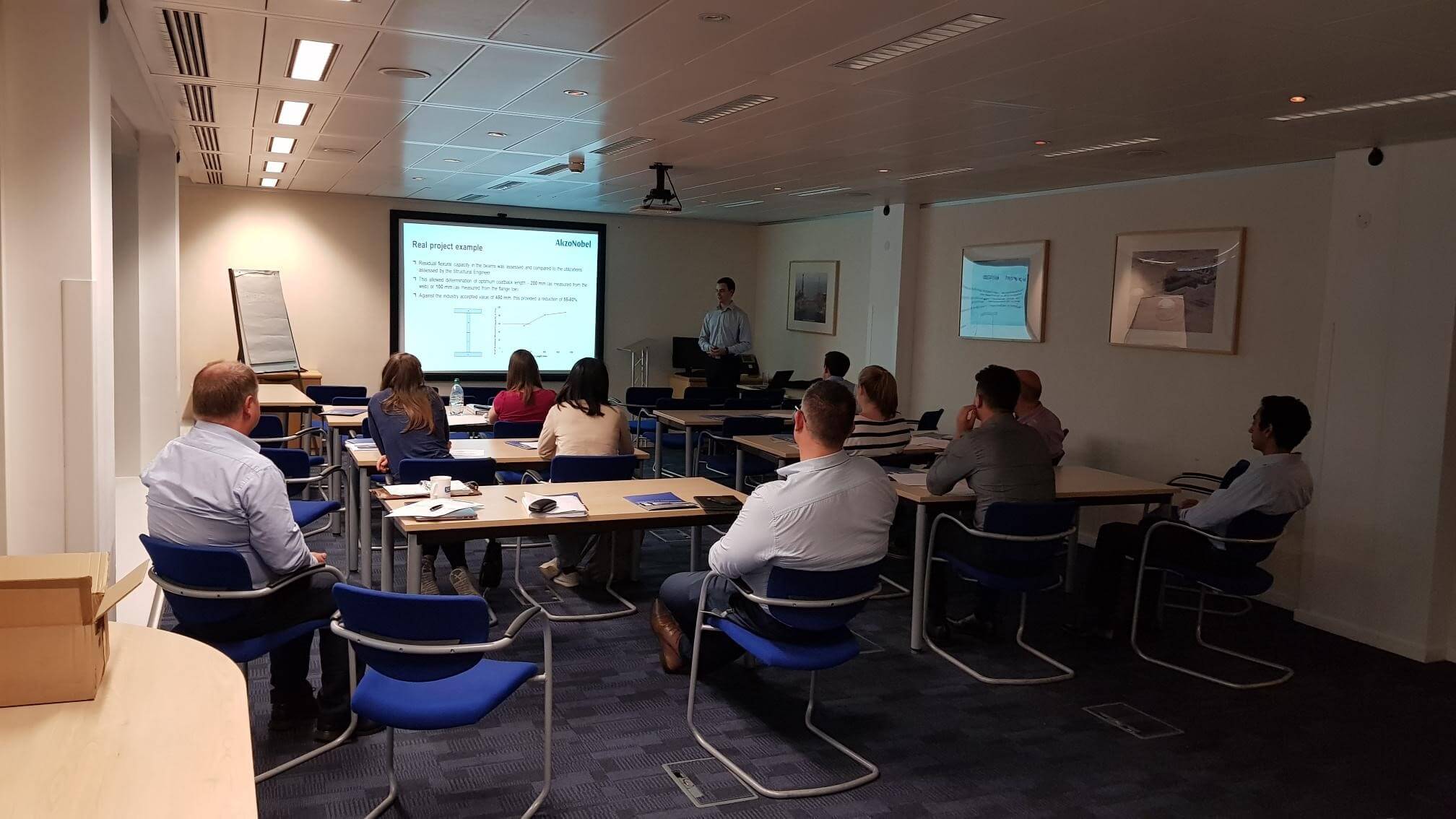
young engineer training in classroomAt the back end of 2018, Argyll Ruane noted that ICorr are investing in the future with initiatives that focus on attracting the younger people from our community. It noted the success of Young ICorr, the redevelopment of inspector training, and the new engineer training programmes such as ‘Fundamentals of Corrosion’.

The Young Engineer Programme is pivotal in the development of young engineers.

What is the Young Engineer Programme?

Designed for the engineer who has been practicing in industry for a few years but wishes to develop their skills and knowledge more broadly, the Young Engineer Programme is an 11-month programme run every two years.

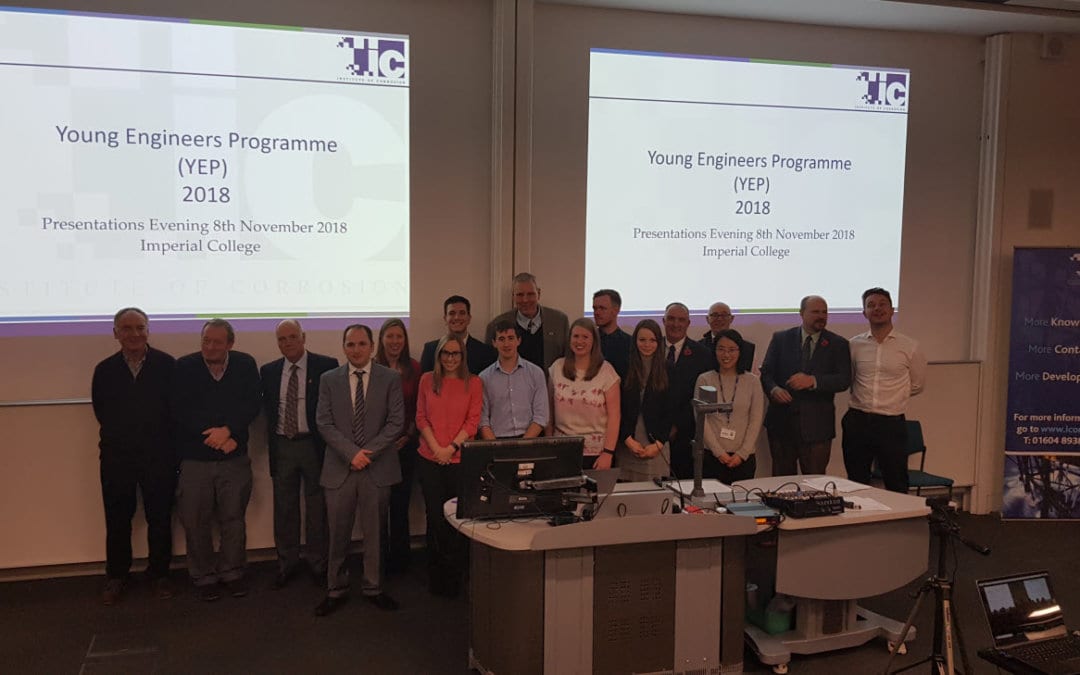
The 2018 programme reached its climax in November 2018, when teams presented to a judging panel, with the winning team crowned and given its reward – a trip to the NACE Corrosion Conference & Expo 2019.

How could the Young Engineer Programme benefit you?

The Young Engineer Programme provides a threefold process of learning:

  1. Delegates receive a series of lectures from industry experts in a range of subjects. This helps them broaden their own knowledge outside their own specific area of industry.
  2. Delegates then work in ‘project teams’ of four. The objective is to collaborate to discuss a real-world corrosion case study provided by an industry partner and come up with a practical engineering solution.
  3. The teams make a presentation of their findings to a panel of ICorr judges and the winning team gets to attend the NACE Corrosion Conference the following year.

In this way, delegates broaden their knowledge, improve their collaborative and project management skills, and develop their communication skills.

Other benefits of becoming a delegate on the Young Engineer Programme include expansion of your professional network and, of course, a major plus on your CV.

You receive mentoring throughout the Young Engineer Programme

mentoring for young engineersWith the group of young engineers split into teams of four, each team is assigned a dedicated mentor. It is the mentor’s job to ensure that their team stays on track and works as a team. The mentor will make sure that the team answers the questions raised by the case study.

As a delegate, you and your team will meet face-to-face with your mentor during the May to November period of the programme. You’ll also meet with your mentor on Skype, and the mentor can ask the author of the case study any questions that your team may have.

What do delegates say about engineer training during the Young Engineer Programme?

Word gets out when engineer training does what it says on the tin – and then some. Responses from 2018 delegates included:

“This programme has altered the way I think about my work and how I carry it out.”

“I hadn’t realised the value of ICorr and I will go back to work on Monday and encourage them to engage.”

A senior engineer in the ICorr fraternity said:

“This is probably the most important function in the UK Corrosion calendar, it’s truly fantastic.”

How do you join the Young Engineer Programme?

The Young Engineer Programme runs every two years. We open the programme to applicants in the September of the year before the programme starts and email our entire membership about the programme prior to this. We also send personal emails to the engineering community.

The programme has exploded in popularity. In 2018, there were 12 delegates in three teams of four who presented their findings on the case study. The current crop numbers eight teams of four. We expect programme applicant numbers to increase further next time round.

To ensure you learn of the next Young Engineer Programme at the earliest opportunity, we recommend that you become a member of the Institute of Corrosion. There are several grades of membership.

The Young Engineer Programme – a summary

As a ‘cradle to grave’ organisation, we support our members with engineer training throughout their career, from apprenticeship to Chartered Engineer status. Young ICorr (aimed at young professionals aged 35 and under) has an expanding membership base, supported by ICorr initiatives such as our free student membership.

The Young Engineer Programme is an invaluable addition to our training initiatives, helping you to expand your knowledge and network, improve your competencies and capabilities, and add prestigious training and development experience to your CV.

To learn more about the Young Engineer Programme, visit our YEP pages or email the Institute of Corrosion at admin@icorr.org.

Unlocking and Managing the Effects of Corrosion

Unlocking and Managing the Effects of Corrosion

Fundamentals of Corrosion Explained

The effects of corrosion include the ultimate destruction of possessions and products (if the product is left untreated) and a real but hidden financial cost. That cost of corrosion is passed onto consumers and businesses – and it’s colossal.

A two-year study by NACE put the corrosion cost at $2.5 trillion each year, or around 3% of global GDP. The study also estimated that implementing best practices in corrosion prevention could result in as much as $875 billion in savings. Imagine the positive effect that releasing this cash could have on world economic growth.

In this article, we briefly discuss the fundamentals of corrosion – the who, what and how of corrosion management.

Who is affected by the effects of corrosion?

There is not a single life on this planet that is not affected by corrosion. Of course, those in developed countries suffer a greater direct impact, but corroded metals seep into the earth, rivers, seas and air. As do chemicals and other hazardous materials which escape because of corrosion in pipes and tanks. Eventually this pollution goes global.

Even more serious than the cost of corrosion is the impact it has on our safety. The effects of corrosion of steel reinforcing bars in concrete can lead to collapse of buildings, bridges and roads. Corrosion of components in planes, trains and automobiles can have disastrous consequences.

Energy and utility companies are in a constant battle against corrosion, with the effects of corrosion causing disruption and cost from drilling platforms to domestic pipelines.

Corrosion causes financial costs, health and safety issues, and loss of life. It’s unsightly and depletes the world’s natural resources.

At the forefront of corrosion prevention are engineers, paint inspectors, designers, technicians and scientists. Engineers in civil, mechanical and naval fields are continually assessing potential or actual corrosion and incorporating anti-corrosion measures into their projects and work strategies.

What are the mechanisms of corrosion?

Classification of the type of corrosion present is commonly made on one of the following three factors:

  1. The nature of the corrosion (immersed or atmospheric)
  2. The mechanism of the corrosion (electrochemical or chemical reactions)
  3. The appearance of the corrosion (uniform or localised)

There are many techniques and tools that are used to help in the detection and classification of corrosion. Eight common forms of wet corrosion can be identified by their appearance:

  1. Uniform corrosion (when the entire surface is corroding at the same rate)
  2. Pitting corrosion (small holes in the metal)
  3. Crevice corrosion (corrosion that occurs in the gap between two adjoining surfaces)
  4. Galvanic corrosion (corrosion of one metal preferentially to another with which it is in electrical contact)
  5. Erosion corrosion, including cavitation and fretting (degradation of a metal due to the relative motion of a corrosive fluid)
  6. Intergranular corrosion (localised corrosion along the grain boundaries of a metal while the bulk of the grains remain unaffected)
  7. Dealloying (occurring in certain alloy metals, in which the alloy metal loses its reactive element and retains the corrosion resistant element)
  8. Environmentally assisted cracking, such as stress corrosion (cracking caused by tensile stress in a corrosive environment)

To identify some of these types of corrosion, you may need to use advanced techniques such as optical or electron microscopy.

How can you manage corrosion?

There are five principal strategies in corrosion prevention:

1.      Selection of materials

Some metals are highly resistant to corrosion (such as gold and platinum), while others have a low resistance to corrosion (like sodium and magnesium).

By using appropriate metals (or alloys) for specific use and environment, engineers can increase the life of products. Their cost is obviously a very important factor in this decision.

2.      Inhibitors

Some chemicals act to inhibit corrosion. These include silicates, phosphates, nitrites, and organic amines. Inhibitors are generally preferred in closed systems where the presence of the inhibitor can be more easily maintained (for example in heating and cooling systems towers).

3.      Coating

Coating isolates the metal from the corrosive environment surrounding it. The coating may be metallic (for example, tin-plated steel). They may also work like galvanised steel in which the coating corrodes in preference to the metal beneath. Coatings are commonly non-metallic, such as paint, and may be either organic or inorganic.

4.      Cathodic protection

Cathodic protection works by applying an external electrical current so that the corrosion reaction takes place on a separate surface to the metal to be protected, with electrons forced to flow to the metal that is to be protected.

5.      Design

Designing products and structures to eliminate or minimise the potential for corrosion helps to reduce maintenance and repair costs and time; for example, by designing structures with fewer crevices in which corrosion often develops.

Obtain Professional Membership of ICorr with ‘Fundamentals of Corrosion’ training

For all who want to expand their career opportunities or wish to expand or refresh their knowledge of corrosion, the Institute of Corrosion offers the five-day Fundamentals of Corrosion for Engineers Course. Successful completion of the course is required to obtain Professional Membership of the Institute of Corrosion if you don’t have either formal qualifications in corrosion or relevant experience.

The interactive course takes place in a classroom format. During the first four days, your time will be occupied by talks and practical sessions. On the last day, there is a short review and an examination. In the course, you will learn:

  • Basic corrosion science and corrosion mechanisms
  • The electrochemical series and its practical uses
  • Corrosion prevention and management methods
  • The basics of cathodic protection
  • Surface preparation challenges, paints and coatings
  • Corrosion and environmental conditions
  • The basics of material selection and design
  • The basics of corrosion testing and monitoring

Presented by Dr Jane Lomas, a corrosion and coatings engineer with more than 30 years corrosion experience, and guest presenter Dr Les Callow, a metallurgist and corrosion engineer with more than 40 years of corrosion experience across multiple industries, this course redefines training standards in fundamentals of corrosion.

For more information and dates of upcoming Fundamentals of Corrosion courses, click here.   Places on this course are strictly limited to 10 people.

How to Become a Chartered Engineer

How to Become a Chartered Engineer

Access the Benefits of CEng with Mentorship and Guidance

As your engineering career progresses, a step you’ll want to take is to register as a Chartered Engineer. This professional registration offers many benefits, including industry recognition and higher earning potential.

In this article, we explore the key benefits of Chartered Engineer (CEng) status and walk you through the registration route for members of the Institute of Corrosion.

What are the benefits of registering as a Chartered Engineer?

Being a Chartered Engineer shows that you have the skill set, knowledge, experience and expertise to do what Chartered Engineers do:

“Develop solutions to engineering problems using new or existing technologies, through innovation, creativity and change and/or they may have technical accountability for complex systems with significant levels of risk.”

With a significant upgrade in the recognition of your technical expertise, your CEng status demonstrates that you are committed to continuous professional development to meet evolving needs. This prestigious title offers some real tangible benefits, including:

·       You improve your career prospects

Chartered Engineer status is likely to help improve your career prospects among a wider audience of employers.

·       You improve your earning potential

According to the 2019 Salary Survey by The Engineer, professionally registered engineers earn substantially more than their non-registered colleagues – almost 25% more. The mean salary for registered engineers is £55,968 versus £45,809 for non-registered engineers.

The salary differential is particularly pronounced in telecoms, utilities and electronics (with an average £18,000 gap) and energy/renewables, and nuclear (with a difference of £13,000). Based on these findings, over 20 years your greater earning potential as a Chartered Engineer might be worth more than £250,000 (and that’s based only on the average difference in salaries).

·       Your competence is internationally recognised

The UK standards under which CEng is registered are recognised around the world. You’ll take your improved employability and earning potential with you wherever you travel for work.

·       You increase your professional network

As a Chartered Engineer, you become a recognised expert in your field. Should you wish, and with membership of a professional body such as the Institute of Corrosion, this can lead to participation in professional working groups, campaigns, reports, and a wider and deeper professional network.

·       You become an ‘appropriate person’

As a CEng, you become classified as an ‘appropriate person’ under the UK Passport list of occupations. This means that you can certify and countersign applications when documented evidence of identity is required (such as passports and bank accounts).

How do you become a Chartered Engineer?

There are several routes to registration as a Chartered Engineer, based upon your qualifications and experience. Whichever route is most appropriate, you will be assessed across five competence statements:

  1. Knowledge and understanding
  2. Application to practice
  3. Technical and commercial leadership
  4. Interpersonal skills commitment
  5. Personal commitment

Within these competencies you will also be assessed on other elements that include:

  • Health and safety
  • Risk assessment
  • Understanding of the environment
  • Sustainability
  • Ethical behaviour

These competencies and other elements are embedded in the core values of the Institute of Corrosion.

In short, the process of becoming a Chartered Engineer as a professional member of the Institute of Corrosion can be summarised as follows:

  • Review the routes to registration as a Chartered Engineer
  • Download and complete your Chartered Engineer application form
  • Send your application to: The Secretary of the Engineering Council Registration Committee, Institute of Corrosion, Corrosion House, 5 St Peters Gardens, Marefair, Northampton, NN1 1SX, United Kingdom.
  • Your professional membership status of the Institute of Corrosion is confirmed, and your application is assessed for acceptability and completeness.
  • Once confirmed as complete, your application is submitted to the next Society of Operations Engineers (SOE) Membership and Standards Committee meeting for review.
  • The SOE advises the Institute of Corrosion of your most appropriate registrant grade and route and any additional information required.
  • You will be requested to attend a Professional Review Interview (PRI).
  • If successful, you will be informed and then invoiced by the Institute of Corrosion for the the Engineering Council UK (ECUK) one-off registration fee and annual registration fee.
  • Your name is added to the SOE’s register and the SOE informs ECUK who will add you to the register and issue your certificate. Only then can you use your post-nominal CEng.

Help to Become a CEng

As part of our commitment to our members, we have established a mentoring programme designed to help ensure that you have the necessary education and experience for registration as a Chartered Engineer. We’ll provide guidance with the assessment of your competency in the field of corrosion engineering, examining your core technical competencies against expected minimum levels for CEng status.

We’ll help you develop a programme that accelerates you to your goal of becoming a Chartered Engineer. This programme may include recommended training and/or conference involvement. We’ll also assist you to complete the application form and we can provide guidance before your PRI.

For more information about the mentoring programme, email the Institute of Corrosion at admin@icorr.org. Or, if you would prefer to speak to us, call us on + 44 (0) 1604 438222.

Start your Chartered Engineer journey today

As a registered Chartered Engineer your competence and capability will be recognised around the world. You are likely to receive a higher salary, and operate within an elite professional network.

Whatever your qualifications and experience, there is a route to CEng. Professional members of the Institute of Corrosion are in an enviable position, with unrivalled mentorship and guidance available – just part of our commitment to our members.

To learn more about the competency standards, visit UKSPEC.

A word from our President

In the latest issue of Corrosion Management, the bi-monthly magazine of the Institute of Corrosion, ICorr President Gareth Hinds says:

“I’m delighted to say that we have signed an agreement with the Society of Operations Engineers allowing them to take over the registration of our CEng, IEng, and EngTech members with the Engineering Council. Huge thanks are due to David Harvey and Bill Hedges for their efforts in securing this seamless transition from the now defunct Society of Environmental Engineers. If you had been holding off submitting an application while this was being sorted, now is the time!”

To enquire about becoming a Chartered Engineer via professional membership of the Institute of Corrosion, email us at admin@icorr.org. 

CHAIN Yourself to a Wider Engineering Network in London

CHAIN Yourself to a Wider Engineering Network in London

At Young ICorr, we’re a pretty sociable group. We’re also all about business, especially the future of the corrosion industry. Though it’s said you should never mix business with pleasure, we’re also innovative. Hang convention! Or should we say CHAIN business and pleasure together?

We’re extremely excited to have a real presence at this year’s CHAIN London Showcase on February 28, and we’d love to see you there.

What is CHAIN?

CHAIN is a movement of inter-institutional events specifically aimed at early career engineers. At the London event, you’ll be treated to a day of talks and workshops designed to engage, inform, and inspire whether you are a student apprentice, recent graduate, or aiming to gain professional registration.

CHAIN shares many values and vision with the Institute of Corrosion, like

What can you expect from CHAIN 2020?

The CHAIN event will examine some of the key challenges facing the engineering profession today, and look at how innovation can dovetail with current knowledge to help us solve these challenges. These aren’t issues that only affect engineering, but the real issues that extend the length and breadth of our society.

The CHAIN 2020 conference is aimed at innovating the creative responses that engineers need to create today to make a better world tomorrow. You’ll hear from experts in fire safety, urban building, cyber security, and engineering in healthcare. And there will be extra focus on discussions covering energy innovation and the climate emergency.

Participation at this event will look great on your CV, but it’s much more than that. It’s a chance to benefit from a plethora of experience, share your views, and share your business card. It’s a great networking event where you’ll meet a huge spread of engineering talent.

Come and Meet Young ICorr at CHAIN 2020

This exciting and challenging day ends with a networking event where you can come and meet Young ICorr at our stand. We’re an integral part of our ‘parent’ the Institute of Corrosion, and our mission is to help young engineers across the spectrum progress in their careers.

Corrosion affects us all, and is inherent in every sector of society. It’s a huge industry, with corrosion costing the world trillions of pounds each year. The Institute of Corrosion’s mission includes advancing corrosion science, technology, and ideas. With our partners Argyll Ruane and Corrodere, the Institute offers exceptional training courses for scientists, engineers, maintenance staff, and inspectors.

CHAIN is your chance to get the inside track on opportunities to boost your career and learn about the wider engineering industry. Why not come along to the Young ICorr stand during the network session, and hear first-hand how you can become part of the exciting future in corrosion prevention?

Click here to book your FREE pass to CHAIN London 2020.

Deadline for Entry

Day(s)

:

Hour(s)

:

Minute(s)

:

Second(s)

Rebranding to Promote the Institute of Corrosion’s Mission

Rebranding to Promote the Institute of Corrosion’s Mission

Supporting Corrosion Professionals Worldwide

In this last article in the series discussing the rebranding of the Institute of Corrosion, you’ll learn about our purpose – why we exist and who we exist for, and how our mission supports the core values and vision of the Institute of Corrosion.

A Global Community of Corrosion Experts

Corrosion is costly and dangerous. Left untended, corrosion causes buildings and bridges to collapse, pipelines to leak, and spillages from industrial plants. Corrosion can lead to fires, flooding, poisoning and air pollution. The more effective our corrosion prevention strategies and techniques become, the safer the world will be.

In the fight against corrosion, collaboration is key. The Institute of Corrosion is the vehicle to drive this collaboration, through its global community of corrosion experts. The sharing of knowledge and expertise aids the innovation and creativity that is needed to develop industry best practice, as we strive for a more environmentally-friendly, safer and more sustainable global infrastructure.

Advancing Science, Technology, and Ideas

In addition to a global community that shares expertise, the Institute of Corrosion assists in corrosion prevention by delivering training that meets the requirements of current standards and leading by example to help advance corrosion science and technology and allowing ideas to flourish.

Through its partners Argyll Ruane and Corrodere, the Institute offers training courses that ensure scientists, engineers, maintenance staff, inspectors, and all corrosion professionals are competent in the standards and knowledge expected.

The Institute also keeps its members updated with the latest advances in best practice. We do this in a variety of ways. As well as ongoing training and CPD, our communication strategy is designed for sharing the Institute of Corrosion’s expertise with the world. Our global reach and digital communication channels combine to ensure that members can network easily and share information and ideas.

Influencing Policy and Decision-Making

The Institute of Corrosion’s expertise, experience, knowledge and global reach places it at the apex of the corrosion prevention industry. This means that the voice of industry experts – your voice – will be heard. At governmental and corporate levels, the expertise we possess in our global community of corrosion experts helps to shape policy and decision-making to extend the lifetime of our infrastructure.

Through the Institute of Corrosion, experts in the field can help to determine policies and decisions that will have a direct impact on society and lead to job creation, lower costs, and the saving of lives.

A Healthier and Safer Environment

As we influence policy and decisions, and as we improve standards in the industry, we will help to drive health and safety in the corrosion industry to create a healthier and safer environment. Scientific and technological advances should improve working practices in the industry, and the Institute’s community of corrosion professionals will be central to this.

Career Development and Networking

The provision of training is not the only way in which the Institute of Corrosion helps to advance the industry and your professional development. As a global organisation with a focus on science and engineering, we can provide networking opportunities at regional and global levels, including through NACE.

Our increasingly diverse membership benefits from conferences, workshops and mentoring, as well as our digital assets that allow you to network globally and exchange ideas and information in real time, anywhere in the world.

Indeed, we encourage you to participate, by following us on our social media (such as LinkedIn) and joining in the conversations we have, commenting on the articles we post, and sharing your expertise and knowledge with your digital network of corrosion professionals. Read our blogs, ask questions, and suggest topics that you would like us to tackle.

From students to CEOs, the Institute of Corrosion brings people together, supporting the industry and individuals, facilitating career development, encouraging networking, and driving policy and decision-making.

Our Expert’s View

Caroline Allanach, Project Inspection Engineer/Pressure Systems Integrity Engineer at BP says:

“The Institute of Corrosion provides support and mentoring in the specialist field of corrosion. Given companies often have a small corrosion engineering workforce, this is essential for the industry. Through Young ICorr events and specialist training, such as the Young Engineer Programme, it has been great to meet fellow corrosion engineers at similar career stages and share experiences, learning and goals.”

The Institute of Corrosion Is Your Institute

Our focus is on the people who make the corrosion industry so vibrant and innovative. The students, academics, scientists, engineers and maintenance professionals, who together provide the depth and breadth of expertise and experience that drive the industry forward.

Our rebranding enables us to redouble this focus, providing meaningful ways for you to network, develop your career, and share your expertise. As the network grows and the knowledge flows, the benefits to the public will continue to expand – a healthier and safer environment, with sustainable infrastructure, lower costs, and more jobs.

Get involved. To join the Institute of Corrosion and become part of one of the largest networks of corrosion professionals in the world, click here.

Sharing the Institute of Corrosion’s Expertise with the World

Sharing the Institute of Corrosion’s Expertise with the World

Broadening and Deepening the Corrosion Conversation

In line with the Institute of Corrosion’s core values, and as part of our rebranding, you are going to see a very different communication approach. Promoting the prevention of corrosion is essential, and we are going to share our knowledge and expertise with the world.

Corrosion costs the global economy trillions of pounds each year. Indeed, according to the Oil and Gas Technology Centre, corrosion costs the world as much as £4 trillion. Sharing of expertise will enable huge strides to be made in the war against corrosion.

In this article, you’ll learn about some of the ways the Institute of Corrosion will be sharing information with the world, and what you can do to help.

If it Isn’t Accessible, it Isn’t Communication

The world must have serious conversations about corrosion. To do so, it is the duty of the Institute of Corrosion to promote the sharing of knowledge and expertise in language that is accessible to all. To achieve this, we will:

  • Make information clear and easy to understand
  • Communicate through channels that people use
  • Provide opportunity for feedback

Providing Information That is Clear and Easy to Understand

Mike Pettigrew, author of The Most Powerful Goal Achievement System in the World, says that he believes “the greatest crime is to learn something that can significantly benefit other people, yet share it with no one”.

For the message to be shared it must be understood. We’re committed to providing people with clear, high-quality, and easy-to-understand communication. Clear and concise language is stronger, more effective, and accessible to a wider audience.

Importantly, clear language ensures understanding. There is less room for misinterpretation. If recipients of communication feel the need to ask clarifying questions, the communicator isn’t doing their job properly.

Communicating through Channels That People Use

It is crucial that we broaden the conversation about corrosion to be more inclusive. We have strong relationships with other corrosion organisations, such as the National Association of Corrosion Engineers (NACE) and the European Federation of Corrosion (EFC). Our collaborative approach with such kindred bodies helps to drive innovation within the corrosion industry.

Our membership can have a strong voice in the industry, but we must enable them to have this voice. To do so, we are broadening and deepening the ways in which we communicate, making them more accessible and more appropriate.

You’ll find it easier to access the Institute and participate in the conversation about corrosion as we extend our digital and other communication methods:

  • Our website is getting an overhaul. It’s going to be clean, sleek, innovative and reflective of the rebranded and new Institute of Corrosion.
  • We will post blogs regularly, keeping you informed of the latest developments in corrosion prevention, training and development opportunities, and industry strategies and methods.
  • Our social media reach will be more vigorous, inviting an active community to share their knowledge, ask questions, and help to shape direction of the industry.
  • In print, you’ll notice our rebranding take shape immediately. The look and feel of our printed material will resonate with the rebranding of the Institute of Corrosion – from letterheads to the Corrosion Management magazine and all printed communication in between.

When the Institute communicates with the world, it will use appropriate language and appropriate channels to do so. For example, our digital communications will be easily understood by all, while Corrosion Management magazine will continue to provide in-depth technical coverage of our industry.

Providing Opportunity for Feedback

As experts and educators, we feel it is critical to give our members a real voice in the world. As part of our responsibility to our community, our communication strategy is to establish a network in which we and you can share best practice, access expertise, and solve problems.

We invite and welcome feedback, through our social media accounts, on our website and blogs, by email, or by picking up the phone. The Institute of Corrosion is your Institute. The membership is your network. Feel free to ask any questions you have, and answer any queries you can. Exchange of information is key to sharing our collective expertise with the world.

We Need You! Help to Shape the Direction of the Corrosion Prevention Industry.

Here at the Institute of Corrosion, our voice in the world must reflect the views, opinions, concerns and expertise of our members. Thus, we have designed our communication strategy to be inclusive.

We invite you to participate in the conversation. Send us your questions. Let us know what you feel needs to be discussed. Share your expertise, experience and knowledge with the institute’s network, and share and repost our blogs, LinkedIn posts, and other social media posts.

The voice of the Institute of Corrosion is your voice. Let it be heard! Get involved.

Our Expert’s View

Don Harrop, Past President and Honorary Fellow of the Institute of Corrosion since 2001, and co-author of Corrosion and Materials in Hydrocarbon Production: A Compendium of Operational and Engineering Aspects, says:

“Corrosion can be a costly oversight – typically between 2% to 4% of a country’s annual GDP. This figure is largely unchanged over the last 60 years, as the demands that society and industry place on the performance and availability/reliability of infrastructure, equipment, and facilities continue to increase with the rapid advancements in technology and ‘can-do’.

“We live in a cost-conscious world where health, safety and environmental regulations rightly become ever more rigorous.  Corrosion has a global presence that all too easily can unexpectedly or unintentionally be awoken. Managing corrosion effectively can sometimes feel like a lonely and isolated pursuit where often the “devil is in the detail”.  Thus, it is paramount in today’s virtually connected world that ease and access to, and timely sharing of, the breadth and depth of the Institute of Corrosion’s expertise is readily available 24/7 – from providing reassurance, identifying a quick fix, to deep rooted experience-based support and guidance.”

In our next article, the last in this series introducing the rebranding of the Institute of Corrosion, we will discuss rebranding to promote the Institute of Corrosion’s Mission. In the meantime, to learn more about the Institute and the lead it is taking in the global corrosion prevention industry, contact us today.

Deadline for Entry

Day(s)

:

Hour(s)

:

Minute(s)

:

Second(s)